本文中,我们介绍一下如何计算 LLM 的参数量。我们将基于 Qwen3 模型架构出发,对模型架构进行拆解,然后给出 LLM 参数量计算公式。
Dense Model
我们首先来看一下 Qwen3 的架构,如下图所示
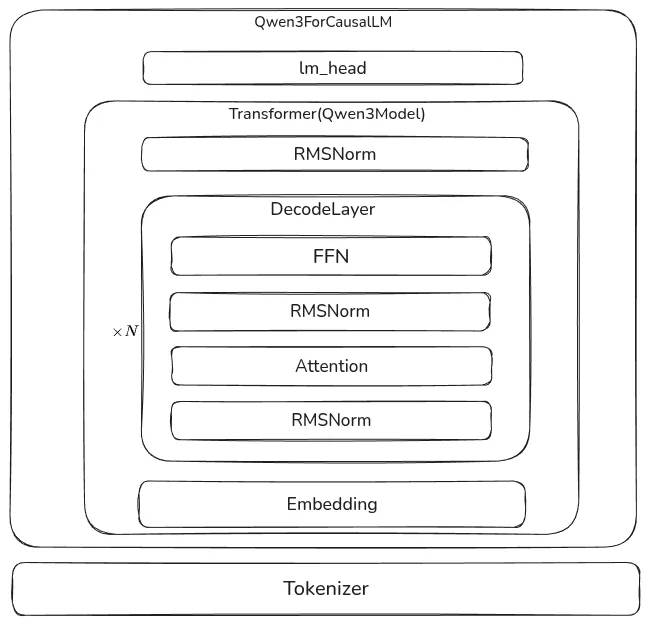
这里,Qwen3ForCausalLM 就是我们的的 LLM, 其关键代码如下
class Qwen3ForCausalLM:
    def __init__(self, config):
        self.model = Qwen3Model(config)
        self.lm_head = nn.Linear(config.hidden_size, config.vocab_size, bias=False)
我们假设 vocab_size, 也就是词表大小为 (我们用 表示词表), hidden_size 为 , 则总参数量为
Qwen3Model 包含三个(含参数的)模块,分别是 nn.Embedding, Qwen3DecodeLayer 以及 Qwen3RMSNorm, 分别代表了输入 token 的 embedding layer, Transformer block 和对输出的 normalization. 其关键代码如下:
class Qwen3Model:
    def __init__(self, config: Qwen3Config):
        self.embed_tokens = nn.Embedding(config.vocab_size, config.hidden_size, self.padding_idx)
        self.layers = nn.ModuleList(
            [Qwen3DecoderLayer(config, layer_idx) for layer_idx in range(config.num_hidden_layers)]
        )
        self.norm = Qwen3RMSNorm(config.hidden_size, eps=config.rms_norm_eps)
其中,nn.Embedding 参数量与 lm_head 一样,都是 .
对于 normalization, 现在大部分 LLM 用的都是 RMSNorm, 其定义如下:
其参数量为:.
如果说我们使用的是 LayerNorm, 则其定义如下:
其参数量为: .
因此,Qwen3Model 的参数量为
这里第一项为 nn.Embedding, 第三项为 Qwen3RMSNorm, 第二项里, 代表 decode layer 的个数,也就是 config.num_hidden_layers.
Qwen3DecoderLayer 包含了四个模块,其关键代码如下
class Qwen3DecoderLayer:
    def __init__(self, config: Qwen3Config):
        self.self_attn = Qwen3Attention(config=config, layer_idx=layer_idx)
        self.mlp = Qwen3MLP(config)
        self.input_layernorm = Qwen3RMSNorm(config.hidden_size, eps=config.rms_norm_eps)
        self.post_attention_layernorm = Qwen3RMSNorm(config.hidden_size, eps=config.rms_norm_eps)
因此,Qwen3DecoderLayer 的参数量为
其中,第一项是两个 Qwen3RMSNorm 的参数。
对于 Qwen3MLP, 其定义如下:
这里 , , 是 MLP 的 hidden size, 代码中用 intermediate_size 来表示,因此
这里三项分别代表 的参数量。
如果说,我们使用原始 transformer 的 MLP, 也就是
其中 , , , , 则总参数为
这里的四项分别代表了 .
Qwen3Attention
接下来,就是 Attention 部分的参数,Qwen3Attention 的关键代码如下:
class Qwen3Attention:
    def __init__(self, config: Qwen3Config, layer_idx: int):
        self.q_proj = nn.Linear(
            config.hidden_size, config.num_attention_heads * self.head_dim, bias=config.attention_bias
        )
        self.k_proj = nn.Linear(config.hidden_size, config.num_key_value_heads * self.head_dim, bias=config.attention_bias)
        self.v_proj = nn.Linear(config.hidden_size, config.num_key_value_heads * self.head_dim, bias=config.attention_bias)
        self.o_proj = nn.Linear(config.num_attention_heads * self.head_dim, config.hidden_size, bias=config.attention_bias)
        self.q_norm = Qwen3RMSNorm(self.head_dim, eps=config.rms_norm_eps)
        self.k_norm = Qwen3RMSNorm(self.head_dim, eps=config.rms_norm_eps)
这里,我们先定义几个量:
- 我们将 head 的个数记为 , 即
num_attention_heads - 我们将每个 head 的 hidden size 记为 , 即
head_dim - 我们将 key 和 value head 的个数记为 , 即
num_key_value_heads
Qwen3Attention 的参数由以下几个部分组成:
- Query projection: ,
- Key projection: ,
- Value projection: ,
- output projection:
- RMSNorm:前文已经提到过,两个 normalization (query norm 以及 key norm) 的总参数量为 .
因此, Qwen3Attention 部分的总参数量为
分别代表 和 两个 normalization layer 的参数量。
注意,这里我们没有加入 bias, 这是因为 QKV bias 在 Qwen3 中被取消,取而代之的是两个 normalization.
如果我们查看 Qwen2Attention 的代码,我们可以得到 Qwen2Attention 的总参数量为
分别代表 和 的参数量。
我们将计算结果汇总在一起就得到:
这是针对 Qwen3ForCausalLM 的参数量计算。这里的变量定义如下:
| Math Variable | Code Variable | Description |
|---|---|---|
num_hidden_layers | Transformer block 个数 | |
vocab_size | 词表大小 | |
hidden_size | token embedding 的维度 | |
intermediate_size | MLP 的中间层的维度 | |
head_dim | 每个 head 的维度 | |
num_attention_heads | query head 的个数 | |
num_key_value_heads | key 和 value head 的个数 |
Verification
接下来,我们就可以基于 Qwen3 的模型来验证了,比如,Qwen3-32B 的配置如下:
| Field | Value |
|---|---|
| 64 | |
| 151936 | |
| 5120 | |
| 25600 | |
| 128 | |
| 64 | |
| 8 |
根据上式,最终的参数量为
我们使用 Qwen3-32B 的 index.json 可以得到其真实的参数量为
与我们计算的结果一致(这里除以 2 的原因是其表示模型权重文件的总大小,以 bytes 为单位,一般模型都是 bfloat16, 大小为 2 个 bytes, 因此总参数量为总大小除以权重的精度)
MoE Model
MoE model 与 Dense model 不同的地方在于每一层的 FFN, 因此,其总参数计算方式为:
对于 MoE layer, 其关键代码为:
class Qwen3MoeSparseMoeBlock:
    def __init__(self, config):
        self.num_experts = config.num_experts
        self.top_k = config.num_experts_per_tok
        self.gate = nn.Linear(config.hidden_size, config.num_experts, bias=False)
        self.experts = nn.ModuleList([Qwen3MoeMLP(config, intermediate_size=config.moe_intermediate_size) for _ in range(self.num_experts)])
我们记 为总专家个数,即 num_experts, 记 为激活专家个数,即 num_experts_per_tok 或者 top_k,
首先 gate 的参数量为 , 接下来每个 expert 都是一个 Qwen3MLP, 因此 experts 总参数量为 . 这样 MoE layer 的总参数量为
在推理时,只有一部分专家,也就是 个专家会参与计算,此时激活参数量为
我们带入到 Qwen3MoeForCausalLM 中就得到:
模型总参数量为:
模型激活参数量为:
这里的变量定义如下:
| Math Variable | Code Variable | Description |
|---|---|---|
num_hidden_layers | Transformer block 个数 | |
vocab_size | 词表大小 | |
hidden_size | token embedding 的维度 | |
intermediate_size | MLP 的中间层的维度 | |
head_dim | 每个 head 的维度 | |
num_attention_heads | query head 的个数 | |
num_key_value_heads | key 和 value head 的个数 | |
num_experts | 总专家个数 | |
top_k (num_experts_per_tok) | 激活专家个数 |
MoE Verification
我们用 Qwen3-235B-A22B 来验证,其配置如下:
| Field | Value |
|---|---|
| 94 | |
| 151936 | |
| 4096 | |
| 1536 | |
| 128 | |
| 64 | |
| 4 | |
| 128 | |
| 8 |
计算得到总参数量为
计算得到激活参数量为
实际总参数量为
可以看到,计算结果与实际相符。
Extension
通过以上计算过程,我们可以很轻松将上述公式扩展到混合架构或者是 MLA 上,对于混合架构,我们分别计算不同 attention 的 layer 个数,然后分别计算。对于 MLA, 我们可以替换 Attention 的计算逻辑。
对于小语言模型系列,比如 0.6B 和 1.7B, 模型的大部分参数集中在 embedding 上,因此 Qwen3 采取了 tie embedding 的方式来减少参数量,具体做法就是 nn.Embedding 和 lm_head 共享参数。
Visualization
接下来,我们来可视化一下不同大小模型不同模块的参数量占比。计算的代码如下:
def compute_param_distribution( N: int, V: int, d: int, d_ff: int, h_d: int, h: int, h_kv: int, tie_word_embeddings: bool) -> dict:
    """
    Compute parameter distribution across different components of the model.

    Args:
        N: Number of layers
        V: Vocabulary size
        d: Hidden dimension
        d_ff: Feed-forward dimension
        h_d: Head dimension
        h: Number of attention heads
        h_kv: Number of key/value heads
        tie_word_embeddings: Whether input and output embeddings are tied

    Returns:
        dict: Parameter counts for each component
    """
    # Embedding parameters
    embedding = V * d
    if not tie_word_embeddings:
        embedding *= 2

    # Attention parameters per layer
    attention_per_layer = h * h_d * d + 2 * h_kv * h_d * d + d * h * h_d + 2 * h_d
    attention_total = attention_per_layer * N

    # FFN parameters per layer
    ffn_per_layer = 3 * d * d_ff
    ffn_total = ffn_per_layer * N

    # RMSNorm (2d), QK-Norm (2d), output normalization (d)
    others = N * (4 * d) + d

    return {
        "Embedding": embedding,
        "Attention": attention_total,
        "FFN": ffn_total,
        "Others": others,
    }
对于 dense 模型,每部分的参数量可视化如下:
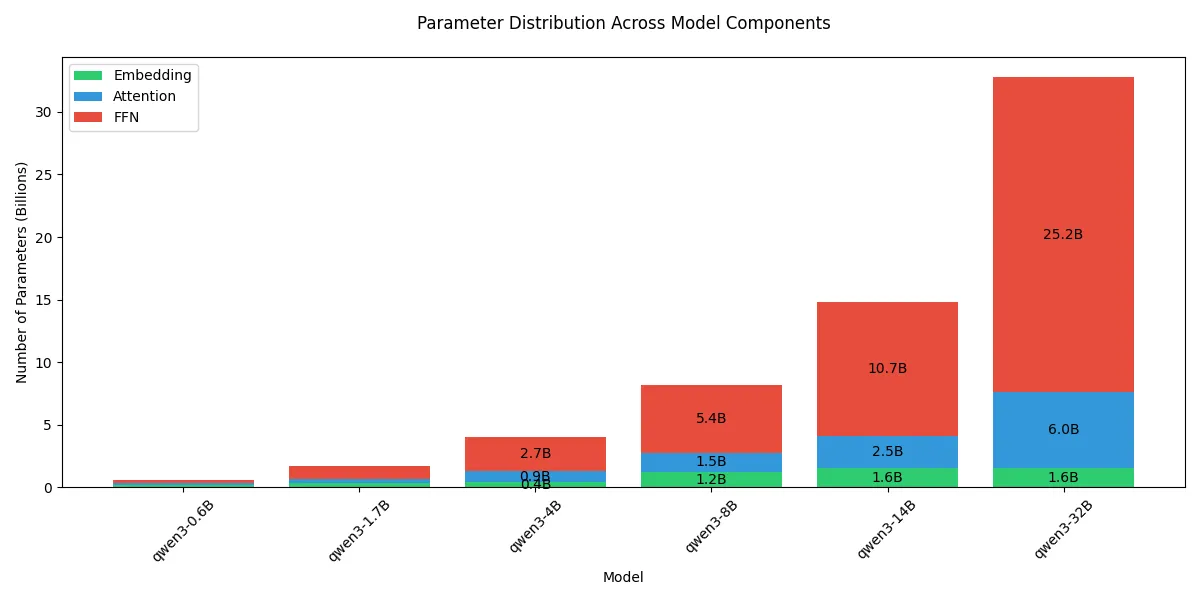
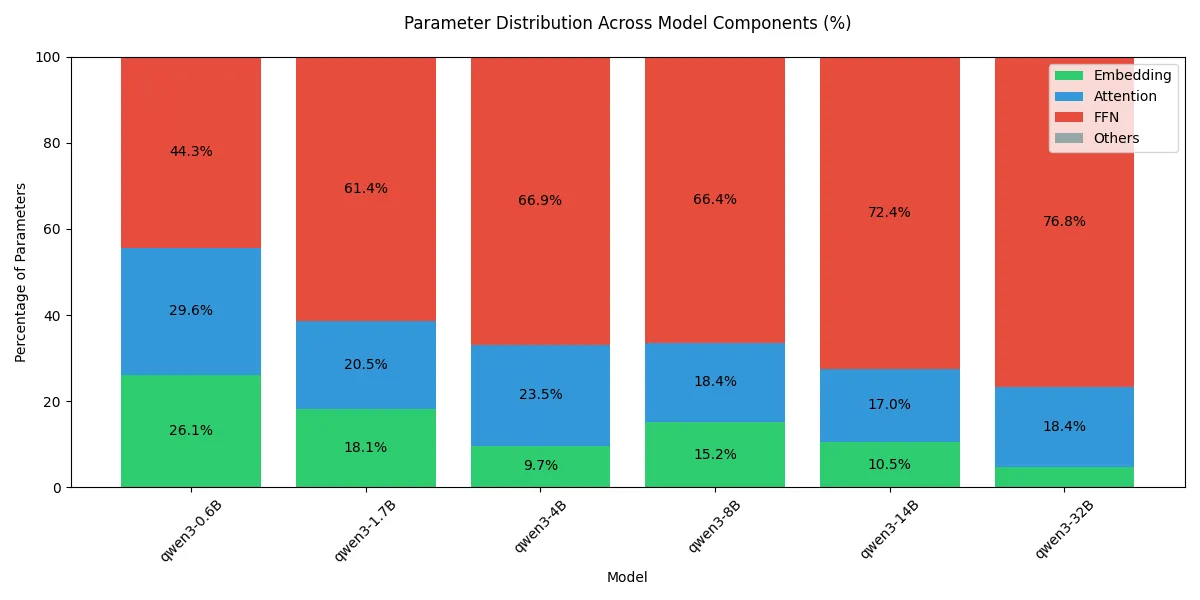
可以看到,随着模型 size 增加,模型大部分参数量都集中在 FFN 上。
接下来,我们可视化一下 MoE 模型的参数分布,核心计算代码如下:
def compute_moe_param_distribution(N, V, d, d_ff, h_d, h, h_kv, n, k, activate=False) -> dict:
    """
    Compute parameter distribution across different components of the MoE model.

    Args:
        N: Number of layers
        V: Vocabulary size
        d: Hidden dimension
        d_ff: Feed-forward dimension
        h_d: Head dimension
        h: Number of attention heads
        h_kv: Number of key/value heads
        n: Number of experts
        k: Number of experts per token
        activate: Whether to compute activated parameters

    Returns:
        dict: Parameter counts for each component
    """
    # Embedding parameters
    embedding = 2 * V * d

    # Attention parameters per layer
    attention_per_layer = h * h_d * d + 2 * h_kv * h_d * d + d * h * h_d + 2 * h_d
    attention_total = attention_per_layer * N

    # FFN parameters per layer
    if activate:
        moe_per_layer = n * d + 3 * k * d * d_ff
    else:
        moe_per_layer = n * d + 3 * n * d * d_ff
    ffn_total = moe_per_layer * N

    # RMSNorm (2d), QK-Norm (2d), output normalization (d)
    others = N * (2 * d + 2 * h_d) + d

    return {
        "Embedding": embedding,
        "Attention": attention_total,
        "MoE": ffn_total,
        "Others": others,
    }
结果如下
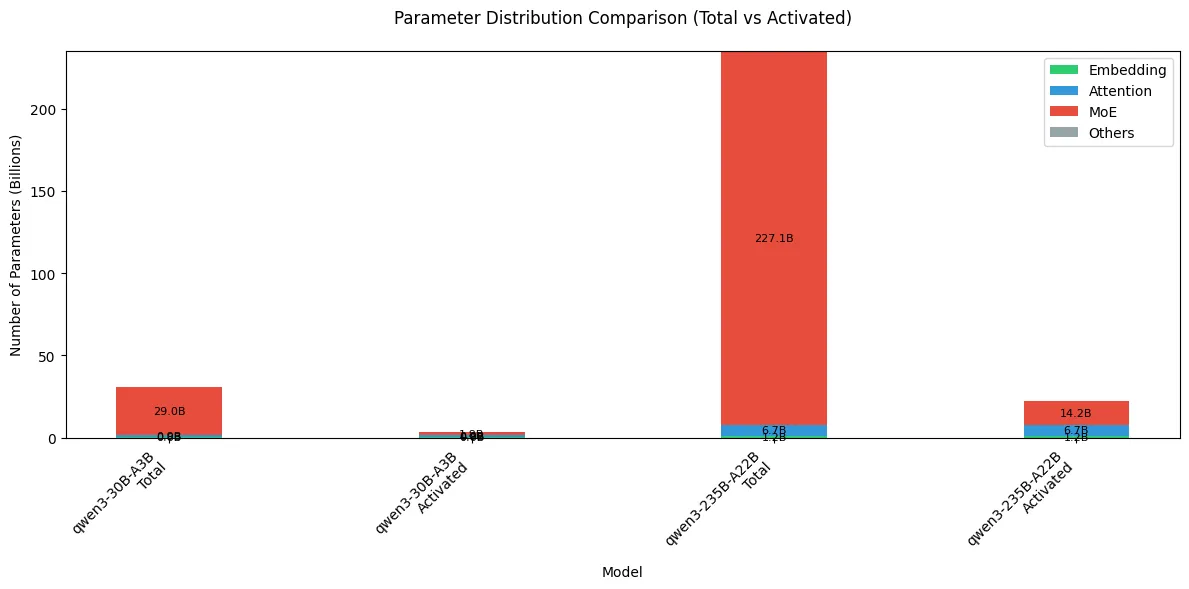
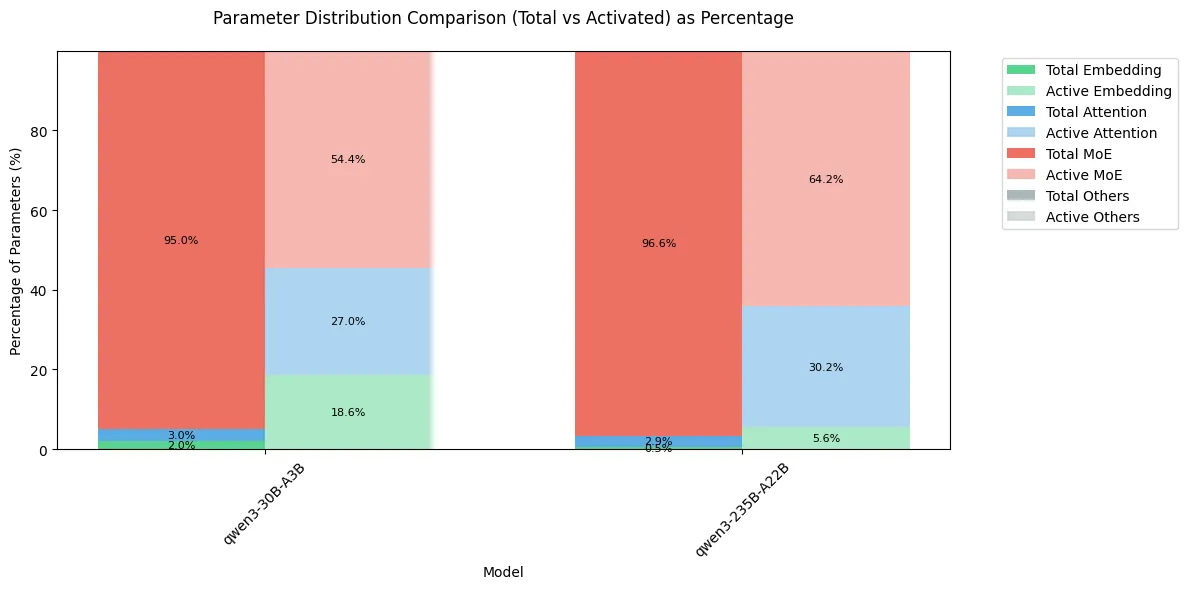
可以看到,MoE 模型的大部分参数还是集中在 MoE 模块上,但是由于其稀疏机制,在激活的参数里,MoE 占比从 95% 以上降低到了 60% 左右。
Conclusion
在本文中,我们基于 Qwen3 大语言模型系列,介绍了如何计算 dense 模型和 MoE 模型的参数量。模型的参数量计算为后面的显存占用以及优化提供了基础。