Introduction
Motivation
现有大部分大语言模型均是基于 Transformer (Vaswani et al., 2017) 架构,scaling law (Hoffmann et al., 2022; Kaplan et al., 2020) 通过实验说明,大语言模型的表现与算力,数据,模型参数量息息相关。 但是,对于 dense 模型来说,我们提高模型参数量时,必须同时提高所使用的算力。这就限制了大模型的 scaling law.
而 MoE 模型的解决方法为在计算时只激活部分参数,这样,我们就可以在同等激活参数量/算力下训练更大参数量的模型,从而达到更好地表现。 因此,MoE 模型的核心思想在于
在使用相同的激活参数量/算力的情况下,提高模型总参数量,从而达到更好的表现。
Why MoE
选择 MoE 的原因有三点:效率, scaling law 以及表现。
Efficiency
MoE 训练更加高效,如下图所示
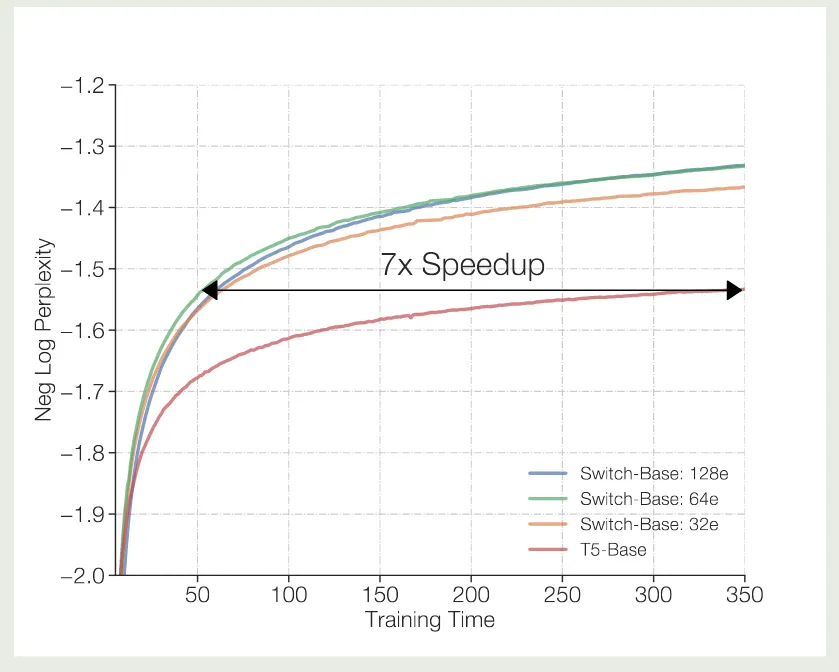
Switch Transformer (Fedus et al., 2022) 的 实验结果说明,MoE model 的训练效率比 dense model 快 7 倍左右。 其他模型也有类似结论。总的来说,MoE 模型相比于 dense 模型,训练效率更高。
(Zhao et al., 2025) 给出的的计算开销如下所示 (4096 context length)
| Model | Type | Size | Training Cost |
|---|---|---|---|
| DeepSeek-V2 | MoE | 236B | 155 GFLOPS/Token |
| DeepSeek-V3 | MoE | 671B | 250 GFLOPS/Token |
| Qwen-72B | Dense | 72B | 394 GFLOPS/Token |
| LLaMa-405B | Dense | 405B | 2448 GFLOPS/Token |
Scaling Law
MoE 模型可以突破传统 scaling law 的限制,在算力固定的情况下,我们可以通过提高 MoE 模型的稀疏度来进一步提高模型的表现 (Tian et al., 2025)
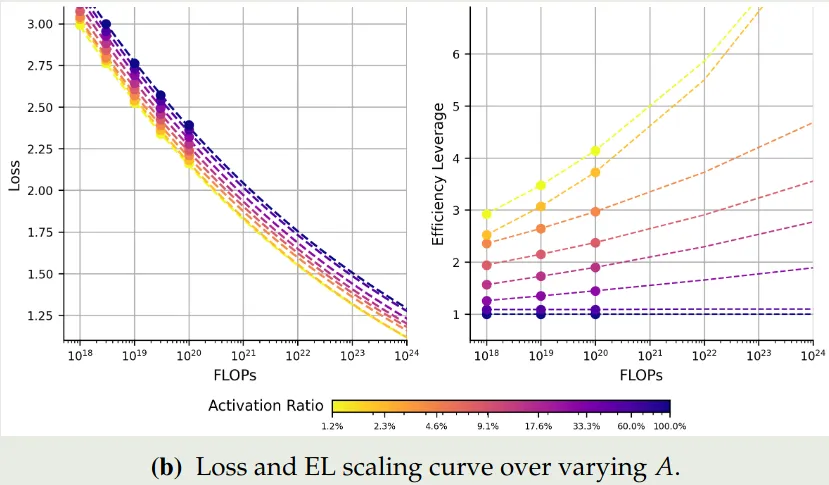
如上图所示,在 FLOPs 给定的情况下,随着模型稀疏度的提高,模型的表现和效率都有提升
Performance
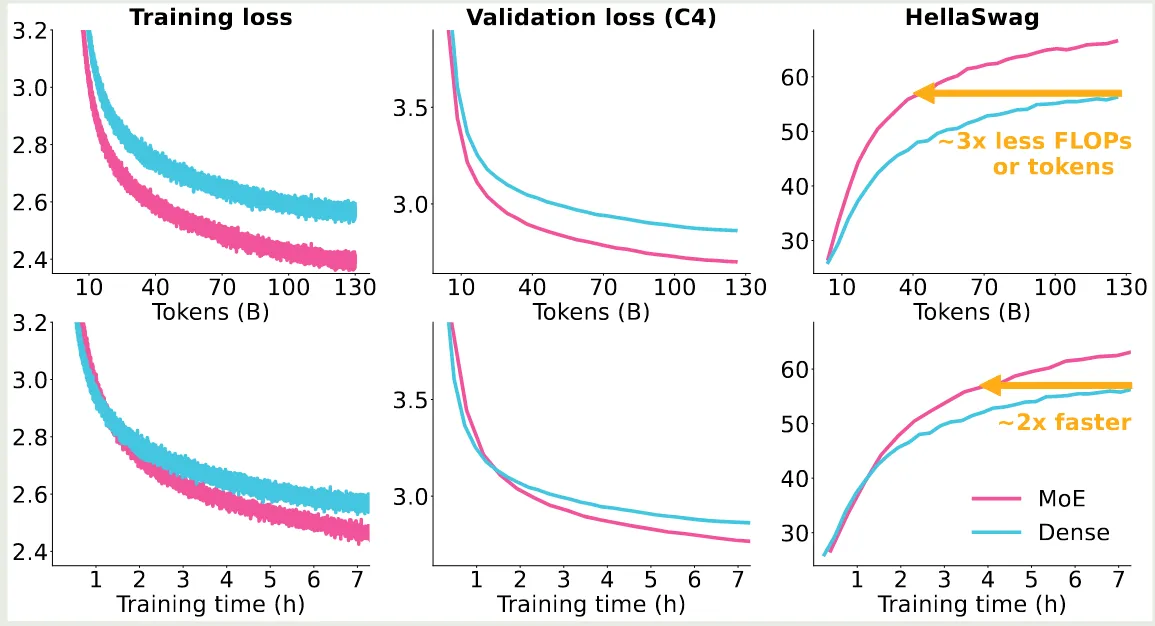
MoE 模型的表现更强,如下图所示,MoE 模型的训练,验证损失以及在下游任务上的表现均超过了 dense 模型
Timeline
下图展示了 MoE 模型的激活比例随时间的变化趋势,可以通过 “Parameters” 和 “Experts” 按钮独立控制显示两种激活比例(可同时显示)。圆圈大小代表模型总参数量。
可以看到,当前大部分模型的参数激活比例都在 左右。从专家激活比例来看,DeepSeek-MoE 和 Hunyuan-A13B 的专家激活比例较高,而 Kimi-K2 和 LongCat 则使用了极低的专家激活比例。Kimi-K2 (Team et al., 2026) 认为提高专家个数可以提高模型表现,而 LongCat 则是使用了 phantom expert 机制。
Why not MoE
前面讲了 MoE 的优点,但是 MoE 也由对应的缺点,主要有以下几点:
- 训练不稳定,早期 MoE 模型训练容易出现不收敛
- 需要更大的 batch size
- 需要更多的 GPU
- Fedus, W., Zoph, B., & Shazeer, N. (2022). Switch transformers: scaling to trillion parameter models with simple and efficient sparsity. J. Mach. Learn. Res., 23(1).
- Hoffmann, J., Borgeaud, S., Mensch, A., Buchatskaya, E., Cai, T., Rutherford, E., de Las Casas, D., Hendricks, L. A., Welbl, J., Clark, A., Hennigan, T., Noland, E., Millican, K., van den Driessche, G., Damoc, B., Guy, A., Osindero, S., Simonyan, K., Elsen, E., … Sifre, L. (2022). Training Compute-Optimal Large Language Models. https://arxiv.org/abs/2203.15556
- Kaplan, J., McCandlish, S., Henighan, T., Brown, T. B., Chess, B., Child, R., Gray, S., Radford, A., Wu, J., & Amodei, D. (2020). Scaling Laws for Neural Language Models. https://arxiv.org/abs/2001.08361
- Team, K., Bai, Y., Bao, Y., Charles, Y., Chen, C., Chen, G., Chen, H., Chen, H., Chen, J., Chen, N., Chen, R., Chen, Y., Chen, Y., Chen, Y., Chen, Z., Cui, J., Ding, H., Dong, M., Du, A., … Zu, X. (2026). Kimi K2: Open Agentic Intelligence. https://arxiv.org/abs/2507.20534
- Tian, C., Chen, K., Liu, J., Liu, Z., Zhang, Z., & Zhou, J. (2025). Towards Greater Leverage: Scaling Laws for Efficient Mixture-of-Experts Language Models. https://arxiv.org/abs/2507.17702
- Vaswani, A., Shazeer, N., Parmar, N., Uszkoreit, J., Jones, L., Gomez, A. N., Kaiser, L., & Polosukhin, I. (2017). Attention Is All You Need. Advances in Neural Information Processing Systems.
- Zhao, C., Deng, C., Ruan, C., Dai, D., Gao, H., Li, J., Zhang, L., Huang, P., Zhou, S., Ma, S., Liang, W., He, Y., Wang, Y., Liu, Y., & Wei, Y. X. (2025, June). Insights into DeepSeek-V3: scaling challenges and reflections on hardware for AI architectures. Proceedings of the 52nd Annual International Symposium on Computer Architecture. 10.1145/3695053.3731412
Basic MoE
Definition
MoE 模型和 dense 模型的示意图如下,图源 OLMoE (Muennighoff et al., 2025)
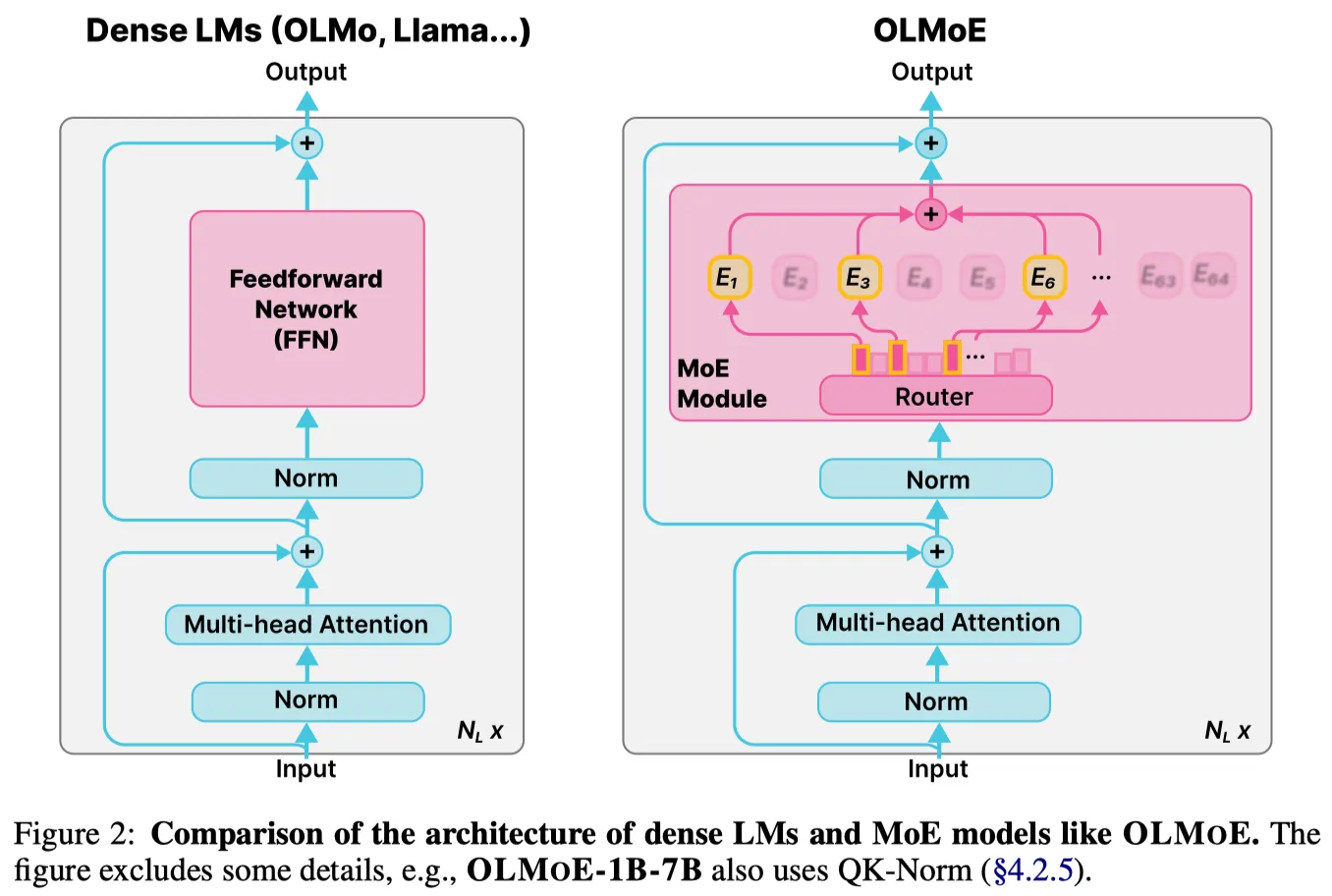
一个 MoE layer 包括两个模块:
- Router:Router 负责为 token 指定合适的专家
- Expert:Expert 负责处理 token
对于输入 , 我们假设有 个 Expert,router 一般是一个 linear layer 再加上一个 gating function (softmax 或者 sigmoid, 我们本文中使用 softmax), 其构建了 的映射,定义为:
其中 , 是可学习的参数, 代表了当前 token 选择第 个 Expert 的概率。
一般来说,Expert 会使用和 dense 模型一样的 MLP, 我们记为
接下来,基于 和 , 我们会使用合适的方法来挑选 个 Expert 出来,其中 是给定的超参数,我们记挑选出来的 个 Expert 的 index 为 , 即
这里 指的是概率值最高的 个值。 最终 MoE layer 的输出为
这里 代表我们对于输出进行归一化,即
Code
OLMoE implementation
class OlmoeSparseMoeBlock(nn.Module):
    def __init__(self, config):
        super().__init__()
        self.num_experts = config.num_experts
        self.top_k = config.num_experts_per_tok
        self.norm_topk_prob = config.norm_topk_prob
        self.gate = nn.Linear(config.hidden_size, self.num_experts, bias=False)
        self.experts = nn.ModuleList([OlmoeMLP(config) for _ in range(self.num_experts)])

    def forward(self, hidden_states: torch.Tensor) -> torch.Tensor:
        batch_size, sequence_length, hidden_dim = hidden_states.shape
        # hidden_states: (batch * sequence_length, hidden_dim)
        hidden_states = hidden_states.view(-1, hidden_dim)
        # router_logits: (batch * sequence_length, n_experts)
        router_logits = self.gate(hidden_states)

        routing_weights = F.softmax(router_logits, dim=1, dtype=torch.float)
        # routing_weights: (batch * sequence_length, top_k)
        # selected_experts: indices of top_k experts
        routing_weights, selected_experts = torch.topk(routing_weights, self.top_k, dim=-1)
        if self.norm_topk_prob:
            routing_weights /= routing_weights.sum(dim=-1, keepdim=True)
        # we cast back to the input dtype
        routing_weights = routing_weights.to(hidden_states.dtype)

        final_hidden_states = torch.zeros(
            (batch_size * sequence_length, hidden_dim), dtype=hidden_states.dtype, device=hidden_states.device
        )

        # One hot encode the selected experts to create an expert mask
        # this will be used to easily index which expert is going to be selected
        expert_mask = torch.nn.functional.one_hot(selected_experts, num_classes=self.num_experts).permute(2, 1, 0)

        # Loop over all available experts in the model and perform the computation on each expert
        for expert_idx in range(self.num_experts):
            expert_layer = self.experts[expert_idx]
            idx, top_x = torch.where(expert_mask[expert_idx])

            # Index the correct hidden states and compute the expert hidden state for
            # the current expert. We need to make sure to multiply the output hidden
            # states by `routing_weights` on the corresponding tokens (top-1 and top-2)
            current_state = hidden_states[None, top_x].reshape(-1, hidden_dim)
            current_hidden_states = expert_layer(current_state) * routing_weights[top_x, idx, None]

            # However `index_add_` only support torch tensors for indexing so we'll use
            # the `top_x` tensor here.
            final_hidden_states.index_add_(0, top_x, current_hidden_states.to(hidden_states.dtype))
        final_hidden_states = final_hidden_states.reshape(batch_size, sequence_length, hidden_dim)
        return final_hidden_states, router_logits
- Muennighoff, N., Soldaini, L., Groeneveld, D., Lo, K., Morrison, J., Min, S., Shi, W., Walsh, E. P., Tafjord, O., Lambert, N., Gu, Y., Arora, S., Bhagia, A., Schwenk, D., Wadden, D., Wettig, A., Hui, B., Dettmers, T., Kiela, D., … Hajishirzi, H. (2025). OLMoE: Open Mixture-of-Experts Language Models. The Thirteenth International Conference on Learning Representations. https://openreview.net/forum?id=xXTkbTBmqq
MoE Design
Experts Design
Number of Experts
一般来说,专家个数越多,模型越稀疏,模型表现越好。扩展专家个数有两个方式:
- 直接增加专家个数,这会导致模型参数量上升,如 Switch Transformer (Fedus et al., 2022)
- 对已有的专家进行切分,将大专家切分为小专家,如 DeepSeekMoE (Dai et al., 2024)
Switch Transformer (Fedus et al., 2022) 也通过实验发现,增加专家个数可以显著提高模型的训练效率和表现,结果如下图所示
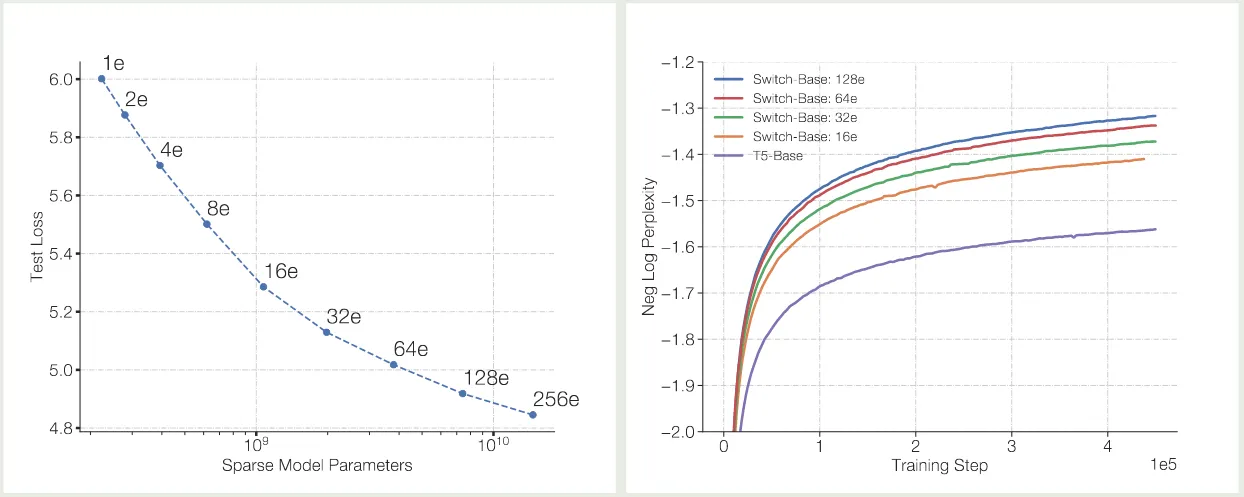
可以看到,当我们增加专家个数的时候,模型的表现是持续提升的。并且当我们增加专家个数之后,模型的训练效率也有所提升。
DeepSeekMoE (Dai et al., 2024) 提出了 fine-granularity expert 的概念,其做法是通过减少 expert 的大小在相同参数量的场景下使用更多的专家。实验结果如下图所示
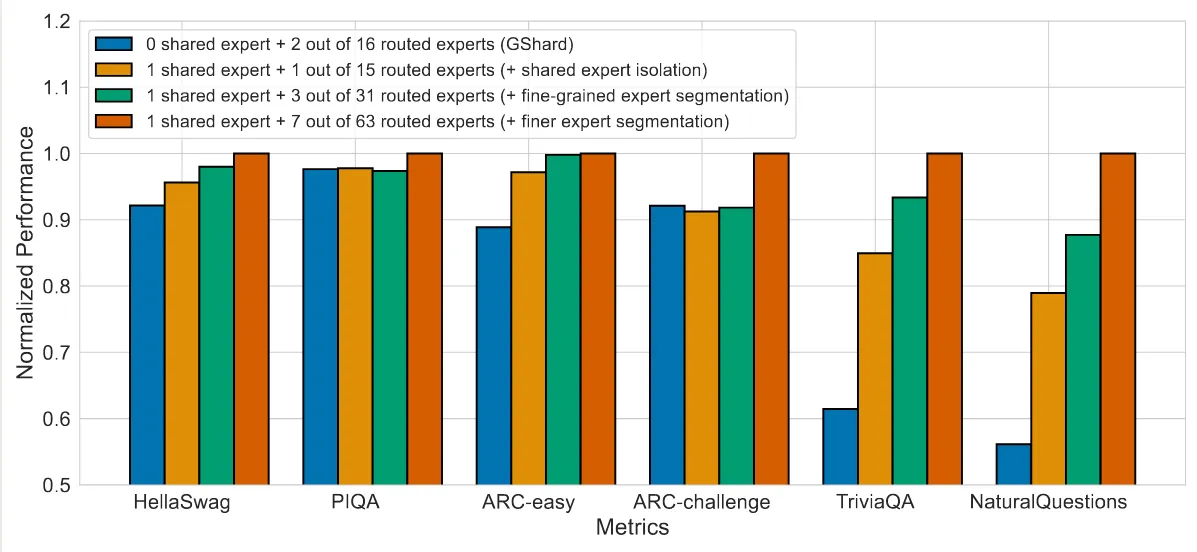
可以看到,在稀疏度 (激活专家个数占总专家个数比例) 不变的情况下,提高专家的粒度,可以提高模型的表现。
OLMoE (Muennighoff et al., 2025) 对 DeepSeekMoE (Dai et al., 2024) 的这个观点进行了验证,结果如下图所示,
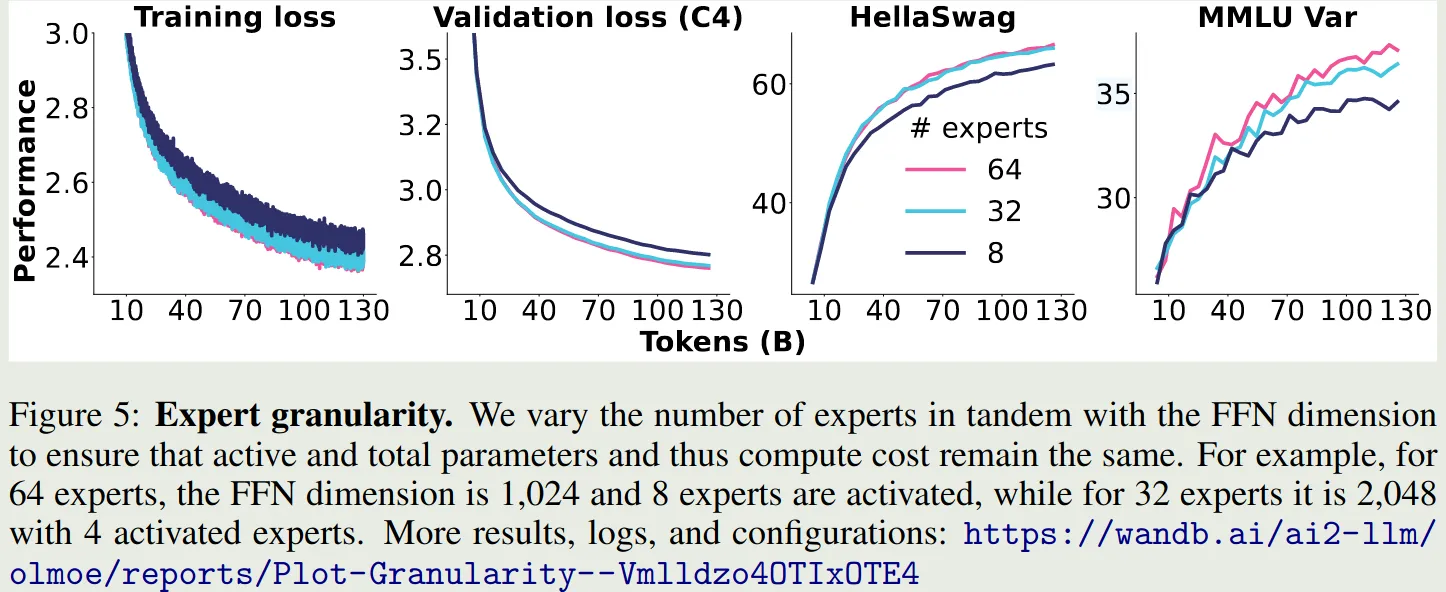
结果显示,当专家粒度从 8E-1A 扩展到 32E-4A 时,模型在 HellaSwag 上的表现提升了 , 但是进一步扩展到 64E-8A 时,模型的表现提升不到 , 这说明了无限制提升专家粒度对模型的提升越来越有限。
Kimi K2(Team et al., 2026) 探究了针对 MoE 模型 sparsity 的 scaling law, 结果也说明,提升 sparsity 可以提高模型的表现。 因此,其相对于 DeepSeek-V3 (DeepSeek-AI et al., 2025) 使用了 额外的的专家数。 Ling-mini-beta (Tian et al., 2025) 进一步验证了这个观点。
MiniMax-M2 (MiniMax et al., 2026) 也验证了细粒度专家可以提高模型表现的结论。
Shared Experts
Shared Expert 由 DeepSeekMoE (Dai et al., 2024) 提出,其基本思想为,固定某几个专家,响应所有的 token,这样可以让某些专家学习到共有的知识,而让其他的专家学习到特定的知识。这个方法随后被 Qwen1.5 (Q. Team, 2024), Qwen2 (Yang et al., 2024) , Qwen2.5 (Qwen et al., 2025) 以及 DeepSeek-V3 (DeepSeek-AI et al., 2025) 所采用。
DeepSeekMoE (Dai et al., 2024) 给出的实验结果如下
作者发现,当使用 shared experts 之后,模型在大部分 benchmark 上的表现都有所提升。
OLMoE (Muennighoff et al., 2025) 在 32 个专家下进行了实验,比较了 4 个激活专家和 3 个激活专家 +1 个共享专家两种设置的表现,结果如下:
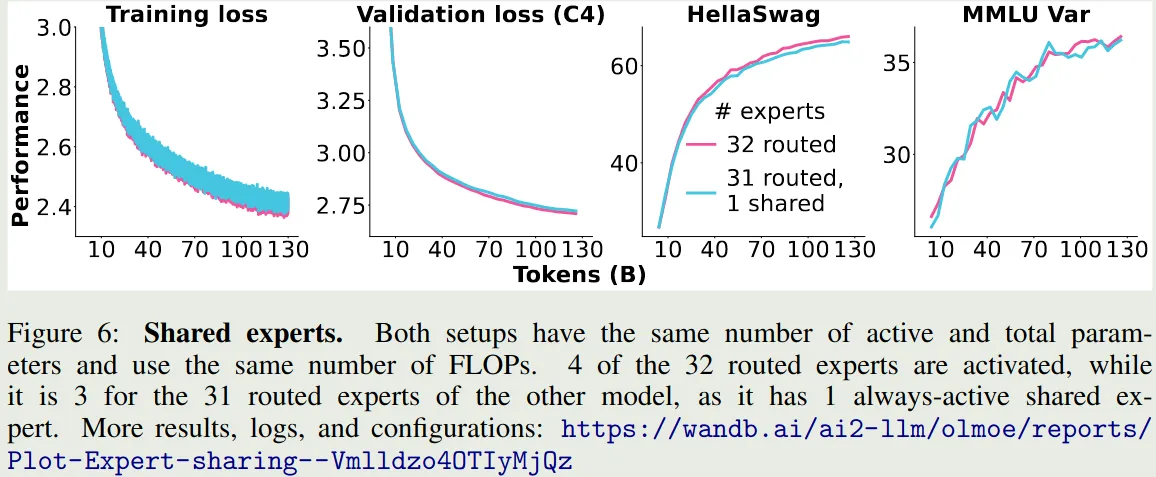
作者认为,加入 shared experts 之后,组合的可能性有所减少,这会降低模型的泛化性。因此,在 olmoe 中,作者没有使用 shared experts.
Ling-mini-beta (Tian et al., 2025) 通过实验得出的结论为,shared expert 应该是一个非零的尽可能小的值,作者认为将 shared expert 设置为 1 是一个比较合理的选择。
Activation Function
一般来说,在选取 top-K 专家时,我们会对 gating layer 的输出进行归一化,通常我们会使用 softmax function:
但是,在 Loss-Free Balancing 中,作者通过实验发现,使用 sigmoid 作为激活函数效果更好,即
其对应的实验结果如下图所示
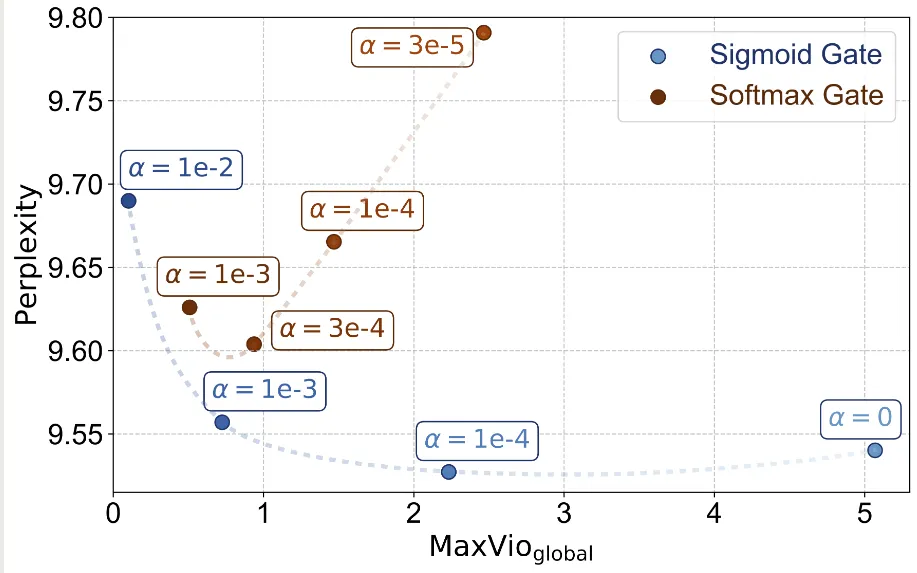
最近的 DeepSeek-V4 (DeepSeek-AI, 2026) 使用了 作为激活函数。
实验结果显示,sigmoid function 对于超参数更加 robust, 且表现也更好一些。 下面是一些使用不同激活函数的模型例子
| Activation function | Models |
|---|---|
| Step 3, Kimi-K2, gpt-oss-120B | |
| GLM-4.5, dots.llm1, DeepSeek-V3, MiniMax-M2 | |
| DeepSeek-V4 |
Routing Z-loss
Routing Z-loss 由 ST-MoE (Zoph et al., 2022) 提出, Switch Transformer (Fedus et al., 2022) 发现在 gating layer 中使用 float32 精度可以提高训练稳定性,但是这还不够,因此 ST-MoE 使用了如下的 router Z-loss:
其中 是 batch size , 代表了第 个专家对 个 token 的激活 logits. OLMoE (Muennighoff et al., 2025) 实验验证结果如下
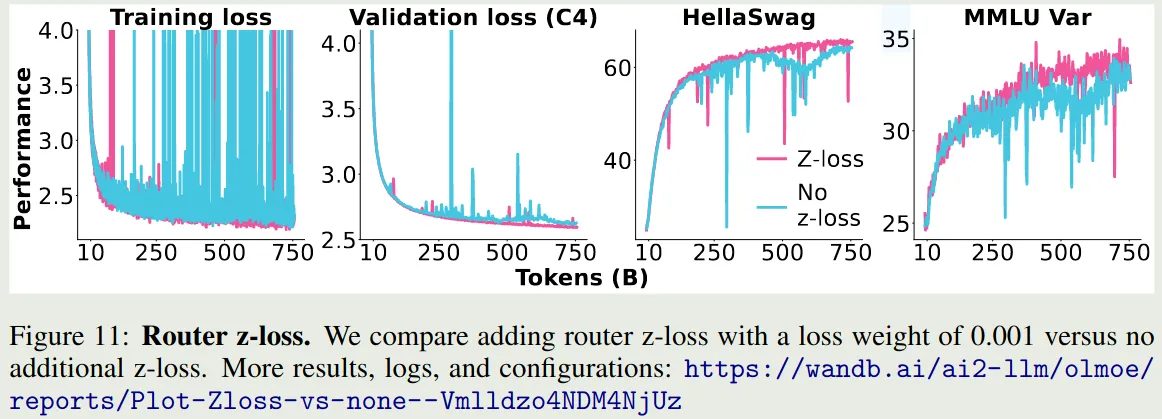
可以看到,加入 router Z-loss 之后,模型训练的稳定性有所提升,因此 Olmoe 采取了这个改进,但是后续的 MoE 模型使用 Z-loss 较少,个人猜测原因是 Loss-Free Balancing 中提出的加入额外的 loss 会影响 nex-token prediction loss
Routing Strategy
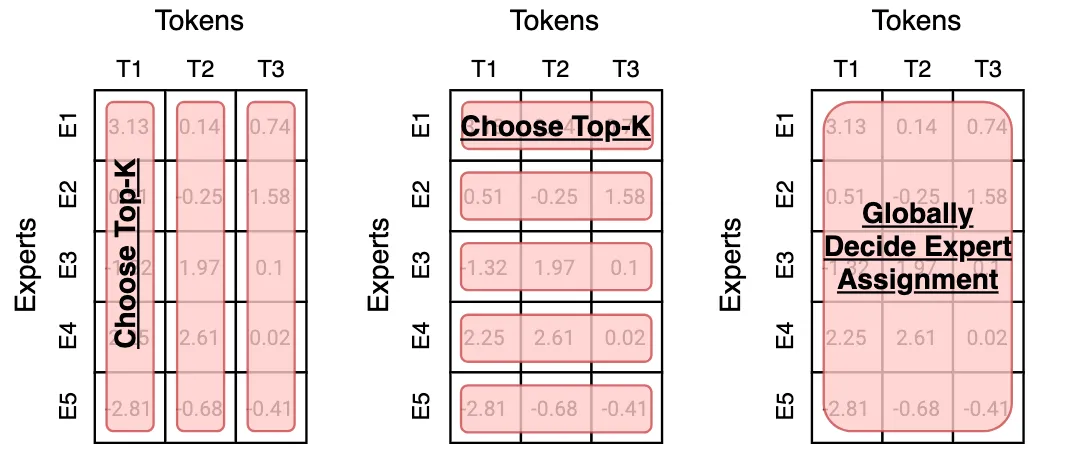
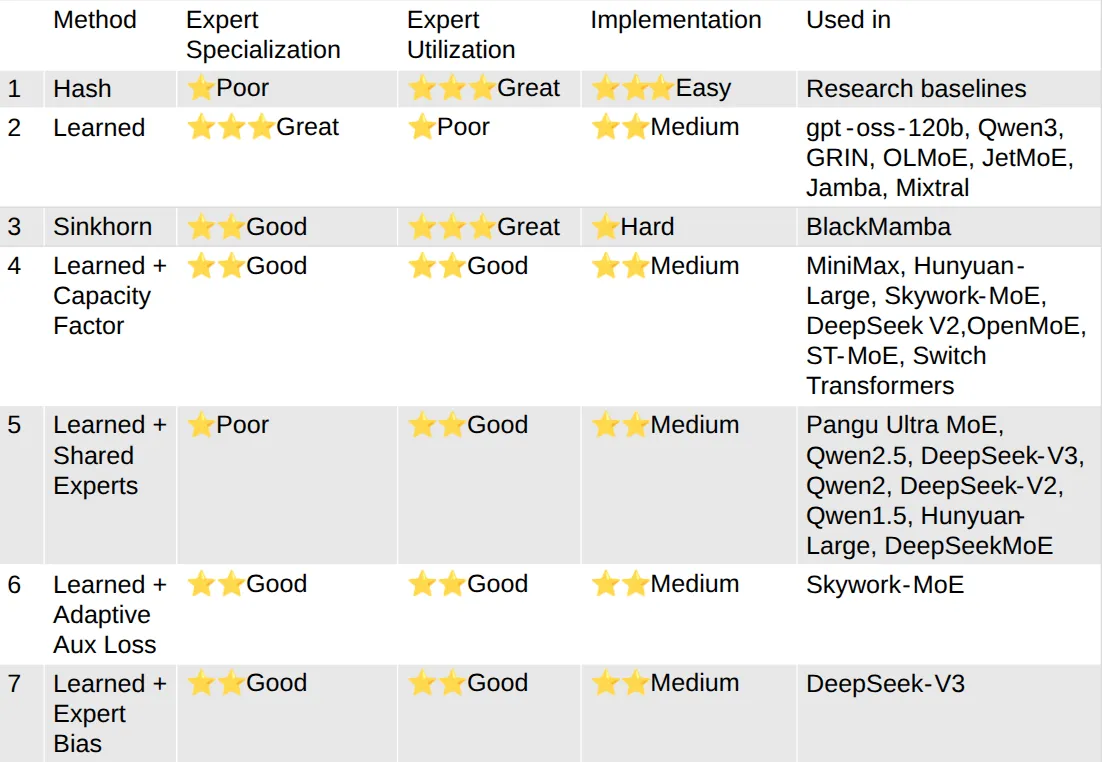
routing 策略直接决定了 MoE 模型的有效性。在为专家分配 token 的时候,我们有如下方式:
- 为每个 token 选取若干个专家
- 为每个专家选取若个个 token
- 动态分配 token 与专家之间的关系
三种选择方式如下图所示,图源 (Fedus, Dean, et al., 2022)
Expert Choice
每个专家选取 top-k 的 token,此时每个专家处理的 token 个数是相同的,这个方法的好处是自带 load balance。缺点是自回归生成的方式没有完整序列长度的信息,从而导致 token dropping,也就是某些 token 不会被任何专家处理,某些 token 会被多个专家处理。
目前采用这个策略的有 OpenMoE-2, 核心思想是 dLLM 的输出长度固定,expert choice 策略更有效
Token Choice
每个 token 选取 top-k 的专家,好处是每个 token 都会被处理,缺点是容易导致负载不均衡。因此,一般需要加上负载均衡或者 token dropping 策略来提高负载均衡
Capacity Factor 由 Switch Transformer (Fedus, Zoph, et al., 2022) 提出,其定义为
设置 capacity factor 之后,当某个专家处理的 token 个数超过 capacity 之后,概专家的计算就会直接跳过,退化为 residual connection. 后续 DeepSeek-V2 (DeepSeek-AI et al., 2024) 也采用了这种策略,但是 DeepSeek-V3 (DeepSeek-AI et al., 2025) 弃用
Load balancing Loss 在训练目标中加入负载均衡损失,要求每个专家处理的 token 个数的分布尽可能均匀。 这部分具体见 Loss-Free Balancing
Global Choice
全局分配决定 token 和专家的匹配关系,后续 Qwen 提出了 Global-batch load balancing 使用了这种方式来提高专家的特化程度
Dynamic Routing
根据输入 token 的难度动态决定激活专家的个数。LongCat-Flash (M. L. Team et al., 2025) 使用了一个 Phantom expert 的方法来实现根据 token 的难度动态分配专家。 具体来说,除了 个专家之外,MoE 还包括 个 zero-computation expert (现在一共有 个专家参与计算), 其计算方式如下
注:LongCat 还使用了 Loss-Free Balancing, 我们这里省略掉了。
Hash Routing
最近的 DeepSeek-V4 (DeepSeek-AI, 2026) 在前三层 MoE layer 中使用了 Hash Routing 策略。 其做法就是基于 token id 来分配对应的专家,即
hash routing 的优势是可以完美保持负载均衡,但是其缺陷在于忽略了 context, 导致最终模型表现效果不佳。
Overview
现在几乎所有的模型都选择方式 1,即每个 token 选取 top-k 的专家。 OLMoE (Muennighoff et al., 2025) 对比了以下方式 1 和方式 2 的表现,如下图所示
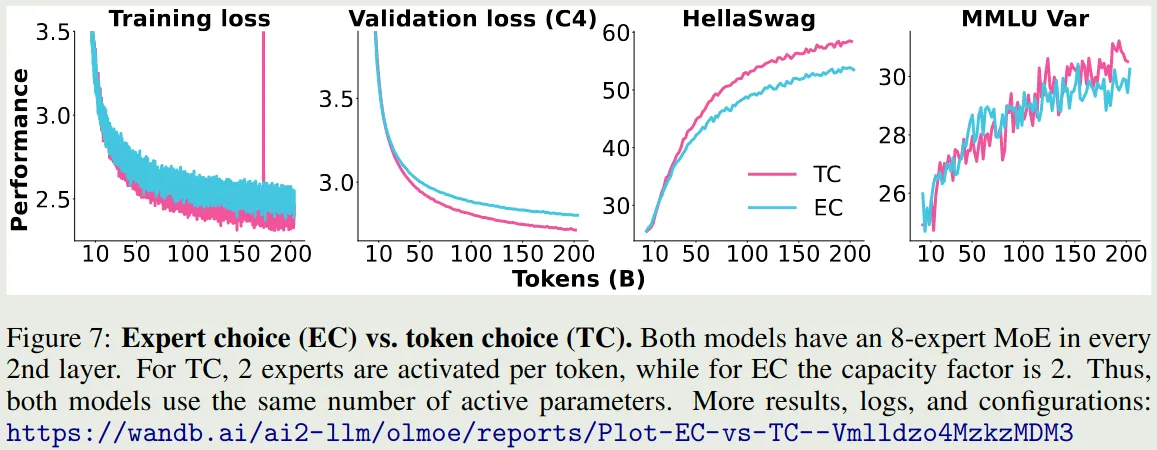
可以看到,加入 load balancing loss 之后,相比于 Expert Choice, Token Choice 的表现更好。但是,expert choice 更加高效,作者认为 expert choice 更适用于多模态,因为丢掉 noise image tokens 对 text token 影响会比较小。因此,在 OLMoE (Muennighoff et al., 2025) 中,作者使用 token choice 作为 routing 策略
Upcycling
upsampling 是一个将 dense model 转化为 MoEmodel 的方法,具体做法就是我们复制 dense model 中的 FFN layer 得到对应 MoE layer 中的 Expert,然后我们再结合 router 训练,这样可以提高整体的训练效率。 相关模型有 MiniCPM (Hu et al., 2024), Qwen1.5 (Q. Team, 2024) 和 Mixtral MoE(Jiang et al., 2024) (疑似)
OLMoE (Muennighoff et al., 2025) 给出的实验结果如下图所示
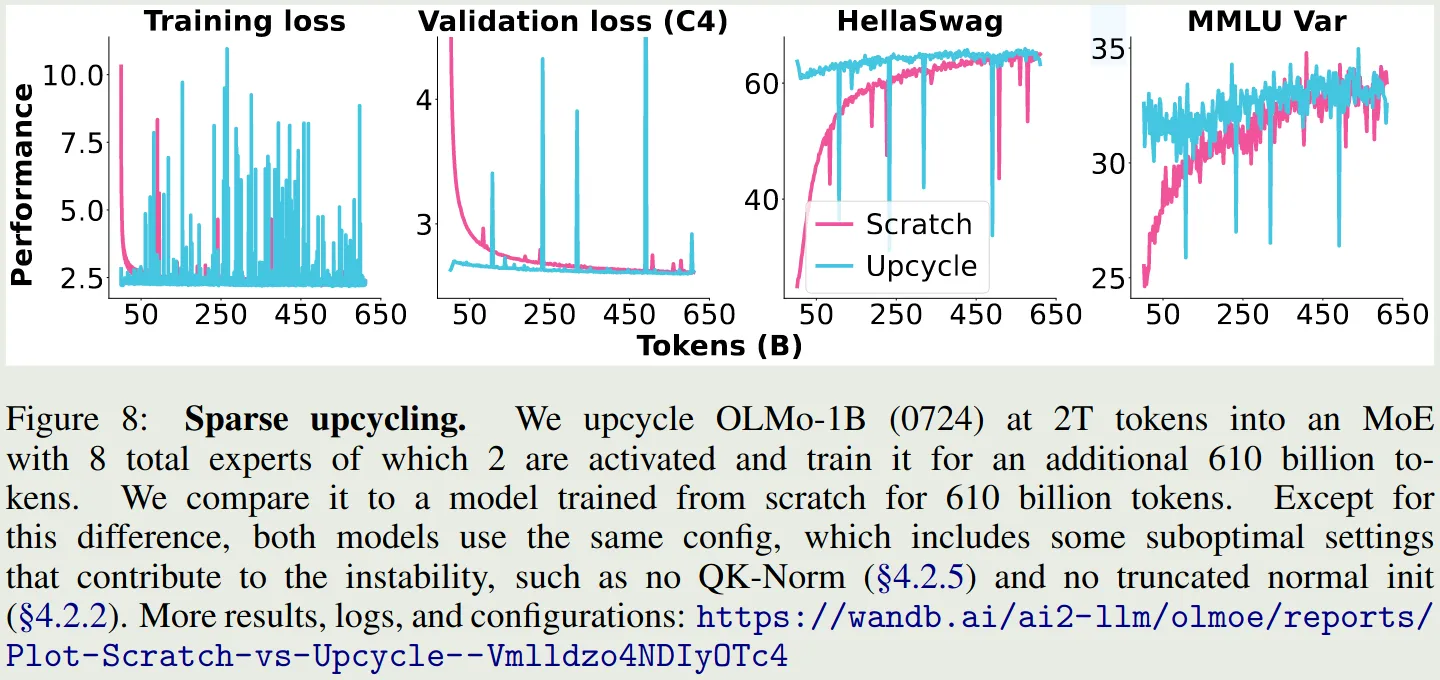
从已有的结果来看,MoE 模型会被 dense 模型的一些超参数所限制,且训练不是很稳定。 因此,现在一般不采用这种方法
LatentMoE
LatentMoE (Elango et al., 2026) 是 NVIDIA 提出的一个 软硬件结合的 MoE 架构。
在原始的 MoE 架构中,一次计算中,我们需要执行一次 All-to-All Dispatch 和一次 All-to-All Combine
最终 LatentMoE 架构的定义如下所示
其中 , 是 latent space dimension. 现在,我们可以在 latent space 中进行通信和计算,这样,我们的内存访问和通信成本相比与原来的 MoE module, 降低了 .
- Dai, D., Deng, C., Zhao, C., Xu, R. X., Gao, H., Chen, D., Li, J., Zeng, W., Yu, X., Wu, Y., Xie, Z., Li, Y. K., Huang, P., Luo, F., Ruan, C., Sui, Z., & Liang, W. (2024). DeepSeekMoE: Towards Ultimate Expert Specialization in Mixture-of-Experts Language Models. https://arxiv.org/abs/2401.06066 back: 1, 2, 3, 4, 5
- DeepSeek-AI. (2026). DeepSeek-V4: Towards Highly Efficient Million-Token Context Intelligence. https://huggingface.co/deepseek-ai/DeepSeek-V4-Pro/blob/main/DeepSeek_V4.pdf back: 1, 2
- DeepSeek-AI, Liu, A., Feng, B., Wang, B., Wang, B., Liu, B., Zhao, C., Dengr, C., Ruan, C., Dai, D., Guo, D., Yang, D., Chen, D., Ji, D., Li, E., Lin, F., Luo, F., Hao, G., Chen, G., … Xie, Z. (2024). DeepSeek-V2: A Strong, Economical, and Efficient Mixture-of-Experts Language Model. https://arxiv.org/abs/2405.04434
- DeepSeek-AI, Liu, A., Feng, B., Xue, B., Wang, B., Wu, B., Lu, C., Zhao, C., Deng, C., Zhang, C., Ruan, C., Dai, D., Guo, D., Yang, D., Chen, D., Ji, D., Li, E., Lin, F., Dai, F., … Pan, Z. (2025). DeepSeek-V3 Technical Report. https://arxiv.org/abs/2412.19437 back: 1, 2, 3
- Elango, V., Bhatia, N., Waleffe, R., Shafipour, R., Asida, T., Khattar, A., Assaf, N., Golub, M., Guman, J., Mitra, T., Zhao, R., Borkar, R., Zilberstein, R., Patwary, M., Shoeybi, M., & Rouhani, B. (2026). LatentMoE: Toward Optimal Accuracy per FLOP and Parameter in Mixture of Experts. https://arxiv.org/abs/2601.18089
- Fedus, W., Dean, J., & Zoph, B. (2022). A Review of Sparse Expert Models in Deep Learning. https://arxiv.org/abs/2209.01667
- Fedus, W., Zoph, B., & Shazeer, N. (2022). Switch transformers: scaling to trillion parameter models with simple and efficient sparsity. J. Mach. Learn. Res., 23(1). back: 1, 2, 3, 4
- Hu, S., Tu, Y., Han, X., He, C., Cui, G., Long, X., Zheng, Z., Fang, Y., Huang, Y., Zhao, W., Zhang, X., Thai, Z. L., Zhang, K., Wang, C., Yao, Y., Zhao, C., Zhou, J., Cai, J., Zhai, Z., … Sun, M. (2024). MiniCPM: Unveiling the Potential of Small Language Models with Scalable Training Strategies. https://arxiv.org/abs/2404.06395
- Jiang, A. Q., Sablayrolles, A., Roux, A., Mensch, A., Savary, B., Bamford, C., Chaplot, D. S., de las Casas, D., Hanna, E. B., Bressand, F., Lengyel, G., Bour, G., Lample, G., Lavaud, L. R., Saulnier, L., Lachaux, M.-A., Stock, P., Subramanian, S., Yang, S., … Sayed, W. E. (2024). Mixtral of Experts. https://arxiv.org/abs/2401.04088
- MiniMax, :, Chen, A., Li, A., Zhou, B., Gong, B., Jiang, B., Dan, B., Yu, C., Wang, C., Ma, C., Zhong, C., Zhu, C., Xiao, C., Yang, C., Du, C., Zhang, C., Zhang, C., Huang, C., … Ge, Z. (2026). The MiniMax-M2 Series: Mini Activations Unleashing Max Real-World Intelligence. https://arxiv.org/abs/2605.26494
- Muennighoff, N., Soldaini, L., Groeneveld, D., Lo, K., Morrison, J., Min, S., Shi, W., Walsh, E. P., Tafjord, O., Lambert, N., Gu, Y., Arora, S., Bhagia, A., Schwenk, D., Wadden, D., Wettig, A., Hui, B., Dettmers, T., Kiela, D., … Hajishirzi, H. (2025). OLMoE: Open Mixture-of-Experts Language Models. The Thirteenth International Conference on Learning Representations. https://openreview.net/forum?id=xXTkbTBmqq back: 1, 2, 3, 4, 5, 6
- Qwen, :, Yang, A., Yang, B., Zhang, B., Hui, B., Zheng, B., Yu, B., Li, C., Liu, D., Huang, F., Wei, H., Lin, H., Yang, J., Tu, J., Zhang, J., Yang, J., Yang, J., Zhou, J., … Qiu, Z. (2025). Qwen2.5 Technical Report. https://arxiv.org/abs/2412.15115
- Team, K., Bai, Y., Bao, Y., Charles, Y., Chen, C., Chen, G., Chen, H., Chen, H., Chen, J., Chen, N., Chen, R., Chen, Y., Chen, Y., Chen, Y., Chen, Z., Cui, J., Ding, H., Dong, M., Du, A., … Zu, X. (2026). Kimi K2: Open Agentic Intelligence. https://arxiv.org/abs/2507.20534
- Team, M. L., Bayan, Li, B., Lei, B., Wang, B., Rong, B., Wang, C., Zhang, C., Gao, C., Zhang, C., Sun, C., Han, C., Xi, C., Zhang, C., Peng, C., Qin, C., Zhang, C., Chen, C., Wang, C., … Su, Z. (2025). LongCat-Flash Technical Report. https://arxiv.org/abs/2509.01322
- Team, Q. (2024). Introducing Qwen1.5. https://qwen.ai/blog?id=qwen1.5 back: 1, 2
- Tian, C., Chen, K., Liu, J., Liu, Z., Zhang, Z., & Zhou, J. (2025). Towards Greater Leverage: Scaling Laws for Efficient Mixture-of-Experts Language Models. https://arxiv.org/abs/2507.17702 back: 1, 2
- Yang, A., Yang, B., Hui, B., Zheng, B., Yu, B., Zhou, C., Li, C., Li, C., Liu, D., Huang, F., Dong, G., Wei, H., Lin, H., Tang, J., Wang, J., Yang, J., Tu, J., Zhang, J., Ma, J., … Fan, Z. (2024). Qwen2 Technical Report. https://arxiv.org/abs/2407.10671
- Zoph, B., Bello, I., Kumar, S., Du, N., Huang, Y., Dean, J., Shazeer, N., & Fedus, W. (2022). ST-MoE: Designing Stable and Transferable Sparse Expert Models. https://arxiv.org/abs/2202.08906
Load Balancing
我们在 MoE Design 中已经介绍了 MoE 模块,MoE 尽管可以在相同的算力下扩大模型的 size, 但是其问题在于训练时容易出现负载不均衡,也就是说只有少数几个专家被激活,其他专家处于闲置状态,从而导致模型性能下降或者退化。
为了解决这个问题,一个通用的做法是使用 load balancing loss. load balancing loss 可以有效实现负载均衡,让各个专家被激活的概率差不多。
我们按照时间发展顺序来介绍 load balancing loss 的推导。
Derivation
我们假设输入的 batch size 为 , 总专家个数为 , 激活专家个数为 , 代表 gating layer 预测的第 个专家对于 token 的重要性程度。
第一个阶段的 load balancing loss 针对广义的 MoE 模型。 (Bengio et al., 2016) 提出了一个让 batch 里每个专家平均激活概率分布更均匀的损失函数,其定义如下所示
其主要目标是让每个专家的平均激活概率接近 , 即均匀分布.
(Shazeer et al., 2017) 对上面的损失函数进行了改进,提出了变异系数 来保证负载均衡,其定义如下:
这里
注意到 , 当且仅当 为均匀分布时 , 因此 important loss 可以让每个专家在一个 batch 中的激活的平均概率尽可能一致。
但是平均概率一致不代表各个专家处理的 token 个数一致,比如一个专家可能处理比较少的 token, 但是每个 token 的权重都很大。 为了解决这个问题,作者额外加入了 load balancing loss
其中
这里 是作者针对离散变量进行的一个光滑化处理,以方便反向传播。
GShard (Lepikhin et al., 2021) 进一步对 (Shazeer et al., 2017) 提出的 loss 进行了简化,首先注意到 , 因此我们有
这里 均为常数。GShard 并没有使用 soft estimation, 因此这里的 定义为
其代表了 一个 batch 里专家 被激活的次数,理想情况下,所有专家被激活的次数应该是一致的,从而我们就实现了负载均衡。
但是现在的问题是, 是一个离散变量,为了解决这个问题,作者使用了重要性来进行近似,即
Switch Transformer (Fedus et al., 2022) 又对 GShard (Lepikhin et al., 2021) 提出的 load balancing loss 进行了规范化,这也是现在大部分 load balancing loss 使用的形式,其定义如下:
其中,
代表了分配给专家 的 token 比例,
代表了这个 batch 里专家 的平均激活概率。 我们可以看到,这个形式和 GShard (Lepikhin et al., 2021) 实际上是等价的:
Analysis
目前关于 load balancing loss 可以实现负载均衡的数学分析是比较少的。Switch Transformer (Fedus et al., 2022) 中进行了如下分析:
The auxiliary loss of Equation 4 encourages uniform routing since it is minimized under a uniform distribution.
但实际上,这个分析是错误的,Switch transformer 中定义的 load balancing loss 并不是在均匀分布时取最小值,而是取最大值。考虑如下情形,
此时,我们有
我找了很多资料,最后发现苏剑林老师在 (苏剑林, 2025) 中进行了分析。 我这里基于苏剑林老师的 blog 进行了一下总结。
分析的核心思想就是,尽管 load balancing loss 目标函数没有意义,但是我们通过 straight-through estimator (STE),就可以得到一个有意义的目标函数,其梯度与 load balancing loss 目标函数的梯度是一致的,这样 load balancing loss 目标函数就完成了其负载均衡的目标。
注意到 load balancing loss 的最终目标是让每个专家处理的 token 个数尽可能一致,也就是
但是 是一个离散变量不可导,因此,基于 STE, 我们可以将其改写为
其中 满足:
此时我们目标函数的梯度就变成了
这样就对应上了我们之前的目标函数。总之,目标函数尽管本身没有意义,但是其对应的梯度却可以让模型实现负载均衡的目标。
Extension
Loss Free Load Balancing Strategy
Loss-Free load balancing (Wang et al., 2024) 是 DeepSeek 提出来的一个无需 load balancing loss 实现负载均衡的方法。 其核心思想是 load balancing loss 会影响语言建模性能,因此在 操作时,作者加入一些扰动,从而让负载高的专家被选择的概率降低,让负载低的专家被选择的概率提高。
具体做法就是在每个专家的 gating score 上加入一个 bias term, 然后再决定对应的专家:
注意这里的 bias item 仅影响 top-K 操作,其对最终的输出没有影响。
为了实现负载均衡,作者根据上一个 batch 的 expert load 情况来调整 bias item, 如果某一个专家的 load 太大,则对应的 bias item 会变小。 其算法实现过程如下:
Input: MoE model , training batch iterator , bias update rate
Initialize for each expert
For a batch
- Train MoE model on the batch data , with gating score calculated
- Count the number of assigned tokens for each expert, and the average number
- Calculate the load violation error
- Update by
Return trained model , corresponding bias
作者对比不同的负载均衡算法如下表所示
| Load Balancing Methods | Balanced Expert Load | Interference Gradients | Future Token Leakage |
|---|---|---|---|
| Loss-Controlled (strong auxiliary loss) | balanced | strong | no leakage |
| Loss-Controlled (weak auxiliary loss) | imbalanced | weak | no leakage |
| Expert Choice | balanced | none | with leakage |
| Loss-Free (Ours) | balanced | none | no leakage |
TODO
Global-batch Load Balancing Loss Strategy
Global-batch Load Balancing (Qiu et al., 2025) 是 Qwen 提出来的一个提高负载均衡的方法。 其核心思想是,现有的 token choice 只是在 batch 层面达到负载均衡,这种局部均衡的性质可能会对模型的全局均衡性产生影响。 因此,作者就预先在 global batch 层面对专家进行分配,从而提高专家在不同 domain 上的特化程度。
一般来说,MoE 模型训练时会使用 expert parallel 策略,此时 load balancing loss 修改为
其中 是 parallel groups 的个数。在这种情况下,模型需要再每个 parallel group 中实现负载均衡。 但是某一个 mircro-batch 里可能只包含某一个 domain 的序列,因此各个专家被强制要求在每一个 domain 中也均衡分布。 作者认为,这种方式会限制专家的能力,进而影响模型的表现。
作者的解决方法在于,获取每个 parallel group 的 然后求 global-batch 的 .
实际中,由于计算节点数量有限,micro-batch size 之和可能会小于 global-batch size, 因此我们会使用 gradient accumulation. 在这种情况下, 作者使用了一个 buffer 来保存多个 micro-batch 的专家选择次数,最终算法实现过程如下所示
Initialize an empty buffer for each expert
While training continues
- For each gradient accumulation step
- Add with new synchtonized selection counts for expert
- Calculate the current with , in the buffer
- Optimizer step, clear gradient
- Reset the buffer with
Sequence level load balancing loss
TODO
Node level load balancing loss
TODO
Experiments
OLMoE (Muennighoff et al., 2025) 对比了加入 load balancing loss 之后模型的表现变化情况,结果如下图所示
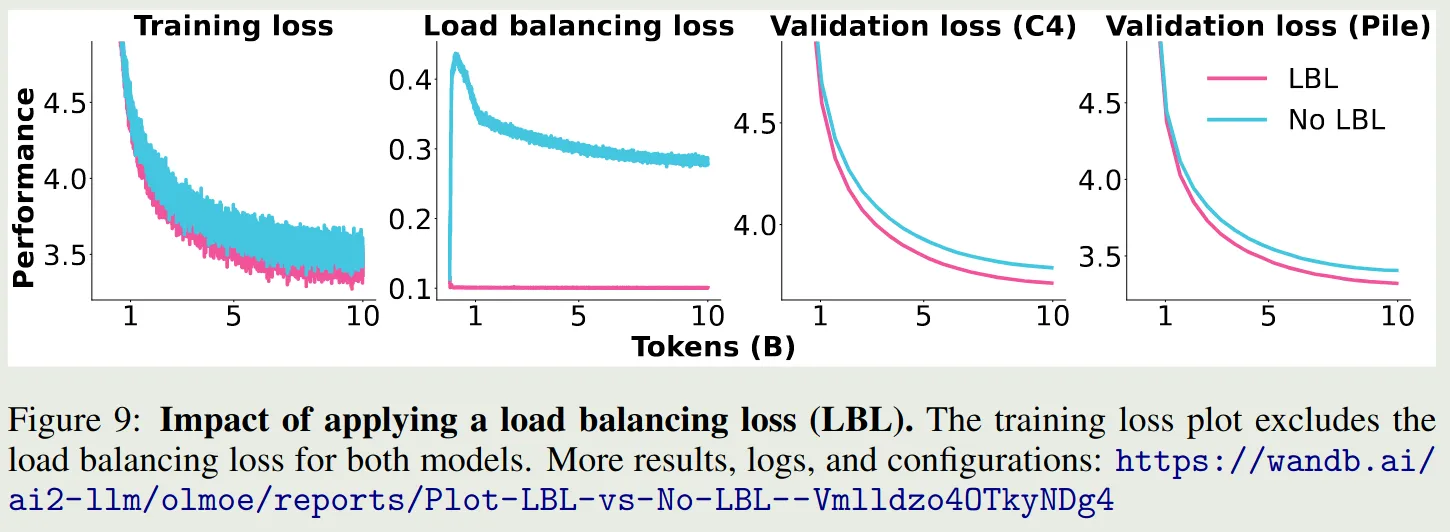
可以看到,加入 load balancing loss 之后,模型的表现均超过了不加时的表现。
作者进一步分析了不同专家在加/不加 load balancing loss 时的激活情况,结果如下图所示
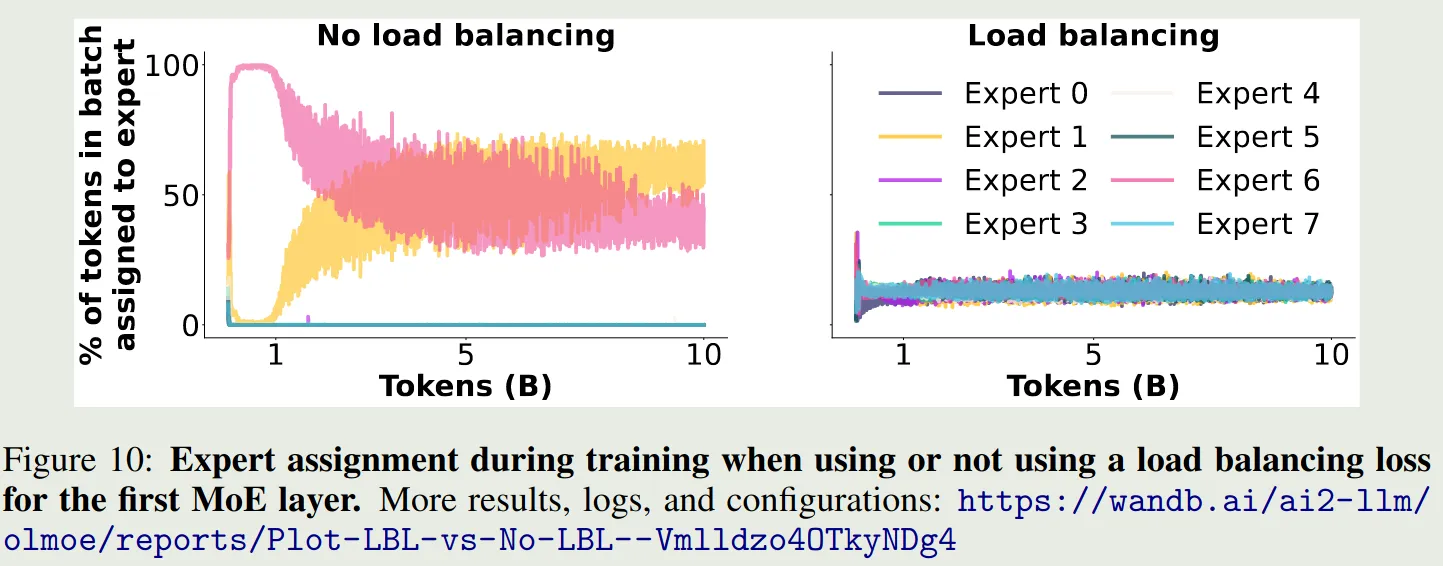
结果显示,load balancing loss 确实可以让不同专家的激活概率大致相当。
(Wang et al., 2024) 使用了 DeepSeekMoE 来进行实验,作者使用了 sigmoid function 作为 gating function, 因为作者发现 sigmoid function 效果比 softmax 效果更好。
作者提出了 maximal violation (MaxVio) 来量化一个 MoE layer 的负载均衡程度
其中 代表了分配给第 个专家的 token 个数, 代表了理想情况下的负载均衡。
实验结果如下图所示
| Model Size | Load Balancing Methods | Validation Perplexity | MaxVioglobal |
|---|---|---|---|
| 1B | Loss-Controlled | 9.56 | 0.72 |
| 1B | Loss-Free | 9.50 | 0.04 |
| 3B | Loss-Controlled | 7.97 | 0.52 |
| 3B | Loss-Free | 7.92 | 0.04 |
实验结果显示,本文提出的 Loss-Free Balancing 效果更好,且负载均衡更高
Capacity Factor
https://www.cerebras.ai/blog/moe-guide-router
- Bengio, E., Bacon, P.-L., Pineau, J., & Precup, D. (2016). Conditional Computation in Neural Networks for faster models. https://arxiv.org/abs/1511.06297
- Fedus, W., Zoph, B., & Shazeer, N. (2022). Switch transformers: scaling to trillion parameter models with simple and efficient sparsity. J. Mach. Learn. Res., 23(1). back: 1, 2
- Lepikhin, D., Lee, H., Xu, Y., Chen, D., Firat, O., Huang, Y., Krikun, M., Shazeer, N., & Chen, Z. (2021). Ghard: Scaling Giant Models with Conditional Computation and Automatic Sharding. International Conference on Learning Representations. https://openreview.net/forum?id=qrwe7XHTmYb back: 1, 2, 3
- Muennighoff, N., Soldaini, L., Groeneveld, D., Lo, K., Morrison, J., Min, S., Shi, W., Walsh, E. P., Tafjord, O., Lambert, N., Gu, Y., Arora, S., Bhagia, A., Schwenk, D., Wadden, D., Wettig, A., Hui, B., Dettmers, T., Kiela, D., … Hajishirzi, H. (2025). OLMoE: Open Mixture-of-Experts Language Models. The Thirteenth International Conference on Learning Representations. https://openreview.net/forum?id=xXTkbTBmqq
- Qiu, Z., Huang, Z., Zheng, B., Wen, K., Wang, Z., Men, R., Titov, I., Liu, D., Zhou, J., & Lin, J. (2025). Demons in the Detail: On Implementing Load Balancing Loss for Training Specialized Mixture-of-Expert Models. https://arxiv.org/abs/2501.11873
- Shazeer, N., Mirhoseini, *Azalia, Maziarz, *Krzysztof, Davis, A., Le, Q., Hinton, G., & Dean, J. (2017). Outrageously Large Neural Networks: The Sparsely-Gated Mixture-of-Experts Layer. International Conference on Learning Representations. https://openreview.net/forum?id=B1ckMDqlg back: 1, 2
- Wang, L., Gao, H., Zhao, C., Sun, X., & Dai, D. (2024). Auxiliary-Loss-Free Load Balancing Strategy for Mixture-of-Experts. https://arxiv.org/abs/2408.15664 back: 1, 2
- 苏剑林. (2025, February). MoE环游记:2、不患寡而患不均. %5Curl%7Bhttps://spaces.ac.cn/archives/10735%7D
Analysis on MoE
前面的章节我们介绍了 MoE layer design 和如何通过 load balancing loss 来提高 MoE 的负载均衡。这一节我们来分析一下 MoE layer 的性质。
Specialization of Experts
OpenMoE (Xue et al., 2024) 分析了 MoE 模型的特化程度,其结论如下
- 大部分专家对于不同的 domain 没有出现 specialization 情况,对于 math domain, specialization 现象比较明显,作者认为这是因为 math domain 包含更多的 special tokens
- 部分专家对于 position ID 有 specialization 现象,并且连续的 token 更偏好相同的专家
- 部分专家对于 Token ID 有 specialization 现象,作者将这种现象称为 Context-independent Specialization.
- 专家还会对语义相似的 token 进行聚类,并且这种聚类在训练早期就已经发生,作者认为其原因在于重新分配 token 会增加最终的 loss
- 对于 token dropping, 作者发现越靠后的 token, 其被 drop 的概率比例也越高。并且对于指令跟随数据,更多的 token 都会被丢掉,因此作者认为指令跟随数据是 MoE 模型的一种 OOD 数据
Saturation of Experts
OLMoE (Muennighoff et al., 2025) 探究了训练过程中激活的专家和训练结束后激活的专家的匹配程度,结果如下图所示
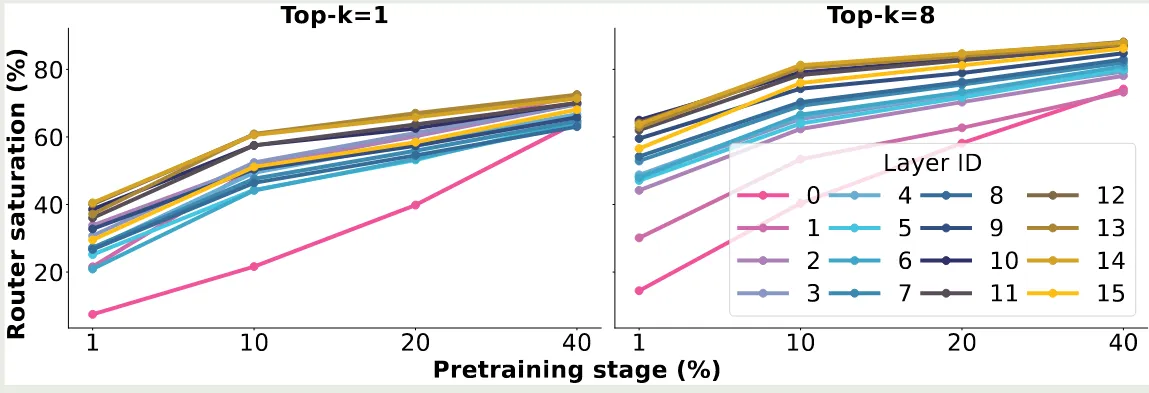
实验结果说明,训练 的数据之后,就有 的 routing 和训练完毕的 routing 一致,当训练 的数据之后,这个比例提升到了 . 作者认为,这是专家特化的结果,初始的 routing 如果改变的话会带来表现下降,因此模型倾向于使用固定的专家处理特定的 token
作者还发现,later layers 比 early layers 饱和更快,early layer, 特别是 layer 0, 饱和的非常慢。 作者认为,这是 DeepSeekMoE (Dai et al., 2024) 放弃在第一层使用 MoE layer 的原因,因为 load balancing loss 收敛更慢。后 续 DeepSeek-V2 (DeepSeek-AI et al., 2024) 和 DeepSeek-V3 (DeepSeek-AI et al., 2025) 均在 early layer 上使用 dense layer 替换掉了 MoE layer
- Dai, D., Deng, C., Zhao, C., Xu, R. X., Gao, H., Chen, D., Li, J., Zeng, W., Yu, X., Wu, Y., Xie, Z., Li, Y. K., Huang, P., Luo, F., Ruan, C., Sui, Z., & Liang, W. (2024). DeepSeekMoE: Towards Ultimate Expert Specialization in Mixture-of-Experts Language Models. https://arxiv.org/abs/2401.06066
- DeepSeek-AI, Liu, A., Feng, B., Wang, B., Wang, B., Liu, B., Zhao, C., Dengr, C., Ruan, C., Dai, D., Guo, D., Yang, D., Chen, D., Ji, D., Li, E., Lin, F., Luo, F., Hao, G., Chen, G., … Xie, Z. (2024). DeepSeek-V2: A Strong, Economical, and Efficient Mixture-of-Experts Language Model. https://arxiv.org/abs/2405.04434
- DeepSeek-AI, Liu, A., Feng, B., Xue, B., Wang, B., Wu, B., Lu, C., Zhao, C., Deng, C., Zhang, C., Ruan, C., Dai, D., Guo, D., Yang, D., Chen, D., Ji, D., Li, E., Lin, F., Dai, F., … Pan, Z. (2025). DeepSeek-V3 Technical Report. https://arxiv.org/abs/2412.19437
- Muennighoff, N., Soldaini, L., Groeneveld, D., Lo, K., Morrison, J., Min, S., Shi, W., Walsh, E. P., Tafjord, O., Lambert, N., Gu, Y., Arora, S., Bhagia, A., Schwenk, D., Wadden, D., Wettig, A., Hui, B., Dettmers, T., Kiela, D., … Hajishirzi, H. (2025). OLMoE: Open Mixture-of-Experts Language Models. The Thirteenth International Conference on Learning Representations. https://openreview.net/forum?id=xXTkbTBmqq
- Xue, F., Zheng, Z., Fu, Y., Ni, J., Zheng, Z., Zhou, W., & You, Y. (2024). OpenMoE: An Early Effort on Open Mixture-of-Experts Language Models. https://arxiv.org/abs/2402.01739
Optimization
MoE 模型的优势在于表现好,但是模型参数往往非常大,为了方便使用,我们需要对训练好的 MoE 模型进行优化,目前主要有蒸馏,专家剪枝/合并以及量化等优化方法
蒸馏是一个将大模型能力传递给小模型的做法,目前已有的包括:
- Switch Transformer (Fedus et al., 2022) 通过蒸馏,在仅使用 参数的情况下,保留了稀疏教师模型 的表现
- Gemini 2.5 (Comanici et al., 2025) 通过蒸馏 Gemini2.5 Pro 得到 Gemini2.5 Flash
- DeepSeek-R1 (Guo et al., 2025) 通过蒸馏来提升小语言模型的 reasoning 能力
- Qwen3 (Yang et al., 2025) 对于小语言模型的训练使用了 off-policy distillation 和 on-policy distillation 来训练小语言模型
- Comanici, G., Bieber, E., Schaekermann, M., Pasupat, I., Sachdeva, N., Dhillon, I., Blistein, M., Ram, O., Zhang, D., Rosen, E., Marris, L., Petulla, S., Gaffney, C., Aharoni, A., Lintz, N., Pais, T. C., Jacobsson, H., Szpektor, I., Jiang, N.-J., … Helmholz, W. (2025). Gemini 2.5: Pushing the Frontier with Advanced Reasoning, Multimodality, Long Context, and Next Generation Agentic Capabilities. https://arxiv.org/abs/2507.06261
- Fedus, W., Zoph, B., & Shazeer, N. (2022). Switch transformers: scaling to trillion parameter models with simple and efficient sparsity. J. Mach. Learn. Res., 23(1).
- Guo, D., Yang, D., Zhang, H., Song, J., Wang, P., Zhu, Q., Xu, R., Zhang, R., Ma, S., Bi, X., Zhang, X., Yu, X., Wu, Y., Wu, Z. F., Gou, Z., Shao, Z., Li, Z., Gao, Z., Liu, A., … Zhang, Z. (2025). DeepSeek-R1 incentivizes reasoning in LLMs through reinforcement learning. Nature, 645(8081), 633–638. 10.1038/s41586-025-09422-z
- Yang, A., Li, A., Yang, B., Zhang, B., Hui, B., Zheng, B., Yu, B., Gao, C., Huang, C., Lv, C., Zheng, C., Liu, D., Zhou, F., Huang, F., Hu, F., Ge, H., Wei, H., Lin, H., Tang, J., … Qiu, Z. (2025). Qwen3 Technical Report. https://arxiv.org/abs/2505.09388
Infra
SonicMoE (Guo et al., 2026) 和 LatentMoE (Elango et al., 2026) 基于 roofline model 从 memory 和 communication 两个方面对 MoE 模型进行了分析. 与 roofline model 一致,我们使用 和 分别代表 GPU 的内存访问 (HBM) 和 GPU 通信 (NVLink) 效率。 我们还假设负载均衡,即每个专家处理的 token 个数是一致的,使用与 load balancing 相同的记号,则每个专家处理的 token 个数为 . MoE module 我们使用 SwiGLU FFN, 其代码如下所示
MoE Experts Implementation
class Qwen3MoeExperts(nn.Module):
    """Collection of expert weights stored as 3D tensors."""

    def __init__(self, config):
        super().__init__()
        self.num_experts = config.num_experts
        self.hidden_dim = config.hidden_size
        self.intermediate_dim = config.moe_intermediate_size
        self.gate_up_proj = nn.Parameter(torch.empty(self.num_experts, 2 * self.intermediate_dim, self.hidden_dim))
        self.down_proj = nn.Parameter(torch.empty(self.num_experts, self.hidden_dim, self.intermediate_dim))
        self.act_fn = ACT2FN[config.hidden_act]

    def forward(
        self,
        hidden_states: torch.Tensor,
        top_k_index: torch.Tensor,
        top_k_weights: torch.Tensor,
    ) -> torch.Tensor:
        final_hidden_states = torch.zeros_like(hidden_states)
        with torch.no_grad():
            expert_mask = torch.nn.functional.one_hot(top_k_index, num_classes=self.num_experts)
            expert_mask = expert_mask.permute(2, 1, 0)
            expert_hit = torch.greater(expert_mask.sum(dim=(-1, -2)), 0).nonzero()

        for expert_idx in expert_hit:
            expert_idx = expert_idx[0]
            if expert_idx == self.num_experts:
                continue
            top_k_pos, token_idx = torch.where(expert_mask[expert_idx])
            current_state = hidden_states[token_idx]
            gate, up = nn.functional.linear(current_state, self.gate_up_proj[expert_idx]).chunk(2, dim=-1)
            current_hidden_states = self.act_fn(gate) * up
            current_hidden_states = nn.functional.linear(current_hidden_states, self.down_proj[expert_idx])
            current_hidden_states = current_hidden_states * top_k_weights[token_idx, top_k_pos, None]
            final_hidden_states.index_add_(0, token_idx, current_hidden_states.to(final_hidden_states.dtype))

        return final_hidden_states
对应的计算为
Roofline Analysis
假设精度为 , 则 expert 部分的计算开销为
up projection 部分的内存访问量为 , 分别代表读取输入,读取权重和保存输出,注意由于算子优化,这里的输出指的是 而不是 . 同理 down projection 部分的内存访问量为 , 从而总的内存访问量为
因此 Arithmetic Density 为
对于固定的 model size 来说, 和 一般是常数,因此,当我们提升 granularity, 即增大 时,MoE module 的 arithmetic intensity 会降低
针对 MoE 模型的 infra 主要涉及 expert parallelism (EP), EP 将 MoE layer 的计算分为了三个阶段:
- all-to-all dispatch: 基于 gating layer 的结果,将 token 通信传输到对应专家所在的 GPU 上
- computation: 执行计算,即 .
- all-to-all combine: 收集专家计算的结果,即 .
其框架图如下所示
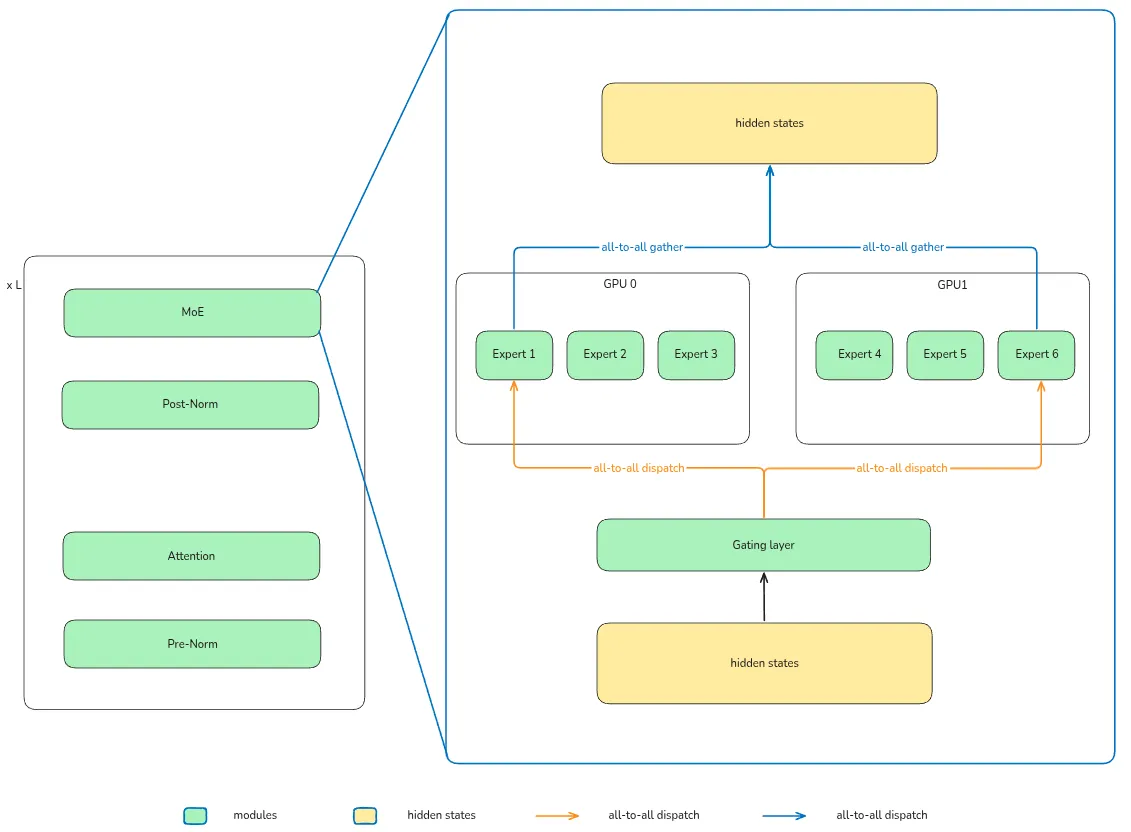
这样,每个 GPU 接收和发送 个 token, 对应的通信量为
这里 和 分别代表 dispatch 和 combine 时的精度,比如 DeepSeek-V3 (DeepSeek-AI et al., 2025) 使用了 FP8 精度进行 dispatch, BF16 精度进行 combine.
这样,MoE module 的 arithmetic intensity (communication) 就是
从上面的分析我们可以看到:
- 对于 low-latency inference 场景,MoE 模型是 memory-bound, 受 expert weights loading 限制,因此主要影响因素为 和
- 对于 high-throughput inference 场景,MoE 模型是 communication bound, 受 all-to-all routing 限制,因此主要影响因素为 和
- DeepSeek-AI, Liu, A., Feng, B., Xue, B., Wang, B., Wu, B., Lu, C., Zhao, C., Deng, C., Zhang, C., Ruan, C., Dai, D., Guo, D., Yang, D., Chen, D., Ji, D., Li, E., Lin, F., Dai, F., … Pan, Z. (2025). DeepSeek-V3 Technical Report. https://arxiv.org/abs/2412.19437
- Elango, V., Bhatia, N., Waleffe, R., Shafipour, R., Asida, T., Khattar, A., Assaf, N., Golub, M., Guman, J., Mitra, T., Zhao, R., Borkar, R., Zilberstein, R., Patwary, M., Shoeybi, M., & Rouhani, B. (2026). LatentMoE: Toward Optimal Accuracy per FLOP and Parameter in Mixture of Experts. https://arxiv.org/abs/2601.18089
- Guo, W., Mishra, M., Cheng, X., Stoica, I., & Dao, T. (2026). SonicMoE: Accelerating MoE with IO and Tile-aware Optimizations. https://arxiv.org/abs/2512.14080
Info on MoE models
MoE model information
| Model | Year | total parameters | activated parameters | shared expert | Routed experts | activated experts |
|---|---|---|---|---|---|---|
| ST-MoE | 2022/4 | 269B | 32B | 0 | 64 | 2 |
| Mistral | 2024/1 | 47B | 13B | 0 | 8 | 2 |
| DeepSeek-MoE | 2024/1 | 145B | 22B | 4 | 128 | 12 |
| DeepSeek-V2 | 2024/5 | 236B | 21B | 2 | 160 | 6 |
| LLaMA4 | 2025/4 | 400B | 17B | 1 | 128 | 1 |
| DeepSeek-V3 | 2024/12 | 671B | 37B | 1 | 256 | 8 |
| Qwen3 | 2025/5 | 235B | 22B | 0 | 128 | 8 |
| dots.llm1 | 2025/6 | 142B | 14B | 2 | 128 | 6 |
| Step 3 | 2025/7 | 316B | 38B | 1 | 48 | 3 |
| Kimi-K2 | 2025/7 | 1043B | 32B | 8 | 384 | 1 |
| GLM-4.5 | 2025/8 | 355B | 32B | 1 | 160 | 8 |
| gpt-oss | 2025/8 | 116B | 5B | 0 | 128 | 4 |
| LongCat | 2025/9 | 560B | 27B* | 0 | 768* | 12 |
| Ling-1T | 2025/10 | 1000B | 51B | 1 | 256 | 8 |
| Kimi-K3 | 2026/ | 2780B | 104B | 2 | 896 | 16 |