本文围绕一个核心问题展开:
我们是如何使用强化学习来提高大语言模型的能力上限的?
为了解决这个问题,我们需要回答:
强化学习是如何建模的?
强化学习有哪些算法?哪些强化学习算法适用/不适用于大语言模型?这些算法背后的原理是什么?
现代大语言模型使用的强化学习算法是什么?
我们将按照下面的学习路径组织:
Foundations : 我们将从基本的 定义 (MDP, return) 出发,建立 LLM generation 与 RL 的对应关系,再用 Bellman Equation 将长期回报转化为递推问题。Evaluation and Improvement : 这一部分,我们先回答“当前 policy 有多好” (policy evaluation ), 再介绍 value-based methods , 该部分会解释为什么 Q-learning/DQN 对理解 RL 很重要,但通常不是优化 LLM policy 的最终选择。Policy Optimization : 这一部分,我们从 policy gradient methods 逐步过渡到 actor-critic methods , 在这个过程中,我们将逐步优化 policy model 和 value model 的训练与使用。这也是后续 PPO 算法的核心。Modern RL Algorithms for LLM : 我们将从 TRPO 开始, 逐步介绍 PPO , GRPO 所做的改进,到这一步,我们就接触到了现代 RL 算法的核心部分。
前两部分建立后续推导所需的共同语言;如果读者已经熟悉经典 RL,可以先阅读
LLM as an MDP ,再从 Policy Evaluation
进入算法主线。
这个 tutorial 主要参考了以下两位老师的课程和材料:
本章的目标是建立全文统一使用的语言:我们先用 MDP 描述 agent 与 environment 的交互,再定义 trajectory, return 和优化目标。
最后我们把 auto-regressive generation 写成一个 token-level MDP.
后续章节我们会一直使用这里定义的 LLM state, action 和 reward.
RL 的基本思想是让 agent 通过与环境交互,学习能够最大化期望回报的策略。
其定义为:
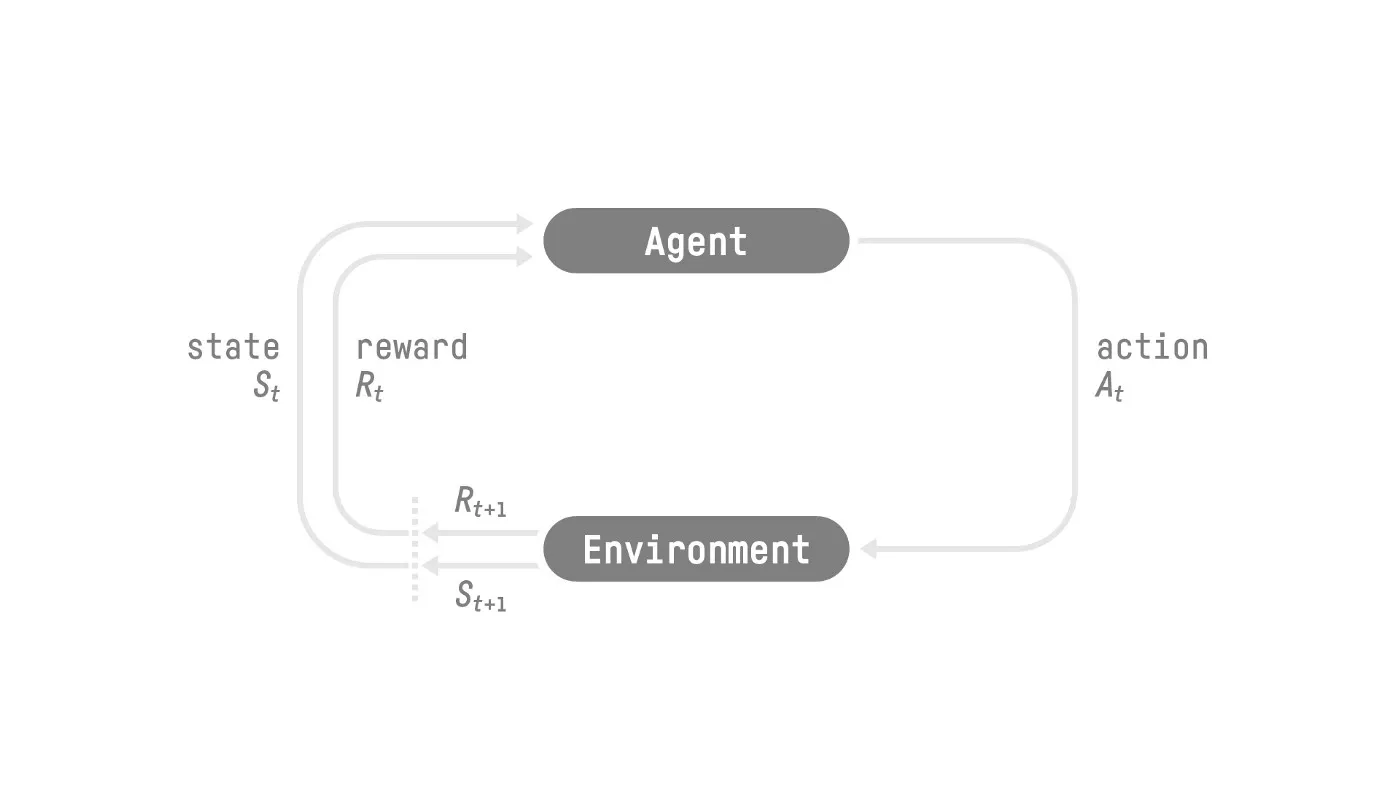
强化学习是一个通过构建可以与 environment 进行交互的 agent 来解决控制和决策任务的学习框架,交互的方式为 agent 执行 action, 然后 environment 给予反馈。
RL 的执行过程如下所示
RL 的数学建模依赖于 Markov Decision Process, 下面我们先介绍相关概念。
Definition: Markov Decision Process MDP 是一个可以用于描述强化学习的数学模型,形式化为:
状态 (State) : s t ∈ S s_t \in \mathcal{S} s t ∈ S S \mathcal{S} S 动作 (Action) : a t ∈ A a_t \in \mathcal{A} a t ∈ A A \mathcal{A} A 奖励 (Reward) : r t ∈ R r_t \in \mathbb{R} r t ∈ R a t a_t a t 终止时间 (Terminal Time) : T T T s T = ⟨ term ⟩ s_T = \langle\text{term}\rangle s T = ⟨ term ⟩ 初始状态分布 (Initial State) : s 0 ∼ p 0 s_0 \sim p_0 s 0 ∼ p 0 状态转移概率 (Transition Probability) : ( r t , s t + 1 ) ∼ p ( ⋅ , ⋅ ∣ s t , a t ) (r_t, s_{t+1}) \sim p(\cdot, \cdot \mid s_t, a_t) ( r t , s t + 1 ) ∼ p ( ⋅ , ⋅ ∣ s t , a t ) 马尔可夫性 (Markov Property) : p ( s t + 1 ∣ s t , a t , … ) = p ( s t + 1 ∣ s t , a t ) , p ( r t ∣ s t , a t , … ) = p ( r t ∣ s t , a t ) . \htmlId{markov_property}{\begin{equation}
p(s_{t+1} \mid s_t, a_t, \ldots) = p(s_{t+1} \mid s_t, a_t),\ p(r_t \mid s_t, a_t, \ldots) = p(r_t \mid s_t, a_t).
\end{equation}} p ( s t + 1 ∣ s t , a t , … ) = p ( s t + 1 ∣ s t , a t ) , p ( r t ∣ s t , a t , … ) = p ( r t ∣ s t , a t ) .
为了简化,我们采用以下约定:
当 r t r_t r t ( s t , a t ) (s_t,a_t) ( s t , a t ) r t = r ( s t , a t ) r_t = r(s_t, a_t) r t = r ( s t , a t )
状态转移函数是平稳的 (stationary), 即 p t ( r , s ′ ∣ s , a ) = p ( r , s ′ ∣ s , a ) p_t(r,s'\mid s,a) = p(r,s'\mid s,a) p t ( r , s ′ ∣ s , a ) = p ( r , s ′ ∣ s , a )
a t a_t a t π \pi π a t = π ( s t ) a_t = \pi(s_t) a t = π ( s t ) a t ∼ π ( ⋅ ∣ s t ) a_t \sim \pi(\cdot \mid s_t) a t ∼ π ( ⋅ ∣ s t ) 通常我们使用神经网络表示策略,即 π = π θ \pi = \pi_\theta π = π θ θ \theta θ
我们用 S t S_t S t A t A_t A t t t t S t = s t S_t=s_t S t = s t A t = a t A_t=a_t A t = a t s t s_t s t a t a_t a t
接下来,我们介绍 trajectory, 也就是 RL 算法所需要的数据的定义
Definition: Trajectory Trajectory (rollout) 定义为 agent 与环境完整的一次交互过程:
τ = ( s 0 , a 0 , r 0 , s 1 , a 1 , r 1 , … , s T − 1 , a T − 1 , r T − 1 , s T ) \tau = (s_0, a_0, r_0, s_1, a_1, r_1, \ldots, s_{T-1}, a_{T-1}, r_{T-1}, s_T) τ = ( s 0 , a 0 , r 0 , s 1 , a 1 , r 1 , … , s T − 1 , a T − 1 , r T − 1 , s T ) 其概率分布为
p ( τ ∣ s 0 , π , p ) = p 0 ( s 0 ) ∏ t = 0 T − 1 π ( a t ∣ s t ) p ( r t , s t + 1 ∣ s t , a t ) p(\tau \mid s_0, \pi, p) = p_0(s_0) \prod_{t=0}^{T-1} \pi(a_t \mid s_t) \, p(r_t, s_{t+1} \mid s_t, a_t) p ( τ ∣ s 0 , π , p ) = p 0 ( s 0 ) t = 0 ∏ T − 1 π ( a t ∣ s t ) p ( r t , s t + 1 ∣ s t , a t )
轨迹的概率分布由初始状态分布、策略以及环境模型共同决定,记为 τ ∼ ( p 0 , π , p ) \tau \sim (p_0, \pi, p) τ ∼ ( p 0 , π , p )
轨迹的概率分布使用了 Markov property .
本教程仅考虑 finite horizon MDP, 即 T < ∞ T < \infty T < ∞
接下来,我们介绍 RL 算法的优化目标 (discounted) return.
Definition: Discounted Return 一条 trajectory 上的 (discounted) return 定义为:
R ( τ ) = ∑ t = 0 T − 1 γ t r t R(\tau) = \sum_{t=0}^{T-1} \gamma^t r_t R ( τ ) = t = 0 ∑ T − 1 γ t r t 其中 γ ∈ ( 0 , 1 ] \gamma \in (0, 1] γ ∈ ( 0 , 1 ] discount factor ,用于将未来的奖励折现到当前时刻。
从时刻 t t t
G t = ∑ k = t T − 1 γ k − t r k G_t = \sum_{k=t}^{T-1} \gamma^{k-t} r_k G t = k = t ∑ T − 1 γ k − t r k G t G_t G t
G t = r t + γ G t + 1 G_t = r_t + \gamma G_{t+1} G t = r t + γ G t + 1 易知
R ( τ ) = G 0 . R(\tau) = G_0. R ( τ ) = G 0 .
RL 的最终目标为最大化 expected return, 形式化为:
max π E τ ∼ ( p 0 , π , p ) R ( τ ) = max π E τ ∼ ( p 0 , π , p ) [ ∑ t = 0 T − 1 γ t r t ] \htmlId{rl_objective}{\begin{equation}
\max_{\pi} \quad \mathbb{E}_{\tau \sim (p_0, \pi, p)} \, R(\tau) = \max_{\pi} \quad \mathbb{E}_{\tau \sim (p_0, \pi, p)} \left[ \sum_{t=0}^{T-1} \gamma^t r_t \right]
\end{equation}} π max E τ ∼ ( p 0 , π , p ) R ( τ ) = π max E τ ∼ ( p 0 , π , p ) [ t = 0 ∑ T − 1 γ t r t ] 这里期望 E π \mathbb{E}^\pi E π a t ∼ π ( ⋅ ∣ s t ) a_t \sim \pi(\cdot \mid s_t) a t ∼ π ( ⋅ ∣ s t ) ( r t , s t + 1 ) ∼ p ( ⋅ , ⋅ ∣ s t , a t ) (r_t, s_{t+1}) \sim p(\cdot, \cdot \mid s_t, a_t) ( r t , s t + 1 ) ∼ p ( ⋅ , ⋅ ∣ s t , a t )
这个目标函数源于强化学习的核心假设
Reward Hypothesis : 所有的目标都可以被描述为最大化 expected return.
由于实际问题中,初始状态 s 0 s_0 s 0 p p p s 0 s_0 s 0 p p p
max π E τ ∼ π R ( τ ) \max_{\pi} \quad \mathbb{E}_{\tau\sim\pi} \, R(\tau) π max E τ ∼ π R ( τ ) 这一节我们介绍如何用 RL 的定义来建模 auto-regressive LLM.
LLM 定义如下:
y t ∼ L L M ( ⋅ ∣ y < t , x ) y_t \sim \mathrm{LLM}(\cdot \mid y_{<t}, x) y t ∼ LLM ( ⋅ ∣ y < t , x ) 其中 x x x y < t y_{<t} y < t y t y_t y t
RL 和 LLM 的对应关系如下 (Shen et al., 2026 ) :
为了让后续公式可以被直接计算和实验验证,我们使用一个 finite-horizon
episodic MDP ToyLLM 作为示例。
它保留 autoregressive generation 的核心结构,同时将 vocabulary 和最大生成长度控制在可以枚举的范围内。
给定一个固定 prompt x x x T T T y ∗ = ( y 0 ∗ , … , y L − 1 ∗ ) y^*=(y_0^*,\ldots,y_{L-1}^*) y ∗ = ( y 0 ∗ , … , y L − 1 ∗ ) L ≤ T L\leq T L ≤ T V ‾ \overline{\mathcal V} V V = V ‾ ∪ { ⟨ e o s ⟩ } \mathcal V=\overline{\mathcal V}\cup\{\langle\mathrm{eos}\rangle\} V = V ∪ {⟨ eos ⟩}
时刻 t t t
s t = ( x , y < t ) , y < t = ( a 0 , … , a t − 1 ) , a t = y t ∈ V . s_t=(x,y_{<t}),\quad
y_{<t}=(a_0,\ldots,a_{t-1}),\quad
a_t=y_t\in\mathcal V. s t = ( x , y < t ) , y < t = ( a 0 , … , a t − 1 ) , a t = y t ∈ V . 普通 token 会被确定性地追加到 prefix;生成 <eos> 或已经生成 T T T <eos> 后的完整 response 记为 y y y
R ( y ) = { 1 , if y = y ∗ , 0 , otherwise . R(y)=\begin{cases}
1,&\text{if }y=y^*,\\
0,&\text{otherwise}.
\end{cases} R ( y ) = { 1 , 0 , if y = y ∗ , otherwise . 对这个固定 prompt, action space 和非终止状态空间分别为
A = V , S n o n − t e r m i n a l = ⋃ t = 0 T − 1 { x } × V ‾ t . \mathcal A=\mathcal V,\qquad \mathcal S_{\mathrm{non-terminal}}=\bigcup_{t=0}^{T-1}\{x\}\times\overline{\mathcal V}^{\,t}. A = V , S non − terminal = t = 0 ⋃ T − 1 { x } × V t . 令 K = ∣ V ‾ ∣ K=|\overline{\mathcal V}| K = ∣ V ∣
S : = ∣ S ∣ = 1 + ∑ t = 0 T − 1 K t . S:=|\mathcal S|=1+\sum_{t=0}^{T-1}K^t. S := ∣ S ∣ = 1 + t = 0 ∑ T − 1 K t . 因此,即使 transition 是确定性的,prefix state space 仍然随 horizon 指数增长。
真实 LLM 的 vocabulary 通常包含数万到数十万个 token, 使 action space 也非常大。
ToyLLM 还有一个重要性质:初始状态的 value 存在解析解。令成功所需的 action sequence 为
a ∗ = { ( y 0 ∗ , … , y L − 1 ∗ , ⟨ e o s ⟩ ) , L < T , ( y 0 ∗ , … , y T − 1 ∗ ) , L = T , a^*=
\begin{cases}
(y_0^*,\ldots,y_{L-1}^*,\langle\mathrm{eos}\rangle),&L<T,\\
(y_0^*,\ldots,y_{T-1}^*),&L=T,
\end{cases} a ∗ = { ( y 0 ∗ , … , y L − 1 ∗ , ⟨ eos ⟩) , ( y 0 ∗ , … , y T − 1 ∗ ) , L < T , L = T , 并令 m = ∣ a ∗ ∣ m=|a^*| m = ∣ a ∗ ∣
V π ( s 0 ) = γ m − 1 ∏ t = 0 m − 1 π ( a t ∗ ∣ x , a < t ∗ ) . V^\pi(s_0)
=\gamma^{m-1}\prod_{t=0}^{m-1}
\pi(a_t^*\mid x,a_{<t}^*). V π ( s 0 ) = γ m − 1 t = 0 ∏ m − 1 π ( a t ∗ ∣ x , a < t ∗ ) . 这个解析解可以作为后续 matrix solve, Monte Carlo 和 temporal-difference learning 实现的 ground truth.
若 policy 接近 uniform distribution, 成功概率大致按 ∣ V ∣ − m |\mathcal V|^{-m} ∣ V ∣ − m
在 Policy Evaluation 一章中,我们将比较依赖完整环境模型的精确解法、只依赖 rollout 的 MC/TD 方法,以及能够在不同 prefix 之间共享信息的 function approximation.
RL 的基础是 MDP, 其核心假设是 Markov property, 即未来的状态和奖励只与当前状态和动作有关,与历史无关。
trajectory return 是随机变量;RL 目标是最大化它在 policy 和环境随机性下的期望。
从 RL 角度看,LLM 本身是一个 policy, 其初始状态为 prompt, 动作空间为 vocabulary 中的 token index, 奖励由多方面给定,environment 仅对 token 进行简单拼接。
ToyLLM 将作为贯穿示例,帮助我们把 Bellman equation、policy evaluation 和 policy
optimization 映射回 token generation。
虽然 action space 和 state space 是离散的,但是其数量级非常大,因此我们通常使用函数逼近来近似 value function 和 Q-function.
Shen, J., Luo, S., Li, Y., Liu, J., Qu, W., Zhang, Y., Huang, Z., Li, T., Hu, M., Liu, X., Chen, Y., & He, J. (2026). A First-Principles Derivation of LLM Policy Optimization: From Expected Reward to GRPO and Its Structural Extensions . https://arxiv.org/abs/2606.16733 Bellman equation 将 return 的递推结构转化为 value function 的递推结构。
本章我们先研究固定 policy 的 value function, 再研究 optimal policy 中的 optimal value function, 前者通向 policy evaluation, 后者通向 value based methods.
在强化学习中,我们关心的是 agent 从当前状态出发,在未来持续决策后能够获得的 expected return.
但是,expected return 依赖于整条未来轨迹:后续会到达什么状态、采取什么动作、获得什么奖励,都是随机的。
直接分析完整 trajectory 的 expected return 往往比较困难。
本节将建立关于 policy value 的基本定理,后续算法可以据此只处理相邻时间步之间的关系。
本节的核心思想在于:
将长期回报写成”当前一步的收益 + 下一状态的未来价值”,把一个全局问题转化为递推问题。
即
long-term return = immediate reward + discounted future return \text{long-term return} = \text{immediate reward} + \text{discounted future return} long-term return = immediate reward + discounted future return
首先,我们介绍两个基本概念,分别是 value function V π ( s t ) V^{\pi}(s_t) V π ( s t ) Q π ( s t , a t ) Q^{\pi}(s_t, a_t) Q π ( s t , a t )
Definition: Value Function 我们定义 value function 如下:
V π ( s t ) = E π [ G t ∣ S t = s t ] V^{\pi}(s_t) = \mathbb{E}^{\pi}[G_t \mid S_t = s_t] V π ( s t ) = E π [ G t ∣ S t = s t ] value function 的具体含义为:agent 从当前状态 s t s_t s t π \pi π
Definition: Q Function Q function (state-action value function) 定义如下:
Q π ( s t , a t ) = E π [ G t ∣ S t = s t , A t = a t ] Q^{\pi}(s_t, a_t) = \mathbb{E}^{\pi}[G_t \mid S_t=s_t, A_t=a_t] Q π ( s t , a t ) = E π [ G t ∣ S t = s t , A t = a t ] 其具体含义为:agent 从当前状态 s t s_t s t a t a_t a t π \pi π
为了方便,我们令 V π ( ⟨ term ⟩ ) = 0 V^{\pi}(\langle\text{term}\rangle) = 0 V π (⟨ term ⟩) = 0 Q π ( ⟨ term ⟩ , a ) = 0 , ∀ a ∈ A Q^{\pi}(\langle\text{term}\rangle, a) = 0, \forall a \in \mathcal{A} Q π (⟨ term ⟩ , a ) = 0 , ∀ a ∈ A
Value function 和 Q function 存在如下关系:
Proposition: Relationship between value function and Q function V π ( s t ) = E a ∼ π ( ⋅ ∣ s t ) [ Q π ( s t , a ) ] V^{\pi}(s_t) = \mathbb{E}_{a \sim \pi(\cdot \mid s_t)}[Q^{\pi}(s_t, a)] V π ( s t ) = E a ∼ π ( ⋅ ∣ s t ) [ Q π ( s t , a )] 即 value function 是 Q function 关于 action a t a_t a t
Proof: 由全概率公式,我们有:
V π ( s t ) = E π [ G t ∣ S t = s t ] = ∑ a ∈ A E π [ G t ∣ S t = s t , A t = a ] π ( a ∣ s t ) = ∑ a ∈ A Q π ( s t , a ) π ( a ∣ s t ) = E a ∼ π ( ⋅ ∣ s t ) [ Q π ( s t , a ) ] \begin{aligned}
V^{\pi}(s_t) &= \mathbb{E}^{\pi}[G_t \mid S_t = s_t] \\
&= \sum_{a \in \mathcal{A}} \mathbb{E}^{\pi}[G_t \mid S_t = s_t, A_t = a] \, \pi(a \mid s_t) \\
&= \sum_{a \in \mathcal{A}} Q^{\pi}(s_t, a) \, \pi(a \mid s_t) = \mathbb{E}_{a \sim \pi(\cdot \mid s_t)}[Q^{\pi}(s_t, a)]
\end{aligned} V π ( s t ) = E π [ G t ∣ S t = s t ] = a ∈ A ∑ E π [ G t ∣ S t = s t , A t = a ] π ( a ∣ s t ) = a ∈ A ∑ Q π ( s t , a ) π ( a ∣ s t ) = E a ∼ π ( ⋅ ∣ s t ) [ Q π ( s t , a )]
Value function 和 Q function 存在如下递推关系:
Proposition: Iterative property of Value function and Q function V π ( s t ) = E a t ∼ π ( ⋅ ∣ s t ) , ( r t , s t + 1 ) ∼ p ( ⋅ , ⋅ ∣ s t , a t ) [ r t + γ V π ( s t + 1 ) ∣ S t = s t ] Q π ( s t , a t ) = E ( r t , s t + 1 ) ∼ p ( ⋅ , ⋅ ∣ s t , a t ) , a t + 1 ∼ π ( ⋅ ∣ s t + 1 ) [ r t + γ Q π ( s t + 1 , a t + 1 ) ∣ S t = s t , A t = a t ] \boxed{
\begin{aligned}
V^{\pi}(s_t) &= \mathbb{E}_{a_t \sim \pi(\cdot \mid s_t), \, (r_t, s_{t+1}) \sim p(\cdot, \cdot \mid s_t, a_t)}[r_t + \gamma V^{\pi}(s_{t+1}) \mid S_t=s_t] \\
Q^{\pi}(s_t, a_t) &= \mathbb{E}_{(r_t, s_{t+1}) \sim p(\cdot, \cdot \mid s_t, a_t), \, a_{t+1} \sim \pi(\cdot \mid s_{t+1})}[r_t + \gamma Q^{\pi}(s_{t+1}, a_{t+1}) \mid S_t=s_t, A_t=a_t]
\end{aligned}
} V π ( s t ) Q π ( s t , a t ) = E a t ∼ π ( ⋅ ∣ s t ) , ( r t , s t + 1 ) ∼ p ( ⋅ , ⋅ ∣ s t , a t ) [ r t + γ V π ( s t + 1 ) ∣ S t = s t ] = E ( r t , s t + 1 ) ∼ p ( ⋅ , ⋅ ∣ s t , a t ) , a t + 1 ∼ π ( ⋅ ∣ s t + 1 ) [ r t + γ Q π ( s t + 1 , a t + 1 ) ∣ S t = s t , A t = a t ]
Proof: 我们以 value function 为例:
V π ( s t ) = E π [ G t ∣ S t = s t ] = E π [ r t + γ G t + 1 ∣ S t = s t ] = E a t ∼ π ( ⋅ ∣ s t ) , ( r t , s t + 1 ) ∼ p ( ⋅ , ⋅ ∣ s t , a t ) [ E π [ r t + γ G t + 1 ∣ s t , a t , r t , s t + 1 ] ∣ S t = s t ] = E a t ∼ π ( ⋅ ∣ s t ) , ( r t , s t + 1 ) ∼ p ( ⋅ , ⋅ ∣ s t , a t ) [ r t + γ E π [ G t + 1 ∣ s t + 1 ] ∣ S t = s t ] = E a t ∼ π ( ⋅ ∣ s t ) , ( r t , s t + 1 ) ∼ p ( ⋅ , ⋅ ∣ s t , a t ) [ r t + γ V π ( s t + 1 ) ∣ S t = s t ] \begin{aligned}
V^{\pi}(s_t) &= \mathbb{E}^{\pi}[G_t \mid S_t = s_t] \\
&= \mathbb{E}^{\pi}[r_t + \gamma G_{t+1} \mid S_t = s_t] \\
&= \mathbb{E}_{a_t \sim \pi(\cdot \mid s_t), \, (r_t, s_{t+1}) \sim p(\cdot, \cdot \mid s_t, a_t)}\left[\mathbb{E}^{\pi}[r_t + \gamma G_{t+1} \mid s_t, a_t, r_t, s_{t+1}] \mid S_t = s_t\right] \\
&= \mathbb{E}_{a_t \sim \pi(\cdot \mid s_t), \, (r_t, s_{t+1}) \sim p(\cdot, \cdot \mid s_t, a_t)}\left[r_t + \gamma \mathbb{E}^{\pi}[G_{t+1} \mid s_{t+1}] \mid S_t = s_t\right] \\
&= \mathbb{E}_{a_t \sim \pi(\cdot \mid s_t), \, (r_t, s_{t+1}) \sim p(\cdot, \cdot \mid s_t, a_t)}\left[r_t + \gamma V^{\pi}(s_{t+1}) \mid S_t = s_t\right]
\end{aligned} V π ( s t ) = E π [ G t ∣ S t = s t ] = E π [ r t + γ G t + 1 ∣ S t = s t ] = E a t ∼ π ( ⋅ ∣ s t ) , ( r t , s t + 1 ) ∼ p ( ⋅ , ⋅ ∣ s t , a t ) [ E π [ r t + γ G t + 1 ∣ s t , a t , r t , s t + 1 ] ∣ S t = s t ] = E a t ∼ π ( ⋅ ∣ s t ) , ( r t , s t + 1 ) ∼ p ( ⋅ , ⋅ ∣ s t , a t ) [ r t + γ E π [ G t + 1 ∣ s t + 1 ] ∣ S t = s t ] = E a t ∼ π ( ⋅ ∣ s t ) , ( r t , s t + 1 ) ∼ p ( ⋅ , ⋅ ∣ s t , a t ) [ r t + γ V π ( s t + 1 ) ∣ S t = s t ] 这里第四个等式使用了 Markov property ,即 G t + 1 G_{t+1} G t + 1 s t + 1 s_{t+1} s t + 1 s t , a t , r t s_t, a_t, r_t s t , a t , r t
Q function 的证明类似,略过。
上面的递推关系说明了 value function 和 Q function 满足一个递推关系,接下来, Bellman Equation Theorem 证明了满足这个递归关系的函数一定是 value function/Q function.
Theorem: Bellman Equation Theorem (Value Function) 令 π \pi π γ ∈ ( 0 , 1 ) \gamma \in (0, 1) γ ∈ ( 0 , 1 ) ∣ S ∣ < ∞ |\mathcal{S}| < \infty ∣ S ∣ < ∞ ∣ r ∣ ≤ R < ∞ |r| \leq R < \infty ∣ r ∣ ≤ R < ∞ a . s . a.s. a . s . π \pi π V π : S → R V^{\pi}: \mathcal{S} \to \mathbb{R} V π : S → R
V π ( s t ) = E a t ∼ π ( ⋅ ∣ s t ) , ( r t , s t + 1 ) ∼ p ( ⋅ , ⋅ ∣ s t , a t ) [ r t + γ V π ( s t + 1 ) ∣ S t = s t ] \htmlId{BE_value_function}{\begin{equation}
V^{\pi}(s_t) = \mathbb{E}_{a_t \sim \pi(\cdot \mid s_t), \, (r_t, s_{t+1}) \sim p(\cdot, \cdot \mid s_t, a_t)}\left[r_t + \gamma V^{\pi}(s_{t+1}) \mid S_t=s_t\right]
\end{equation}} V π ( s t ) = E a t ∼ π ( ⋅ ∣ s t ) , ( r t , s t + 1 ) ∼ p ( ⋅ , ⋅ ∣ s t , a t ) [ r t + γ V π ( s t + 1 ) ∣ S t = s t ] 反之,如果存在函数 V : S → R V: \mathcal{S} \to \mathbb{R} V : S → R V = V π V = V^{\pi} V = V π
Proof: 由 iterative property 我们知道 value function 满足 Bellman equation,接下来我们证明唯一性.
假设存在函数 V : S → R V: \mathcal{S} \to \mathbb{R} V : S → R T π \mathcal{T}^{\pi} T π
( T π V ) ( s t ) : = E a t ∼ π ( ⋅ ∣ s t ) , ( r t , s t + 1 ) ∼ p ( ⋅ , ⋅ ∣ s t , a t ) [ r t + γ V ( s t + 1 ) ∣ S t = s t ] \htmlId{bellman_operator}{\begin{equation}
(\mathcal{T}^{\pi} V)(s_t) := \mathbb{E}_{a_t \sim \pi(\cdot \mid s_t), \, (r_t, s_{t+1}) \sim p(\cdot, \cdot \mid s_t, a_t)}\left[r_t + \gamma V(s_{t+1}) \mid S_t=s_t\right]
\end{equation}} ( T π V ) ( s t ) := E a t ∼ π ( ⋅ ∣ s t ) , ( r t , s t + 1 ) ∼ p ( ⋅ , ⋅ ∣ s t , a t ) [ r t + γ V ( s t + 1 ) ∣ S t = s t ] 我们证明该算子是一个 contraction mapping, 考虑范数 ∥ V ∥ ∞ = max s ∈ S ∣ V ( s ) ∣ \|V\|_{\infty} = \max_{s \in \mathcal{S}} |V(s)| ∥ V ∥ ∞ = max s ∈ S ∣ V ( s ) ∣
∣ ( T π V 1 ) ( s t ) − ( T π V 2 ) ( s t ) ∣ = ∣ E a t ∼ π ( ⋅ ∣ s t ) , ( r t , s t + 1 ) ∼ p ( ⋅ , ⋅ ∣ s t , a t ) [ γ V 1 ( s t + 1 ) − γ V 2 ( s t + 1 ) ] ∣ ≤ γ E a t ∼ π ( ⋅ ∣ s t ) , ( r , s t + 1 ) ∼ p ( ⋅ , ⋅ ∣ s t , a t ) ∣ V 1 ( s t + 1 ) − V 2 ( s t + 1 ) ∣ ≤ γ max s ∈ S ∣ V 1 ( s ) − V 2 ( s ) ∣ = γ ∥ V 1 − V 2 ∥ ∞ \begin{aligned}
\left|(\mathcal{T}^{\pi} V_1)(s_t) - (\mathcal{T}^{\pi} V_2)(s_t)\right| &= \left|\mathbb{E}_{a_t \sim \pi(\cdot \mid s_t), \, (r_t, s_{t+1}) \sim p(\cdot, \cdot \mid s_t, a_t)}\left[\gamma V_1(s_{t+1}) - \gamma V_2(s_{t+1})\right]\right| \\
&\leq \gamma \, \mathbb{E}_{a_t \sim \pi(\cdot \mid s_t), \, (r, s_{t+1}) \sim p(\cdot, \cdot \mid s_t, a_t)}\left|V_1(s_{t+1}) - V_2(s_{t+1})\right| \\
&\leq \gamma \max_{s \in \mathcal{S}}\left|V_1(s) - V_2(s)\right| \\
&= \gamma \left\|V_1 - V_2\right\|_{\infty}
\end{aligned} ∣ ( T π V 1 ) ( s t ) − ( T π V 2 ) ( s t ) ∣ = E a t ∼ π ( ⋅ ∣ s t ) , ( r t , s t + 1 ) ∼ p ( ⋅ , ⋅ ∣ s t , a t ) [ γ V 1 ( s t + 1 ) − γ V 2 ( s t + 1 ) ] ≤ γ E a t ∼ π ( ⋅ ∣ s t ) , ( r , s t + 1 ) ∼ p ( ⋅ , ⋅ ∣ s t , a t ) ∣ V 1 ( s t + 1 ) − V 2 ( s t + 1 ) ∣ ≤ γ s ∈ S max ∣ V 1 ( s ) − V 2 ( s ) ∣ = γ ∥ V 1 − V 2 ∥ ∞ 上式对任意 s ∈ S s \in \mathcal{S} s ∈ S
∥ T π V 1 − T π V 2 ∥ ∞ ≤ γ ∥ V 1 − V 2 ∥ ∞ \left\|\mathcal{T}^{\pi} V_1 - \mathcal{T}^{\pi} V_2\right\|_{\infty} \leq \gamma \left\|V_1 - V_2\right\|_{\infty} ∥ T π V 1 − T π V 2 ∥ ∞ ≤ γ ∥ V 1 − V 2 ∥ ∞ 由于 γ < 1 \gamma < 1 γ < 1 T π \mathcal{T}^{\pi} T π
根据 不动点定理 ,已知 V π V^{\pi} V π V = V π V = V^{\pi} V = V π
对于 Q function, 我们也有相同的结论:
Theorem: Bellman Equation Theorem (Q Function) 令 π \pi π γ ∈ ( 0 , 1 ) \gamma \in (0, 1) γ ∈ ( 0 , 1 ) ∣ S ∣ < ∞ |\mathcal{S}| < \infty ∣ S ∣ < ∞ ∣ A ∣ < ∞ |\mathcal{A}| < \infty ∣ A ∣ < ∞ ∣ r ∣ ≤ R < ∞ |r| \leq R < \infty ∣ r ∣ ≤ R < ∞ a . s . a.s. a . s . π \pi π Q π : S × A → R Q^{\pi}: \mathcal{S} \times \mathcal{A} \to \mathbb{R} Q π : S × A → R
Q π ( s t , a t ) = E ( r t , s t + 1 ) ∼ p ( ⋅ , ⋅ ∣ s t , a t ) , a t + 1 ∼ π ( ⋅ ∣ s t + 1 ) [ r t + γ Q π ( s t + 1 , a t + 1 ) ∣ S t = s t , A t = a t ] \boxed{
Q^{\pi}(s_t, a_t) = \mathbb{E}_{(r_t, s_{t+1}) \sim p(\cdot, \cdot \mid s_t, a_t), \, a_{t+1} \sim \pi(\cdot \mid s_{t+1})}\left[r_t + \gamma Q^{\pi}(s_{t+1}, a_{t+1}) \mid S_t=s_t, A_t=a_t\right]
} Q π ( s t , a t ) = E ( r t , s t + 1 ) ∼ p ( ⋅ , ⋅ ∣ s t , a t ) , a t + 1 ∼ π ( ⋅ ∣ s t + 1 ) [ r t + γ Q π ( s t + 1 , a t + 1 ) ∣ S t = s t , A t = a t ] 反之,如果存在函数 Q : S × A → R Q: \mathcal{S} \times \mathcal{A} \to \mathbb{R} Q : S × A → R Q = Q π Q = Q^{\pi} Q = Q π
Proof: 证明与 value function 的证明类似,略过。
上一节我们介绍了针对一般 policy 的 Bellman equation, 这一节我们给出针对 optimal policy 的 Bellman Optimal Equation.
我们首先给出 optimal policy 的定义
Definition: Optimal Policy 如果策略 π ∗ \pi^* π ∗
V π ∗ ( s ) ≥ V π ( s ) , ∀ s ∈ S , ∀ π V^{\pi^*}(s) \geq V^{\pi}(s), \quad \forall s \in \mathcal{S}, \, \forall \pi V π ∗ ( s ) ≥ V π ( s ) , ∀ s ∈ S , ∀ π 则称策略 π ∗ \pi^* π ∗ optimal policy .
对应的 V π ∗ V^{\pi^*} V π ∗ Q π ∗ Q^{\pi^*} Q π ∗ optimal value function 和 optimal Q function , 简记为 V ∗ = V π ∗ V^* = V^{\pi^*} V ∗ = V π ∗ Q ∗ = Q π ∗ Q^* = Q^{\pi^*} Q ∗ = Q π ∗
⚠️
optimal policy 通常依赖于状态 s s s V ∗ V^* V ∗
与 value function V π V^\pi V π Q π Q^\pi Q π V ∗ V^{*} V ∗ Q ∗ Q^{*} Q ∗
Proposition: Relationship between optimal value function and optimal Q function V ∗ ( s t ) = max a ∈ A Q ∗ ( s t , a ) \boxed{V^*(s_t) = \max_{a \in \mathcal{A}} Q^*(s_t, a)} V ∗ ( s t ) = a ∈ A max Q ∗ ( s t , a ) 即 V ∗ V^* V ∗ Q ∗ Q^* Q ∗
Proof: 我们先证左边小于等于右边:
V ∗ ( s t ) = E a ∼ π ∗ ( ⋅ ∣ s t ) [ Q ∗ ( s t , a ) ] ≤ E a ∼ π ∗ ( ⋅ ∣ s t ) [ max a ∈ A Q ∗ ( s t , a ) ] = max a ∈ A Q ∗ ( s t , a ) V^*(s_t) = \mathbb{E}_{a \sim \pi^*(\cdot \mid s_t)}[Q^*(s_t, a)] \leq \mathbb{E}_{a \sim \pi^*(\cdot \mid s_t)}[\max_{a \in \mathcal{A}} Q^*(s_t, a)] = \max_{a \in \mathcal{A}} Q^*(s_t, a) V ∗ ( s t ) = E a ∼ π ∗ ( ⋅ ∣ s t ) [ Q ∗ ( s t , a )] ≤ E a ∼ π ∗ ( ⋅ ∣ s t ) [ a ∈ A max Q ∗ ( s t , a )] = a ∈ A max Q ∗ ( s t , a ) 再证右边小于等于左边:
令 a ∗ ∈ arg max a Q ∗ ( s t , a ) a^* \in \arg\max_{a} Q^*(s_t, a) a ∗ ∈ arg max a Q ∗ ( s t , a ) π ′ \pi' π ′ π ′ ( a ∗ ∣ s t ) = 1 \pi'(a^* \mid s_t) = 1 π ′ ( a ∗ ∣ s t ) = 1
max a ∈ A Q ∗ ( s t , a ∗ ) = Q π ′ ( s t , a ∗ ) = V π ′ ( s t ) ≤ V ∗ ( s t ) \max_{a \in \mathcal{A}} Q^*(s_t, a^*) = Q^{\pi'}(s_t, a^*) = V^{\pi'}(s_t) \leq V^*(s_t) a ∈ A max Q ∗ ( s t , a ∗ ) = Q π ′ ( s t , a ∗ ) = V π ′ ( s t ) ≤ V ∗ ( s t ) 因此两边相等。
接下来,我们给出关于 optimal value function V ∗ V^* V ∗
Theorem: Bellman Optimality Equation Theorem (value function) 假设 γ ∈ ( 0 , 1 ) \gamma \in (0, 1) γ ∈ ( 0 , 1 ) ∣ S ∣ < ∞ |\mathcal{S}| < \infty ∣ S ∣ < ∞ ∣ A ∣ < ∞ |\mathcal{A}| < \infty ∣ A ∣ < ∞ ∣ r ∣ ≤ R < ∞ |r| \leq R < \infty ∣ r ∣ ≤ R < ∞ V ∗ : S → R V^*:\mathcal{S} \to \mathbb{R} V ∗ : S → R
V ∗ ( s t ) = max a ∈ A E ( r t , s t + 1 ) ∼ p ( ⋅ , ⋅ ∣ s t , a t ) [ r t + γ V ∗ ( s t + 1 ) ∣ S t = s t , A t = a t ] \boxed{
V^*(s_t) = \max_{a \in \mathcal{A}} \mathbb{E}_{(r_t, s_{t+1}) \sim p(\cdot, \cdot \mid s_t, a_t)}\left[r_t + \gamma V^*(s_{t+1}) \mid S_t=s_t,A_t=a_t\right]
} V ∗ ( s t ) = a ∈ A max E ( r t , s t + 1 ) ∼ p ( ⋅ , ⋅ ∣ s t , a t ) [ r t + γ V ∗ ( s t + 1 ) ∣ S t = s t , A t = a t ] 反之,如果存在函数 V : S → R V: \mathcal{S} \to \mathbb{R} V : S → R V = V ∗ V = V^* V = V ∗
最后,我们可以给出一个 optimal deterministic policy:
π ∗ ( s t ) = arg max a ∈ A E ( r t , s t + 1 ) ∼ p ( ⋅ , ⋅ ∣ s t , a t ) [ r t + γ V ∗ ( s t + 1 ) ∣ S t = s t , A t = a t ] = arg max a ∈ A Q ∗ ( s t , a ) \htmlId{optimal_deterministic_policy}{\begin{align}
\pi^*(s_t) &= \arg\max_{a \in \mathcal{A}} \mathbb{E}_{(r_t, s_{t+1}) \sim p(\cdot, \cdot \mid s_t, a_t)}\left[r_t + \gamma V^*(s_{t+1}) \mid S_t=s_t, A_t=a_t\right]\\
&= \arg\max_{a \in \mathcal{A}} Q^*(s_t, a)
\end{align}} π ∗ ( s t ) = arg a ∈ A max E ( r t , s t + 1 ) ∼ p ( ⋅ , ⋅ ∣ s t , a t ) [ r t + γ V ∗ ( s t + 1 ) ∣ S t = s t , A t = a t ] = arg a ∈ A max Q ∗ ( s t , a )
证明需要用到下面的引理
Lemma: Monotonicity of Bellman operator 令 π \pi π T π \mathcal{T}^{\pi} T π T ∗ \mathcal{T}^* T ∗ Bellman operator 和 Bellman optimality operator, 其中 Bellman optimality operator 定义为
( T ∗ V ) ( s t ) : = max a ∈ A E ( r t , s t + 1 ) ∼ p ( ⋅ , ⋅ ∣ s t , a t ) [ r t + γ V ( s t + 1 ) ∣ S t = s t , A t = a t ] \htmlId{bellman_optimality_operator}{\begin{equation}
(\mathcal{T}^* V)(s_t) := \max_{a \in \mathcal{A}} \mathbb{E}_{(r_t, s_{t+1}) \sim p(\cdot, \cdot \mid s_t, a_t)}\left[r_t + \gamma V(s_{t+1}) \mid S_t=s_t, A_t=a_t\right]
\end{equation}} ( T ∗ V ) ( s t ) := a ∈ A max E ( r t , s t + 1 ) ∼ p ( ⋅ , ⋅ ∣ s t , a t ) [ r t + γ V ( s t + 1 ) ∣ S t = s t , A t = a t ] 我们有:
对任意 V : S → R V: \mathcal{S} \to \mathbb{R} V : S → R T π V ( s ) ≤ T ∗ V ( s ) , ∀ s ∈ S \mathcal{T}^{\pi} V(s) \leq \mathcal{T}^* V(s), \, \forall s \in \mathcal{S} T π V ( s ) ≤ T ∗ V ( s ) , ∀ s ∈ S
对任意 U , V : S → R U, V: \mathcal{S} \to \mathbb{R} U , V : S → R U ≤ V U \leq V U ≤ V T ∗ U ( s ) ≤ T ∗ V ( s ) , ∀ s ∈ S \mathcal{T}^* U(s) \leq \mathcal{T}^* V(s), \, \forall s \in \mathcal{S} T ∗ U ( s ) ≤ T ∗ V ( s ) , ∀ s ∈ S
证明如下
Proof: 我们首先证明 Bellman optimality operator T ∗ \mathcal{T}^* T ∗ V 1 , V 2 V_1, V_2 V 1 , V 2
∣ ( T ∗ V 1 ) ( s t ) − ( T ∗ V 2 ) ( s t ) ∣ = ∣ max a E [ r t + γ V 1 ( s t + 1 ) ] − max a E [ r t + γ V 2 ( s t + 1 ) ] ∣ ≤ max a ∣ E [ r t + γ V 1 ( s t + 1 ) ] − E [ r t + γ V 2 ( s t + 1 ) ] ∣ = γ max a ∣ E [ V 1 ( s t + 1 ) − V 2 ( s t + 1 ) ] ∣ ≤ γ ∥ V 1 − V 2 ∥ ∞ \begin{aligned}
\left|(\mathcal{T}^* V_1)(s_t) - (\mathcal{T}^* V_2)(s_t)\right| &= \left|\max_{a} \mathbb{E}[r_t + \gamma V_1(s_{t+1})] - \max_{a} \mathbb{E}[r_t + \gamma V_2(s_{t+1})]\right| \\
&\leq \max_{a} \left|\mathbb{E}[r_t + \gamma V_1(s_{t+1})] - \mathbb{E}[r_t + \gamma V_2(s_{t+1})]\right| \\
&= \gamma \max_{a} \left|\mathbb{E}[V_1(s_{t+1}) - V_2(s_{t+1})]\right| \\
&\leq \gamma \|V_1 - V_2\|_{\infty}
\end{aligned} ∣ ( T ∗ V 1 ) ( s t ) − ( T ∗ V 2 ) ( s t ) ∣ = a max E [ r t + γ V 1 ( s t + 1 )] − a max E [ r t + γ V 2 ( s t + 1 )] ≤ a max ∣ E [ r t + γ V 1 ( s t + 1 )] − E [ r t + γ V 2 ( s t + 1 )] ∣ = γ a max ∣ E [ V 1 ( s t + 1 ) − V 2 ( s t + 1 )] ∣ ≤ γ ∥ V 1 − V 2 ∥ ∞ 这里第一个不等式使用了 ∣ max s v ( s ) − max s u ( s ) ∣ ≤ max s ∣ u ( s ) − v ( s ) ∣ |\max_s v(s) - \max_s u(s)| \leq \max_s |u(s) - v(s)| ∣ max s v ( s ) − max s u ( s ) ∣ ≤ max s ∣ u ( s ) − v ( s ) ∣
因此 ∥ T ∗ V 1 − T ∗ V 2 ∥ ∞ ≤ γ ∥ V 1 − V 2 ∥ ∞ \|\mathcal{T}^* V_1 - \mathcal{T}^* V_2\|_{\infty} \leq \gamma \|V_1 - V_2\|_{\infty} ∥ T ∗ V 1 − T ∗ V 2 ∥ ∞ ≤ γ ∥ V 1 − V 2 ∥ ∞ T ∗ \mathcal{T}^* T ∗
根据不动点定理 ,T ∗ \mathcal{T}^* T ∗ V ∗ V^* V ∗
我们定义:
π ∗ ( s t ) = arg max a ∈ A E ( r t , s t + 1 ) ∼ p ( ⋅ , ⋅ ∣ s t , a t ) [ r + γ V ∗ ( s t + 1 ) ∣ S t = s t , A t = a t ] \pi^*(s_t) = \arg\max_{a \in \mathcal{A}} \mathbb{E}_{(r_t, s_{t+1}) \sim p(\cdot, \cdot \mid s_t, a_t)}\left[r + \gamma V^*(s_{t+1}) \mid S_t=s_t, A_t=a_t\right] π ∗ ( s t ) = arg a ∈ A max E ( r t , s t + 1 ) ∼ p ( ⋅ , ⋅ ∣ s t , a t ) [ r + γ V ∗ ( s t + 1 ) ∣ S t = s t , A t = a t ] 此时,我们有 TODO
V ∗ ( s t ) = E π ∗ [ r t + γ V ∗ ( s t + 1 ) ∣ s t ] = E π ∗ [ r t + γ E π ∗ [ r t + 1 + γ V ∗ ( s t + 2 ) ∣ s t + 1 ] ∣ s t ] = E π ∗ [ E π ∗ [ r t + γ ( r t + 1 + γ V ∗ ( s t + 2 ) ) ∣ s t + 1 ] ∣ s t ] = E π ∗ [ r t + γ r t + 1 + γ 2 V ∗ ( s t + 2 ) ∣ s t ] = E π ∗ [ r t + γ r t + 1 + γ 2 r t + 2 + ⋯ ∣ s t ] = V π ∗ ( s t ) \begin{aligned}
V^*(s_t) &= \mathbb{E}^{\pi^*}\left[r_t+\gamma V^*(s_{t+1})\mid s_t\right]\\
&= \mathbb{E}^{\pi^*}\left[r_t+\gamma \mathbb{E}^{\pi^*}\left[r_{t+1}+\gamma V^*(s_{t+2})\mid s_{t+1}\right]\mid s_t\right]\\
&= \mathbb{E}^{\pi^*}\left[\mathbb{E}^{\pi^*}\left[r_t+\gamma (r_{t+1}+\gamma V^*(s_{t+2}))\mid s_{t+1}\right]\mid s_t\right]\\
&= \mathbb{E}^{\pi^*}\left[r_t+\gamma r_{t+1}+\gamma^2 V^*(s_{t+2})\mid s_t\right]\\
&= \mathbb{E}^{\pi^*}\left[r_t+\gamma r_{t+1}+\gamma^2r_{t+2}+\cdots\mid s_t\right]= V^{\pi^*}(s_t)
\end{aligned} V ∗ ( s t ) = E π ∗ [ r t + γ V ∗ ( s t + 1 ) ∣ s t ] = E π ∗ [ r t + γ E π ∗ [ r t + 1 + γ V ∗ ( s t + 2 ) ∣ s t + 1 ] ∣ s t ] = E π ∗ [ E π ∗ [ r t + γ ( r t + 1 + γ V ∗ ( s t + 2 )) ∣ s t + 1 ] ∣ s t ] = E π ∗ [ r t + γ r t + 1 + γ 2 V ∗ ( s t + 2 ) ∣ s t ] = E π ∗ [ r t + γ r t + 1 + γ 2 r t + 2 + ⋯ ∣ s t ] = V π ∗ ( s t ) 即 V ∗ = V π ∗ V^*=V^{\pi^*} V ∗ = V π ∗ Law of Total Expectation .
现在我们证明 π ∗ \pi^* π ∗ π \pi π
V π = T π V ≤ T ∗ V ≤ ( T ∗ ) 2 ( V π ) ≤ ⋯ ≤ ( T ∗ ) k ( V π ) → k → ∞ fixed-point / contraction V ∗ . V^\pi=\mathcal{T}^{\pi}V \le \mathcal{T}^*V
\leq (\mathcal{T}^*)^2(V^\pi)
\leq \cdots
\leq (\mathcal{T}^*)^k(V^\pi)
\xrightarrow[k\to\infty]{\text{fixed-point / contraction}} V^*. V π = T π V ≤ T ∗ V ≤ ( T ∗ ) 2 ( V π ) ≤ ⋯ ≤ ( T ∗ ) k ( V π ) fixed-point / contraction k → ∞ V ∗ . 即 V π ≤ V ∗ V^\pi\leq V^* V π ≤ V ∗ Lemma , 由于 V π V^\pi V π V ∗ = V π ∗ V^*=V^{\pi^*} V ∗ = V π ∗
对于 optimal Q function Q ∗ Q^* Q ∗
Theorem: Bellman Optimality Equation Theorem (Q function) 假设 γ ∈ ( 0 , 1 ) \gamma \in (0, 1) γ ∈ ( 0 , 1 ) ∣ S ∣ < ∞ |\mathcal{S}| < \infty ∣ S ∣ < ∞ ∣ A ∣ < ∞ |\mathcal{A}| < \infty ∣ A ∣ < ∞ ∣ r ∣ ≤ R < ∞ |r| \leq R < \infty ∣ r ∣ ≤ R < ∞ Q ∗ : S × A → R Q^*: \mathcal{S} \times \mathcal{A} \to \mathbb{R} Q ∗ : S × A → R
Q ∗ ( s t , a t ) = E ( r t , s t + 1 ) ∼ p ( ⋅ , ⋅ ∣ s t , a t ) [ r + γ max a t + 1 ∈ A Q ∗ ( s t + 1 , a t + 1 ) ∣ S t = s t , A t = a t ] \boxed{
Q^*(s_t, a_t) = \mathbb{E}_{(r_t, s_{t+1}) \sim p(\cdot, \cdot \mid s_t, a_t)}\left[r + \gamma \max_{a_{t+1} \in \mathcal{A}} Q^*(s_{t+1}, a_{t+1}) \mid S_t=s_t, A_t=a_t\right]
} Q ∗ ( s t , a t ) = E ( r t , s t + 1 ) ∼ p ( ⋅ , ⋅ ∣ s t , a t ) [ r + γ a t + 1 ∈ A max Q ∗ ( s t + 1 , a t + 1 ) ∣ S t = s t , A t = a t ] 反之,如果存在函数 Q : S × A → R Q: \mathcal{S} \times \mathcal{A} \to \mathbb{R} Q : S × A → R Q = Q ∗ Q = Q^* Q = Q ∗
Proof: 证明与 value function 类似,略过。
下一章我们将从这个精确但不可扩展的起点出发,逐步引入 sampling 和 function approximation 来完成 policy evaluation.
G t = r t + γ G t + 1 G_t=r_t+\gamma G_{t+1} G t = r t + γ G t + 1 Bellman equation 回答“固定 policy 的价值是什么”,Bellman optimality equation 回答“所有 policy 中的最优价值是什么”。
对 LLM,value 描述从 (prompt, token prefix) 继续生成后的期望最终得分; Bellman recursion 则承担将稀疏 terminal reward 传回早期 token 的 credit assignment.
在 Bellman Equation Theorem 一节中,我们看到 V π V^\pi V π T π \mathcal T^\pi T π evaluation 问题:
给定一个策略 π \pi π π \pi π V π V^\pi V π
我们将先从完整 MDP 模型的精确解法,逐步过渡到只依赖 rollout 的 MC/TD 方法和现代 RL 使用的函数逼近方法。
本章始终固定 π \pi π
已知完整环境模型,如何精确计算 V π V^\pi V π
只能采样 rollout 时,如何用 MC/TD 估计 V π V^\pi V π
状态太多时,如何用函数逼近在不同 prefix 之间共享信息?
如何利用这些估计改变策略,将留到下一章 Value Based Methods 。
沿用 ToyLLM ,取普通词表 { A , B } \{A,B\} { A , B } T = 2 T=2 T = 2 y ∗ = ( B , A ) y^*=(B,A) y ∗ = ( B , A ) γ = 1 \gamma=1 γ = 1 <eos>;提前结束或生成其他 response 均获得零奖励。
假设当前固定策略满足
π ( A ∣ x ) = 0.6 , π ( B ∣ x ) = 0.3 , π ( ⟨ e o s ⟩ ∣ x ) = 0.1 , π ( A ∣ x , B ) = 0.5. \pi(A\mid x)=0.6,\quad \pi(B\mid x)=0.3,\quad
\pi(\langle\mathrm{eos}\rangle\mid x)=0.1,\qquad
\pi(A\mid x,B)=0.5. π ( A ∣ x ) = 0.6 , π ( B ∣ x ) = 0.3 , π (⟨ eos ⟩ ∣ x ) = 0.1 , π ( A ∣ x , B ) = 0.5. 在 prefix B B B 0.5 0.5 0.5 B A BA B A
V π ( x , B ) = 0.5 , Q π ( x , B ) = 0.5 , Q π ( x , A ) = Q π ( x , ⟨ e o s ⟩ ) = 0 , V^\pi(x,B)=0.5,\qquad
Q^\pi(x,B)=0.5,\qquad
Q^\pi(x,A)=Q^\pi(x,\langle\mathrm{eos}\rangle)=0, V π ( x , B ) = 0.5 , Q π ( x , B ) = 0.5 , Q π ( x , A ) = Q π ( x , ⟨ eos ⟩) = 0 , V π ( x ) = 0.3 × 0.5 = 0.15. V^\pi(x)=0.3\times0.5=0.15. V π ( x ) = 0.3 × 0.5 = 0.15. 这里 V π ( x , B ) V^\pi(x,B) V π ( x , B ) B B B Q π ( x , B ) Q^\pi(x,B) Q π ( x , B ) x x x B B B γ = 1 \gamma=1 γ = 1 即使已经知道动作 B B B A A A π ( B ∣ x ) = 0.3 \pi(B\mid x)=0.3 π ( B ∣ x ) = 0.3
一般 finite-horizon MDP 的价值还依赖剩余时间,可以把时间并入 state。
ToyLLM 的 prefix 长度已经包含这一信息,终止状态的 value 统一设为零。
以下 contraction 论证使用 0 < γ < 1 0<\gamma<1 0 < γ < 1 γ = 1 \gamma=1 γ = 1
这一节我们介绍针对离散小空间场景下的求解和优化方案。
对于有限状态空间,固定策略的 Bellman Equation 可以写成线性方程组。这里计算的是 V π V^\pi V π V ∗ V^* V ∗
V π = R π + γ P π V π V_{\pi} = R_{\pi} + \gamma P_{\pi} V_{\pi} V π = R π + γ P π V π 其中
V π = [ V π ( s 1 ) , … , V π ( s S ) ] T ∈ R S R π = [ R π ( s 1 ) , … , R π ( s S ) ] T ∈ R S P π = [ P π ( s j ∣ s i ) ] ∈ R S × S \begin{aligned}
V_\pi &= [V_{\pi}(s_1),\dots, V_{\pi}(s_S)]^T\in\mathbb{R}^S\\
R_\pi &=[R_{\pi}(s_1),\dots, R_{\pi}(s_S)]^T\in\mathbb{R}^S\\
P_\pi &=[P_\pi(s_j\mid s_i)]\in\mathbb{R}^{S\times S}
\end{aligned} V π R π P π = [ V π ( s 1 ) , … , V π ( s S ) ] T ∈ R S = [ R π ( s 1 ) , … , R π ( s S ) ] T ∈ R S = [ P π ( s j ∣ s i )] ∈ R S × S 其中 R π ( s ) = E [ r ∣ s , a ∼ π ] R_\pi(s)=\mathbb E[r\mid s,a\sim\pi] R π ( s ) = E [ r ∣ s , a ∼ π ] P π P_\pi P π P π P_\pi P π
( I S − γ P π ) V π = R π (\mathbf{I}_S - \gamma P_{\pi})V_{\pi} = R_{\pi} ( I S − γ P π ) V π = R π 实现时使用线性求解器 SOLVE,不必显式计算逆矩阵。
下面的 STEP(s,a) 伪代码针对 ToyLLM 这样的确定性 reward/transition;随机环境需要枚举并加权所有可能的 ( r , s ′ ) (r,s') ( r , s ′ ) STEP 样本不能给出精确模型。
这里 S \mathcal S S
Algorithm: Value function Matrix Exact Solve Input : policy π \pi π γ \gamma γ S \mathcal{S} S S S S
assign index i ( s ) i(s) i ( s ) s ∈ S , i = 1 , … , S s\in\mathcal{S}, i=1,\dots,S s ∈ S , i = 1 , … , S
P = 0 S × S P=\mathbf{0}_{S\times S} P = 0 S × S R = 0 S R=\mathbf{0}_{S} R = 0 S For each s ∈ S s\in\mathcal{S} s ∈ S
i ← i ( s ) i\gets i(s) i ← i ( s ) For each a ∈ A a\in\mathcal{A} a ∈ A
( s ′ , r , d o n e ) ← S T E P ( s , a ) (s', r, \mathrm{done}) \gets \mathrm{STEP}(s, a) ( s ′ , r , done ) ← STEP ( s , a ) R [ i ] ← R [ i ] + π ( a ∣ s ) ⋅ r R[i]\gets R[i]+\pi(a\mid s)\cdot r R [ i ] ← R [ i ] + π ( a ∣ s ) ⋅ r If NOT d o n e \mathrm{done} done
j ← i ( s ′ ) j\gets i(s') j ← i ( s ′ ) P [ i , j ] ← P [ i , j ] + π ( a ∣ s ) P[i,j]\gets P[i,j]+\pi(a\mid s) P [ i , j ] ← P [ i , j ] + π ( a ∣ s )
V ← S O L V E ( I S − γ P , R ) V\gets \mathrm{SOLVE}(I_S-\gamma P, R) V ← SOLVE ( I S − γ P , R ) return V V V
迭代算法则是给定随机初始化的 V 0 V_0 V 0 { V k } \{V_k\} { V k } V k + 1 = R π + γ P π V k V_{k+1}=R_{\pi} + \gamma P_{\pi}V_k V k + 1 = R π + γ P π V k V π V_{\pi} V π
Algorithm: Value function Matrix Iterative Solve Input : policy π \pi π γ \gamma γ θ \theta θ S \mathcal{S} S
V ( s ) = 0 , s ∈ S V(s)=0, s\in\mathcal{S} V ( s ) = 0 , s ∈ S Δ = ∞ \Delta=\infty Δ = ∞ While Δ > θ \Delta > \theta Δ > θ
Δ ← 0 \Delta\gets0 Δ ← 0 For each s ∈ S s\in\mathcal{S} s ∈ S
v ← 0 v\gets0 v ← 0 For each a ∈ A a\in\mathcal{A} a ∈ A
( s ′ , r , d o n e ) ← S T E P ( s , a ) (s', r, \mathrm{done}) \gets \mathrm{STEP}(s, a) ( s ′ , r , done ) ← STEP ( s , a ) If d o n e \mathrm{done} done
v ← v + π ( a ∣ s ) ⋅ r v \gets v + \pi(a|s) \cdot r v ← v + π ( a ∣ s ) ⋅ r
Else
v ← v + π ( a ∣ s ) ⋅ ( r + γ ⋅ V ( s ′ ) ) v \gets v + \pi(a|s) \cdot (r + \gamma \cdot V(s')) v ← v + π ( a ∣ s ) ⋅ ( r + γ ⋅ V ( s ′ ))
Δ ← m a x ( Δ , ∣ v − V ( s ) ∣ ) \Delta ← max(\Delta, |v − V(s)|) Δ ← ma x ( Δ , ∣ v − V ( s ) ∣ ) V ( s ) ← v V(s) \gets v V ( s ) ← v
return V V V
对 ToyLLM 的有限生成树,还可以按 prefix 长度倒序计算,避免稠密矩阵求解;但这仍需要访问所求解的状态。
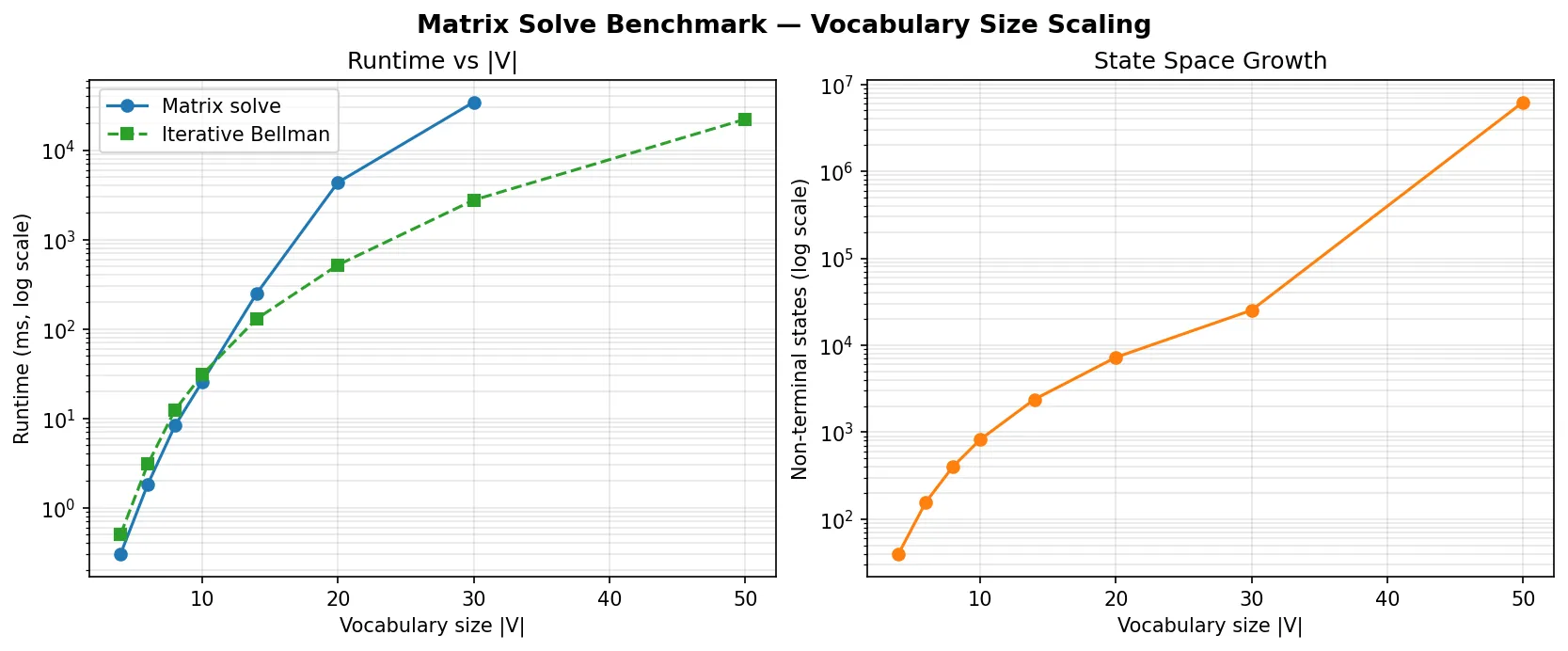
下面是两种已有实现的求解时间变化曲线
可以看到,由于稠密线性方程组的直接求解通常需要 O ( S 3 ) \mathcal{O}(S^3) O ( S 3 ) O ( S 2 ) \mathcal{O}(S^2) O ( S 2 ) S S S
由 V π V^{\pi} V π
V π ( s 0 ) = E π [ R ( τ ) ∣ s 0 ] V^{\pi}(s_0) = \mathbb{E}^{\pi}\left[R(\tau) \mid s_0\right] V π ( s 0 ) = E π [ R ( τ ) ∣ s 0 ] 由于 return 是一个随机变量,我们可以利用 Monte Carlo (MC) 方法得到一个 Unbiased Estimator ,即从 s 0 s_0 s 0 M M M
{ τ ( i ) = ( s 0 , a 0 ( i ) , r 0 ( i ) , … , a T ( i ) − 1 ( i ) , r T ( i ) − 1 ( i ) , s T ( i ) ( i ) ) } , i = 1 , … , M \{\tau^{(i)} = (s_0, a_0^{(i)}, r_0^{(i)}, \dots, a_{T^{(i)}-1}^{(i)}, r_{T^{(i)}-1}^{(i)}, s_{T^{(i)}}^{(i)})\}, \quad i = 1, \dots, M { τ ( i ) = ( s 0 , a 0 ( i ) , r 0 ( i ) , … , a T ( i ) − 1 ( i ) , r T ( i ) − 1 ( i ) , s T ( i ) ( i ) )} , i = 1 , … , M 然后我们使用样本平均 (sample mean) 来近似期望:
V π ( s 0 ) = E π [ R ( τ ) ∣ s 0 ] ≈ 1 M ∑ i = 1 M R ( τ ( i ) ) V^{\pi}(s_0) = \mathbb{E}^{\pi}[R(\tau) \mid s_0] \approx \frac{1}{M} \sum_{i=1}^{M} R(\tau^{(i)}) V π ( s 0 ) = E π [ R ( τ ) ∣ s 0 ] ≈ M 1 i = 1 ∑ M R ( τ ( i ) ) 对应的算法如下所示
Algorithm: Tabular Learning with MC Input : policy π \pi π γ \gamma γ M M M S \mathcal{S} S p 0 p_0 p 0
V ( s ) = 0 , R e t u r n S u m ( s ) = 0 , R e t u r n C o u n t ( s ) = 0 , s ∈ S V(s)=0, \mathrm{ReturnSum}(s)=0, \mathrm{ReturnCount}(s)=0, s\in\mathcal{S} V ( s ) = 0 , ReturnSum ( s ) = 0 , ReturnCount ( s ) = 0 , s ∈ S For e p i s o d e = 1 , 2 , … , M \mathrm{episode}=1,2,\dots,M episode = 1 , 2 , … , M
s ∼ p 0 s\sim p_0 s ∼ p 0 d o n e = f a l s e \mathrm{done}=\mathrm{false} done = false τ = [ ] \tau=[] τ = [ ] While not d o n e \mathrm{done} done
a ∼ π ( ⋅ ∣ s ) a\sim\pi(\cdot\mid s) a ∼ π ( ⋅ ∣ s ) ( s ′ , r , d o n e ) ← S T E P ( s , a ) (s', r, \mathrm{done}) \gets \mathrm{STEP}(s, a) ( s ′ , r , done ) ← STEP ( s , a ) τ . a p p e n d ( ( s , r ) ) \tau.\mathrm{append}((s,r)) τ . append (( s , r )) s ← s ′ s\gets s' s ← s ′
R e t u r n s = [ ] \mathrm{Returns}=[] Returns = [ ] G ← 0 G\gets0 G ← 0 For ( s , r ) (s,r) ( s , r ) r e v e r s e d ( τ ) \mathrm{reversed}(\tau) reversed ( τ )
G ← r + γ G G\gets r + \gamma G G ← r + γ G R e t u r n s . p r e p e n d ( ( s , G ) ) \mathrm{Returns}.\mathrm{prepend}((s,G)) Returns . prepend (( s , G ))
V i s i t e d = ∅ \mathrm{Visited}=\emptyset Visited = ∅ For ( s , G ) (s,G) ( s , G ) R e t u r n s \mathrm{Returns} Returns
If s ∉ V i s i t e d s\not\in \mathrm{Visited} s ∈ Visited
V i s i t e d . a d d ( s ) \mathrm{Visited}.\mathrm{add}(s) Visited . add ( s ) R e t u r n S u m ( s ) ← R e t u r n S u m ( s ) + G \mathrm{ReturnSum}(s) \gets \mathrm{ReturnSum}(s) +G ReturnSum ( s ) ← ReturnSum ( s ) + G R e t u r n C o u n t ( s ) ← R e t u r n C o u n t ( s ) + 1 \mathrm{ReturnCount}(s) \gets \mathrm{ReturnCount}(s)+ 1 ReturnCount ( s ) ← ReturnCount ( s ) + 1 V ( s ) ← R e t u r n S u m ( s ) / R e t u r n C o u n t ( s ) V(s)\gets \mathrm{ReturnSum}(s) / \mathrm{ReturnCount}(s) V ( s ) ← ReturnSum ( s ) / ReturnCount ( s )
return V V V
MC 的优点是 estimator 是一个 unbiased estimator, 其缺点在于我们必须完整采样完一条轨迹才能得到这个估计,对于 long-horizon task, MC 方法效率很低。
为了解决这个问题,我们可以使用 Temporal difference (TD) learning 方法。
Temporal difference (TD) learning 通过相邻两步的转换关系来近似 value function.
其核心思想在于
注意到:
V π ( s t ) = E π [ r t + γ V π ( s t + 1 ) ∣ S t = s t ] V^{\pi}(s_t) = \mathbb{E}^{\pi}[r_t + \gamma V^{\pi}(s_{t+1}) \mid S_t=s_t] V π ( s t ) = E π [ r t + γ V π ( s t + 1 ) ∣ S t = s t ] 我们首先定义 TD target 和 TD error 如下
Definition: TD target and TD error 给定当前 estimator V t V_t V t TD target 为
V ‾ t = { r t , if s t + 1 is terminal , r t + γ V t ( s t + 1 ) , otherwise . \overline{V}_t =
\begin{cases}
r_t,&\text{if }s_{t+1}\text{ is terminal},\\
r_t+\gamma V_t(s_{t+1}),&\text{otherwise}.
\end{cases} V t = { r t , r t + γ V t ( s t + 1 ) , if s t + 1 is terminal , otherwise . 定义 TD error 为
δ t = V ‾ t − V t ( s t ) . \delta_t = \overline{V}_t - V_t(s_t). δ t = V t − V t ( s t ) .
接下来,我们基于 TD error 更新 V t V_t V t
V t + 1 ( s ) = { V t ( s t ) + α t ( s t ) δ t , if s = s t , V t ( s ) , otherwise . V_{t+1}(s) = \begin{cases}
V_t(s_t) + \alpha_t(s_t)\delta_t,&\text{if }s=s_t,\\
V_t(s),&\text{otherwise}.
\end{cases} V t + 1 ( s ) = { V t ( s t ) + α t ( s t ) δ t , V t ( s ) , if s = s t , otherwise . 其中 α t ( s t ) ∈ ( 0 , 1 ) \alpha_t(s_t) \in (0, 1) α t ( s t ) ∈ ( 0 , 1 )
TD learning 对应的算法如下所示
Algorithm: Tabular Learning with TD Input : policy π \pi π γ \gamma γ α \alpha α M M M S \mathcal{S} S p 0 p_0 p 0
V ( s ) = 0 , s ∈ S V(s)=0, s\in\mathcal{S} V ( s ) = 0 , s ∈ S For e p i s o d e = 1 , 2 , … , M \mathrm{episode}=1,2,\dots,M episode = 1 , 2 , … , M
s ∼ p 0 s\sim p_0 s ∼ p 0 d o n e = f a l s e \mathrm{done}=\mathrm{false} done = false While not d o n e \mathrm{done} done
a ∼ π ( ⋅ ∣ s ) a\sim\pi(\cdot\mid s) a ∼ π ( ⋅ ∣ s ) ( s ′ , r , d o n e ) ← S T E P ( s , a ) (s', r, \mathrm{done}) \gets \mathrm{STEP}(s, a) ( s ′ , r , done ) ← STEP ( s , a ) If d o n e \mathrm{done} done Else
y ← r + γ ⋅ V ( s ′ ) y \gets r + \gamma \cdot V(s') y ← r + γ ⋅ V ( s ′ )
V ( s ) ← V ( s ) + α ⋅ ( y − V ( s ) ) V(s)\gets V(s) + \alpha\cdot(y-V(s)) V ( s ) ← V ( s ) + α ⋅ ( y − V ( s )) s ← s ′ s\gets s' s ← s ′
return V V V
一次 TD 更新可以写成
V t + 1 ( s t ) = ( 1 − α t ) V t ( s t ) + α t V ‾ t . V_{t+1}(s_t)=(1-\alpha_t)V_t(s_t)+\alpha_t\overline V_t. V t + 1 ( s t ) = ( 1 − α t ) V t ( s t ) + α t V t . 因此,当 0 < α t < 1 0<\alpha_t<1 0 < α t < 1 V ‾ t \overline V_t V t V t V_t V t 向当前 target 靠近不等于已经证明收敛 。
给定采样前的历史 F t \mathcal F_t F t V t V_t V t s t s_t s t
E [ δ t ∣ F t ] = ( T π V t ) ( s t ) − V t ( s t ) . \mathbb E[\delta_t\mid\mathcal F_t]
=(\mathcal T^\pi V_t)(s_t)-V_t(s_t). E [ δ t ∣ F t ] = ( T π V t ) ( s t ) − V t ( s t ) . 也就是说,TD error 的条件期望是当前估计的 Bellman residual。
当 V t = V π V_t=V^\pi V t = V π V π − V t V^\pi-V_t V π − V t
Theorem: Convergence of Tabular TD (discounted case) 对有限 MDP、固定策略 π \pi π 0 < γ < 1 0<\gamma<1 0 < γ < 1
∑ n = 1 ∞ α n ( s ) = ∞ , ∑ n = 1 ∞ α n ( s ) 2 < ∞ , \sum_{n=1}^{\infty}\alpha_n(s)=\infty,\qquad
\sum_{n=1}^{\infty}\alpha_n(s)^2<\infty, n = 1 ∑ ∞ α n ( s ) = ∞ , n = 1 ∑ ∞ α n ( s ) 2 < ∞ , 则标准 on-policy tabular TD(0) 的估计几乎必然收敛到 V π V^\pi V π
回到 ToyLLM:若所有 value 初始化为零,一次成功的 B A BA B A B B B V ( x , B ) V(x,B) V ( x , B ) V ( x , B ) V(x,B) V ( x , B )
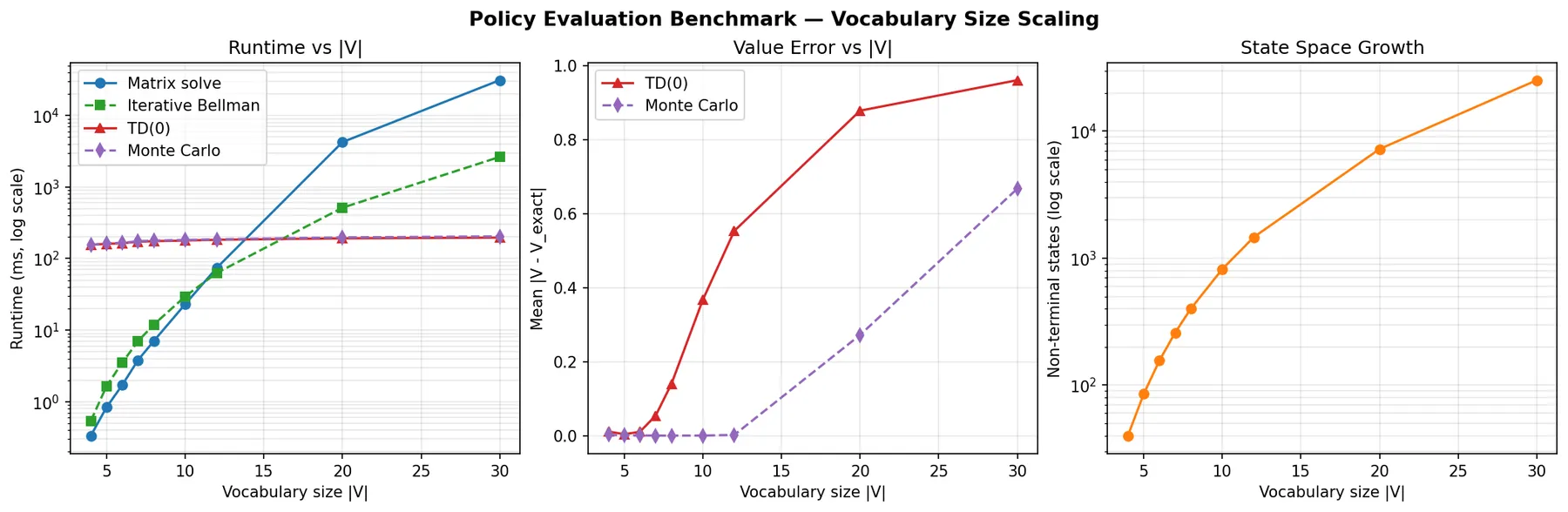
这里保留不同 vocab size 下 matrix solve、MC 和 TD 的已有实验图。
需要先区分代码中的两种环境配置:旧版 benchmark 使用成功 + 1 +1 + 1 − 1 -1 − 1 <EOS>;本章手算例子采用成功 1 1 1 0 0 0 γ = 1 \gamma=1 γ = 1 V π = 2 p s u c c e s s − 1 V^\pi=2p_{\mathrm{success}}-1 V π = 2 p success − 1 γ < 1 \gamma<1 γ < 1
代码中 scripts/benchmark.py 默认使用 max_len=4、gamma=0.9、uniform policy,并对重复运行取中位数。具体复现应保留命令参数,不能仅凭图片恢复所有实验配置。
对于 MC 和 TD, 我们将 episodes 设置为 10 , 000 10,000 10 , 000 0.1 0.1 0.1
可以看到,matrix exact/iterative solve 每次都需要枚举状态,而 MC/TD 的单条数据成本主要由
rollout 长度决定,因此我们可以在不枚举整个状态空间的情况下更新被访问的状态。
不过,固定 rollout budget 并不保证所有状态都得到充分访问,因此随着状态空间的增大,MC/TD 方法的误差也逐渐增高。
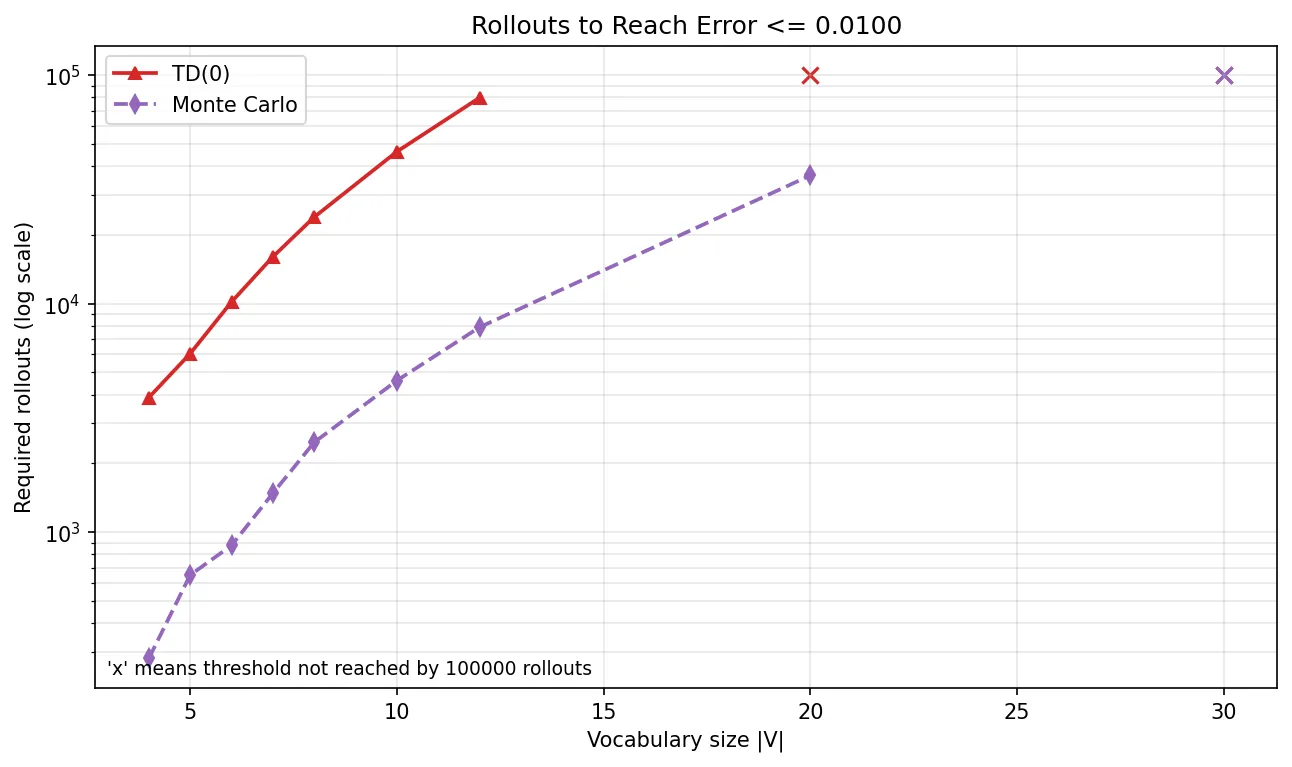
我们采样成功的概率为
p s u c c e s s = ∏ t = 0 m − 1 π ( a t ∗ ∣ a < t ∗ ) . p_{\mathrm{success}}=\prod_{t=0}^{m-1}\pi(a_t^*\mid a_{<t}^*). p success = t = 0 ∏ m − 1 π ( a t ∗ ∣ a < t ∗ ) . 如果 policy 接近均匀分布,该概率大致按 ∣ V ∣ − m |\mathcal V|^{-m} ∣ V ∣ − m 100 , 000 100,000 100 , 000 0.01 0.01 0.01
可以看到,在这组 terminal +1/-1 reward、固定超参数和误差指标下,MC 比 TD 更快达到目标误差。
图中的叉号表示在预算内未达到误差阈值:TD 在词表大小为 20 和 30 时未达标,MC 在 30 时未达标。稀疏成功轨迹是可能的瓶颈,但仅凭该图不能确定具体原因。
解释这类实验时,需要同时报告 horizon、固定策略、value 初始化、误差在哪些状态上计算,以及多个随机种子的结果。
在本章的 0/1 reward 版本中,大量失败 prefix 的真实 value 为零,因此不能仅由全状态平均误差很小推断成功路径已经被学会。旧图使用 +1/-1 reward,未访问状态的零初始化也可能与真实的负 value 有较大误差;两种配置需要分别解释。
将全状态误差与初始状态误差、成功路径上的误差分别报告,会更容易区分覆盖不足和估计不准。
这里需要区分两个问题:
tabular learning 方法不能在相似 prefix 之间共享信息
稀疏 verifier reward 导致有效样本极少。
函数逼近主要缓解前一个问题;后一个问题还需要更好的 exploration, reward shaping 或更强的初始 policy.
上面我们介绍了 MC 和 TD 两种 value function 估计方法,但是当动作空间和状态空间特别大时,tabular learning 仍然存在扩展性问题。
为了解决这个扩展性不足的问题,当状态空间 S \mathcal{S} S V π V^{\pi} V π
这里我们使用 V ϕ : S → R V_{\phi}:\mathcal{S}\to\mathbb{R} V ϕ : S → R V π V^{\pi} V π ϕ \phi ϕ d π d^\pi d π
d π ( s ) = E τ ∼ π [ ∑ t = 0 T ( τ ) − 1 1 { s t = s } ] E τ ∼ π [ T ( τ ) ] . d^\pi(s)=\frac{\mathbb E_{\tau\sim\pi}[\sum_{t=0}^{T(\tau)-1}\mathbf 1\{s_t=s\}]}{\mathbb E_{\tau\sim\pi}[T(\tau)]}. d π ( s ) = E τ ∼ π [ T ( τ )] E τ ∼ π [ ∑ t = 0 T ( τ ) − 1 1 { s t = s }] . 它对应按 transition 加权,而不是每条 episode 权重相同。
我们使用 mean squared value error:
L ( ϕ ) = E s ∼ d π [ 1 2 ( V ϕ ( s ) − V π ( s ) ) 2 ] . \mathcal{L}(\phi) = \mathbb{E}_{s \sim d^\pi}\left[\frac{1}{2}\left(V_{\phi}(s) - V^{\pi}(s)\right)^2\right]. L ( ϕ ) = E s ∼ d π [ 2 1 ( V ϕ ( s ) − V π ( s ) ) 2 ] . V π ( s ) V^\pi(s) V π ( s ) V π ( s ) = E π [ G ∣ S = s ] V^\pi(s)=\mathbb E^\pi[G\mid S=s] V π ( s ) = E π [ G ∣ S = s ]
∇ ϕ L ( ϕ ) = E s ∼ d π [ ( V ϕ ( s ) − V π ( s ) ) ∇ ϕ V ϕ ( s ) ] = E s ∼ d π , G ∼ π ( ⋅ ∣ s ) [ ( V ϕ ( s ) − G ) ∇ ϕ V ϕ ( s ) ] . \begin{aligned}
\nabla_{\phi} \mathcal{L}(\phi)
&= \mathbb{E}_{s \sim d^\pi}
\left[\left(V_{\phi}(s)-V^\pi(s)\right)\nabla_{\phi}V_{\phi}(s)\right]\\
&= \mathbb{E}_{s \sim d^\pi,\,G\sim\pi(\cdot\mid s)}
\left[\left(V_{\phi}(s)-G\right)\nabla_{\phi}V_{\phi}(s)\right].
\end{aligned} ∇ ϕ L ( ϕ ) = E s ∼ d π [ ( V ϕ ( s ) − V π ( s ) ) ∇ ϕ V ϕ ( s ) ] = E s ∼ d π , G ∼ π ( ⋅ ∣ s ) [ ( V ϕ ( s ) − G ) ∇ ϕ V ϕ ( s ) ] . 现在我们可以使用 MC 方法来估计梯度:
∇ ϕ L ( ϕ ) ≈ g : = 1 M ∑ i = 1 M ( V ϕ ( s ( i ) ) − G ( i ) ) ∇ ϕ V ϕ ( s ( i ) ) . \nabla_{\phi} \mathcal{L}(\phi) \approx g
:= \frac{1}{M}\sum_{i=1}^{M}
\left(V_{\phi}(s^{(i)})-G^{(i)}\right)\nabla_{\phi}V_{\phi}(s^{(i)}). ∇ ϕ L ( ϕ ) ≈ g := M 1 i = 1 ∑ M ( V ϕ ( s ( i ) ) − G ( i ) ) ∇ ϕ V ϕ ( s ( i ) ) . 结合 MC 和 SGD 的算法如下:
Algorithm: Value function approximation with MC While not converged:
从固定策略的状态访问分布采样非终止状态 s ∼ d π s\sim d^\pi s ∼ d π
从这个状态开始,固定 π \pi π
计算该 continuation 的 discounted return G G G
g ← ( V ϕ ( s ) − G ) ∇ ϕ V ϕ ( s ) g\gets(V_\phi(s)-G)\nabla_\phi V_\phi(s) g ← ( V ϕ ( s ) − G ) ∇ ϕ V ϕ ( s ) 使用 g g g ϕ \phi ϕ
上面将“选训练状态”和“从该状态采样 return”分开,以明确条件期望。
实际训练也可以像 tabular MC 一样复用完整 rollout 的每个 prefix,并把各自的 G t G_t G t
如果能够访问真实的 V π ( s ′ ) V^\pi(s') V π ( s ′ )
L ( ϕ ) = E s ∼ d π π [ 1 2 ( V ϕ ( s ) − ( r + γ V π ( s ′ ) ) ) 2 ] . \mathcal{L}(\phi) = \mathbb{E}_{s \sim d^\pi}^\pi
\left[\frac{1}{2}\left(V_{\phi}(s)-\left(\textcolor{red}{r+\gamma V^{\pi}(s')}\right)\right)^2\right]. L ( ϕ ) = E s ∼ d π π [ 2 1 ( V ϕ ( s ) − ( r + γ V π ( s ′ ) ) ) 2 ] . 对应的梯度为:
∇ ϕ L ( ϕ ) = E s ∼ d π π [ ( V ϕ ( s ) − r − γ V π ( s ′ ) ) ∇ ϕ V ϕ ( s ) ] . \nabla_{\phi} \mathcal{L}(\phi)
=\mathbb{E}_{s \sim d^\pi}^{\pi}
\left[\left(V_{\phi}(s)-r-\gamma \textcolor{red}{V^{\pi}(s')}\right)
\nabla_{\phi}V_{\phi}(s)\right]. ∇ ϕ L ( ϕ ) = E s ∼ d π π [ ( V ϕ ( s ) − r − γ V π ( s ′ ) ) ∇ ϕ V ϕ ( s ) ] . 这里梯度包含了一个未知量 V π ( s ′ ) V^{\pi}(s') V π ( s ′ ) V ϕ ( s ′ ) V_{\phi}(s') V ϕ ( s ′ )
g : = E s ∼ d π π [ ( V ϕ ( s ) − r − γ V ϕ ( s ′ ) ) ∇ ϕ V ϕ ( s ) ] . g:=\mathbb{E}_{s \sim d^\pi}^{\pi}
\left[\left(V_{\phi}(s)-r-\gamma V_{\phi}(s')\right)
\nabla_{\phi}V_{\phi}(s)\right]. g := E s ∼ d π π [ ( V ϕ ( s ) − r − γ V ϕ ( s ′ ) ) ∇ ϕ V ϕ ( s ) ] . 这里的 g g g
pred = V_phi(s0)
target = r + gamma * V_phi(s1)
td_error = pred - target
loss = 0.5 * td_error ** 2
loss.backward()
可以看到,我们实际上求的梯度是:
∇ ϕ [ 1 2 ( V ϕ ( s ) − ( r + γ V ϕ ( s ′ ) ) ) 2 ] = ( V ϕ ( s ) − ( r + γ V ϕ ( s ′ ) ) ) ( ∇ ϕ V ϕ ( s ) − γ ∇ ϕ V ϕ ( s ′ ) ) ≠ g \begin{aligned}
&\nabla_{\phi}\left[\frac{1}{2}\left(V_{\phi}(s) - (r + \gamma V_{\phi}(s'))\right)^2\right] \\
&= (V_{\phi}(s) - (r + \gamma V_{\phi}(s')))
(\nabla_{\phi} V_{\phi}(s) - \gamma\nabla_{\phi} V_{\phi}(s'))\\
&\neq g
\end{aligned} ∇ ϕ [ 2 1 ( V ϕ ( s ) − ( r + γ V ϕ ( s ′ )) ) 2 ] = ( V ϕ ( s ) − ( r + γ V ϕ ( s ′ ))) ( ∇ ϕ V ϕ ( s ) − γ ∇ ϕ V ϕ ( s ′ )) = g 为了解决这个问题,我们可以使用 stop-gradient 技巧来避免 V ϕ ( s ′ ) V_{\phi}(s') V ϕ ( s ′ )
L ( ϕ ) = 1 2 ( V ϕ ( s ) − ( r + γ s g [ V ϕ ( s ′ ) ] ) ) 2 \mathcal{L}(\phi)=\frac{1}{2}\left(V_{\phi}(s) - (r + \gamma \, \mathrm{sg}[V_{\phi}(s')])\right)^2 L ( ϕ ) = 2 1 ( V ϕ ( s ) − ( r + γ sg [ V ϕ ( s ′ )]) ) 2 其中 s g [ ⋅ ] \mathrm{sg}[\cdot] sg [ ⋅ ]
s g [ x ] = x (forward) , ∂ s g [ x ] ∂ x = 0 (autograd) \mathrm{sg}[x]=x\quad\text{(forward)},\qquad
\frac{\partial\,\mathrm{sg}[x]}{\partial x}=0\quad\text{(autograd)} sg [ x ] = x (forward) , ∂ x ∂ sg [ x ] = 0 (autograd) 对应的梯度就是:
∇ ϕ [ 1 2 ( V ϕ ( s ) − ( r + γ s g [ V ϕ ( s ′ ) ] ) ) 2 ] = ( V ϕ ( s ) − ( r + γ V ϕ ( s ′ ) ) ) ∇ ϕ V ϕ ( s ) = g \nabla_{\phi}\left[\frac{1}{2}\left(V_{\phi}(s) - (r + \gamma \, \mathrm{sg}[V_{\phi}(s')])\right)^2\right] = (V_{\phi}(s) - (r + \gamma V_{\phi}(s')))\nabla_{\phi} V_{\phi}(s) = g ∇ ϕ [ 2 1 ( V ϕ ( s ) − ( r + γ sg [ V ϕ ( s ′ )]) ) 2 ] = ( V ϕ ( s ) − ( r + γ V ϕ ( s ′ ))) ∇ ϕ V ϕ ( s ) = g 对应的 Python 代码为:
# Single transition; terminal targets do not bootstrap.
pred = V_phi(s0)
with torch.no_grad():
    target = r if terminated else r + gamma * V_phi(s1)
loss = 0.5 * (pred - target).square()
loss.backward()
最终,正确的 TD 算法如下:
Algorithm: Value function approximation with TD While not converged:
从固定策略的 rollout 中采样非终止起点 s 0 ∼ d π s_0\sim d^\pi s 0 ∼ d π a 0 ∼ π ( ⋅ ∣ s 0 ) a_0\sim\pi(\cdot\mid s_0) a 0 ∼ π ( ⋅ ∣ s 0 ) ( r 0 , s 1 ) ∼ p ( ⋅ , ⋅ ∣ s 0 , a 0 ) (r_0,s_1)\sim p(\cdot,\cdot\mid s_0,a_0) ( r 0 , s 1 ) ∼ p ( ⋅ , ⋅ ∣ s 0 , a 0 )
compute TD target
y = { r 0 + γ s g [ V ϕ ( s 1 ) ] , if s 1 ≠ ⟨ term ⟩ r 0 , otherwise y = \begin{cases}
r_0 + \gamma \, \mathrm{sg}[V_{\phi}(s_1)], & \text{if } s_1 \neq \langle\text{term}\rangle \\
r_0, & \text{otherwise}
\end{cases} y = { r 0 + γ sg [ V ϕ ( s 1 )] , r 0 , if s 1 = ⟨ term ⟩ otherwise
g = ( V ϕ ( s 0 ) − y ) ∇ ϕ V ϕ ( s 0 ) g = (V_{\phi}(s_0) - y) \nabla_{\phi} V_{\phi}(s_0) g = ( V ϕ ( s 0 ) − y ) ∇ ϕ V ϕ ( s 0 ) Update ϕ \phi ϕ g g g
实际上,我们可以进一步推广 TD 到多步场景,注意到:
V π ( s 0 ) = E π [ r 0 + γ V π ( s 1 ) ∣ s 0 ] = E π [ r 0 + γ E π [ r 1 + γ V π ( s 2 ) ∣ s 1 ] ∣ s 0 ] = E π [ r 0 + γ r 1 + γ 2 V π ( s 2 ) ∣ s 0 ] . \begin{aligned}
V^{\pi}(s_0) &= \mathbb{E}^{\pi}[r_0 + \gamma V^{\pi}(s_1) \mid s_0] \\
&= \mathbb{E}^{\pi}[r_0 + \gamma \mathbb{E}^{\pi}[r_1 + \gamma V^{\pi}(s_2) \mid s_1] \mid s_0] \\
&= \mathbb{E}^{\pi}[r_0 + \gamma r_1 + \gamma^2 V^{\pi}(s_2) \mid s_0].
\end{aligned} V π ( s 0 ) = E π [ r 0 + γ V π ( s 1 ) ∣ s 0 ] = E π [ r 0 + γ E π [ r 1 + γ V π ( s 2 ) ∣ s 1 ] ∣ s 0 ] = E π [ r 0 + γ r 1 + γ 2 V π ( s 2 ) ∣ s 0 ] . 因此:
V π ( s 0 ) = E π [ r 0 + γ r 1 + γ 2 V π ( s 2 ) ∣ s 0 ] V^{\pi}(s_0) = \mathbb{E}^{\pi}[r_0 + \gamma r_1 + \gamma^2 V^{\pi}(s_2) \mid s_0] V π ( s 0 ) = E π [ r 0 + γ r 1 + γ 2 V π ( s 2 ) ∣ s 0 ] 重复这个过程 k k k k k k
V π ( s 0 ) = E π [ ∑ i = 0 k − 1 γ i r i + γ k V π ( s k ) ∣ s 0 ] V^{\pi}(s_0) = \mathbb{E}^{\pi}\left[\sum_{i=0}^{k-1} \gamma^i r_i + \gamma^k V^{\pi}(s_k) \mid s_0\right] V π ( s 0 ) = E π [ i = 0 ∑ k − 1 γ i r i + γ k V π ( s k ) ∣ s 0 ] 基于 k-step transition ,我们可以构建对应的目标函数并应用 stop-gradient:
Algorithm: Value function approximation with k-step TD while not converged:
从固定策略的 rollout 中采样非终止起点 s 0 ∼ d π s_0\sim d^\pi s 0 ∼ d π t = 0 t=0 t = 0
for t = 0 , … , k − 1 t = 0, \ldots, k-1 t = 0 , … , k − 1
a t ∼ π ( ⋅ ∣ s t ) a_t \sim \pi(\cdot \mid s_t) a t ∼ π ( ⋅ ∣ s t ) ( r t , s t + 1 ) ∼ p ( ⋅ , ⋅ ∣ s t , a t ) (r_t, s_{t+1}) \sim p(\cdot, \cdot \mid s_t, a_t) ( r t , s t + 1 ) ∼ p ( ⋅ , ⋅ ∣ s t , a t )
Let n ≤ k n\leq k n ≤ k y = { ∑ t = 0 n − 1 γ t r t + γ n s g [ V ϕ ( s n ) ] , if s n ≠ ⟨ term ⟩ , ∑ t = 0 n − 1 γ t r t , otherwise . y = \begin{cases}
\sum_{t=0}^{n-1} \gamma^t r_t + \gamma^n \, \mathrm{sg}[V_{\phi}(s_n)], & \text{if } s_n \neq \langle\text{term}\rangle, \\
\sum_{t=0}^{n-1} \gamma^t r_t, & \text{otherwise}.
\end{cases} y = { ∑ t = 0 n − 1 γ t r t + γ n sg [ V ϕ ( s n )] , ∑ t = 0 n − 1 γ t r t , if s n = ⟨ term ⟩ , otherwise .
g ← ( V ϕ ( s 0 ) − y ) ∇ ϕ V ϕ ( s 0 ) g \gets (V_{\phi}(s_0) - y) \nabla_{\phi} V_{\phi}(s_0) g ← ( V ϕ ( s 0 ) − y ) ∇ ϕ V ϕ ( s 0 ) Update ϕ \phi ϕ g g g
Q π ( s , a ) Q^\pi(s,a) Q π ( s , a ) V π ( s ) V^\pi(s) V π ( s ) π \pi π s t s_t s t ( s t , a t ) (s_t,a_t) ( s t , a t ) G t G_t G t
y t Q = { r t , s t + 1 is terminal , r t + γ s g [ Q ϕ ( s t + 1 , a t + 1 ) ] , a t + 1 ∼ π ( ⋅ ∣ s t + 1 ) , otherwise . y_t^Q=\begin{cases}
r_t,&s_{t+1}\text{ is terminal},\\
r_t+\gamma\,\mathrm{sg}[Q_\phi(s_{t+1},a_{t+1})],
\quad a_{t+1}\sim\pi(\cdot\mid s_{t+1}),&\text{otherwise}.
\end{cases} y t Q = { r t , r t + γ sg [ Q ϕ ( s t + 1 , a t + 1 )] , a t + 1 ∼ π ( ⋅ ∣ s t + 1 ) , s t + 1 is terminal , otherwise . 采用相同的 semi-gradient 更新:
ϕ ← ϕ − α ( Q ϕ ( s t , a t ) − y t Q ) ∇ ϕ Q ϕ ( s t , a t ) . \phi\gets\phi-\alpha\bigl(Q_\phi(s_t,a_t)-y_t^Q\bigr)\nabla_\phi Q_\phi(s_t,a_t). ϕ ← ϕ − α ( Q ϕ ( s t , a t ) − y t Q ) ∇ ϕ Q ϕ ( s t , a t ) . 也可以将采样的 Q ϕ ( s t + 1 , a t + 1 ) Q_\phi(s_{t+1},a_{t+1}) Q ϕ ( s t + 1 , a t + 1 ) ∑ a ′ π ( a ′ ∣ s t + 1 ) Q ϕ ( s t + 1 , a ′ ) \sum_{a'}\pi(a'\mid s_{t+1})Q_\phi(s_{t+1},a') ∑ a ′ π ( a ′ ∣ s t + 1 ) Q ϕ ( s t + 1 , a ′ ) k k k
这里下一动作来自固定 π \pi π arg max a ′ Q ϕ ( s ′ , a ′ ) \arg\max_{a'}Q_\phi(s',a') arg max a ′ Q ϕ ( s ′ , a ′ )
MC 必须等待 episode 结束,然后用真实 return 监督每个已访问状态。
对固定状态而言,sample return 是 V π V^\pi V π
TD 使用 V ϕ ( s t + 1 ) V_\phi(s_{t+1}) V ϕ ( s t + 1 ) V π V^\pi V π
k-step TD 在两者之间插值:
TD(0) ← k = 1 k-step TD → k ≥ T − t MC . \text{TD(0)}
\xleftarrow{\quad k=1\quad}
\text{k-step TD}
\xrightarrow{\quad k\geq T-t\quad}
\text{MC}. TD(0) k = 1 k-step TD k ≥ T − t MC . 配套代码位于 ToyLLM 项目 。在仓库根目录运行:
uv sync
uv run python scripts/run_tutorial_control.py --episodes 10000 --seeds 5 --output outputs/tutorial_control.json
脚本显式使用 failure_reward=0.0, strip_eos=True,其中代码的 <BOS> 对应本文的固定 prompt 初始状态 x x x <EOS> 对应数学记号中的终止 token。
hand_example 同时报告 backward evaluation 与 matrix solve 的精确值;两者都应得到初始 value 0.15 0.15 0.15 evaluation 部分按 seed 报告 MC/TD 的初始状态估计、初始状态绝对误差和全状态 MAE,整个过程中固定策略的动作概率不变。
TD 使用常数步长 0.1 0.1 0.1
现有 make_bow_feature_extractor 可用于线性函数逼近实验,但 bag-of-tokens 不保留顺序:例如 prefix A B 和 B A 会有相同表示。
在更长的 exact-match 任务中,它们可能有不同的真实 value,因此该表示可能无法拟合所有状态。函数逼近提供共享能力,也会引入表示误差。
Policy evaluation 始终固定 π \pi π V π V^\pi V π Q π Q^\pi Q π
完整模型允许精确求解,MC/TD 则用 rollout 替代对整个环境的枚举。
MC 使用完整 return;TD 使用 bootstrap;k-step TD 在等待奖励和依赖估计之间提供选择。
Function approximation 可以让不同 prefix 共享表示,但不保证自动解决稀疏奖励或状态覆盖问题。
当 γ = 1 \gamma=1 γ = 1 V π V^\pi V π
回到本章开头,我们现在可以估计出 V π ( x ) = 0.15 V^\pi(x)=0.15 V π ( x ) = 0.15 Q π ( x , B ) = 0.5 Q^\pi(x,B)=0.5 Q π ( x , B ) = 0.5 0.6 0.6 0.6 A A A 既然已经知道动作的好坏,怎样利用这些价值改进策略?
上一章的 Policy Evaluation 固定策略 π \pi π V π V^\pi V π Q π Q^\pi Q π control :如何利用价值估计,得到更好的策略?
Evaluation 回答“按当前策略行动,未来能得到多少奖励”;control 则进一步问“知道各个动作的价值后,应该怎样改变行动规则”。
Value-based methods 根据 value/Q-function 选择动作,由价值估计间接决定策略。
本章不再重复 MC、TD 和函数逼近的推导,而是沿着四个问题展开:
已经知道 Q π Q^\pi Q π π \pi π
每次改进前,必须把价值完全算准确吗?——value iteration。
只有采样数据、没有完整模型时,如何改进策略?——SARSA 与 Q-learning。
Q-table 太大时,如何训练神经网络来做 control?——DQN。
固定策略的价值满足
V π ( s ) = ∑ a π ( a ∣ s ) Q π ( s , a ) . V^\pi(s)=\sum_a\pi(a\mid s)Q^\pi(s,a). V π ( s ) = a ∑ π ( a ∣ s ) Q π ( s , a ) . 这个平均值不超过最好的动作价值。因此,一个自然的改进是让新策略选择当前 Q π Q^\pi Q π
π n e w ( s ) ∈ arg max a Q π ( s , a ) , Q π ( s , π n e w ( s ) ) ≥ V π ( s ) . \pi_{\mathrm{new}}(s)\in\arg\max_a Q^\pi(s,a),\qquad
Q^\pi(s,\pi_{\mathrm{new}}(s))\geq V^\pi(s). π new ( s ) ∈ arg a max Q π ( s , a ) , Q π ( s , π new ( s )) ≥ V π ( s ) . 这里有一个需要解释的跳跃:Q π Q^\pi Q π π \pi π
Theorem: Policy Improvement 在有限状态、有限动作、有界奖励且 0 < γ < 1 0<\gamma<1 0 < γ < 1 π ′ \pi' π ′
∑ a π ′ ( a ∣ s ) Q π ( s , a ) ≥ V π ( s ) , \sum_a\pi'(a\mid s)Q^\pi(s,a)\geq V^\pi(s), a ∑ π ′ ( a ∣ s ) Q π ( s , a ) ≥ V π ( s ) , 则 V π ′ ( s ) ≥ V π ( s ) V^{\pi'}(s)\geq V^\pi(s) V π ′ ( s ) ≥ V π ( s ) Q π Q^\pi Q π
Proof: Repeated improvement of the continuation 由条件可得 T π ′ V π ≥ V π \mathcal T^{\pi'}V^\pi\geq V^\pi T π ′ V π ≥ V π
V π ≤ T π ′ V π ≤ ( T π ′ ) 2 V π ≤ ⋯ ⟶ V π ′ . V^\pi\leq\mathcal T^{\pi'}V^\pi
\leq(\mathcal T^{\pi'})^2V^\pi
\leq\cdots\longrightarrow V^{\pi'}. V π ≤ T π ′ V π ≤ ( T π ′ ) 2 V π ≤ ⋯ ⟶ V π ′ . 最后一步使用固定策略 Bellman operator 的 contraction 性质。
因此,把未来更多步骤替换成 π ′ \pi' π ′ γ = 1 \gamma=1 γ = 1
继续使用上一章的两步 ToyLLM:target 为 B A BA B A γ = 1 \gamma=1 γ = 1 B B B 0.3 0.3 0.3 B B B A A A 0.5 0.5 0.5
V π ( x ) = 0.15 , Q π ( x , B ) = 0.5 , Q π ( x , A ) = Q π ( x , ⟨ e o s ⟩ ) = 0. V^\pi(x)=0.15,\qquad Q^\pi(x,B)=0.5,
\qquad Q^\pi(x,A)=Q^\pi(x,\langle\mathrm{eos}\rangle)=0. V π ( x ) = 0.15 , Q π ( x , B ) = 0.5 , Q π ( x , A ) = Q π ( x , ⟨ eos ⟩) = 0. 如果只把第一个动作改成必选 B B B 0.15 0.15 0.15 0.5 0.5 0.5 Q π Q^\pi Q π B B B A A A B A BA B A
V π n e w ( x ) = 1. V^{\pi_{\mathrm{new}}}(x)=1. V π new ( x ) = 1. 这个例子区分了三个量:旧策略的 value 为 0.15 0.15 0.15 0.5 0.5 0.5 1 1 1
改进策略后,旧的 Q π Q^\pi Q π
π k → evaluation V π k , Q π k → improvement π k + 1 . \pi_k\xrightarrow{\text{evaluation}}V^{\pi_k},Q^{\pi_k}
\xrightarrow{\text{improvement}}\pi_{k+1}. π k evaluation V π k , Q π k improvement π k + 1 . Algorithm: Exact Policy Iteration
Initialize a deterministic policy π 0 \pi_0 π 0
For k = 0 , 1 , … k=0,1,\ldots k = 0 , 1 , …
Evaluation : compute V π k V^{\pi_k} V π k Q π k ( s , a ) = E [ r + γ V π k ( s ′ ) ∣ s , a ] . Q^{\pi_k}(s,a)=\mathbb E[r+\gamma V^{\pi_k}(s')\mid s,a]. Q π k ( s , a ) = E [ r + γ V π k ( s ′ ) ∣ s , a ] . Improvement : for every non-terminal state,
π k + 1 ( s ) ∈ arg max a Q π k ( s , a ) . \pi_{k+1}(s)\in\arg\max_a Q^{\pi_k}(s,a). π k + 1 ( s ) ∈ arg a max Q π k ( s , a ) . Stop if π k + 1 = π k \pi_{k+1}=\pi_k π k + 1 = π k
Return π k \pi_k π k
在上述 finite discounted MDP 条件下,policy improvement 保证 value 单调不降。
若策略尚未最优,至少一个状态的 value 严格提高;deterministic policies 的数量有限,因此精确 policy iteration 在有限次改进后到达最优策略。
停止时 V π k = T ∗ V π k V^{\pi_k}=\mathcal T^*V^{\pi_k} V π k = T ∗ V π k
这一保证依赖精确 evaluation。用有限样本或 neural network 得到的 Q ^ \hat Q Q ^
Policy iteration 每轮都要完成一次 evaluation,代价可能很大。
能不能只做少量 backup,就立即改进动作选择?
先比较两个更新:
( T π V k ) ( s ) = ∑ a π ( a ∣ s ) E [ r + γ V k ( s ′ ) ∣ s , a ] , ( T ∗ V k ) ( s ) = max a E [ r + γ V k ( s ′ ) ∣ s , a ] . \begin{aligned}
(\mathcal T^\pi V_k)(s)
&=\sum_a\pi(a\mid s)\mathbb E[r+\gamma V_k(s')\mid s,a],\\
(\mathcal T^*V_k)(s)
&=\max_a\mathbb E[r+\gamma V_k(s')\mid s,a].
\end{aligned} ( T π V k ) ( s ) ( T ∗ V k ) ( s ) = a ∑ π ( a ∣ s ) E [ r + γ V k ( s ′ ) ∣ s , a ] , = a max E [ r + γ V k ( s ′ ) ∣ s , a ] . 第一行对动作按固定策略取平均,目标是 V π V^\pi V π V ∗ V^* V ∗ V k + 1 = T ∗ V k V_{k+1}=\mathcal T^*V_k V k + 1 = T ∗ V k value iteration 。
这可以理解为把 evaluation 和 improvement 紧密交替进行;中间的 V k V_k V k
Algorithm: Value Iteration with a Known Model
Initialize V 0 ( s ) V_0(s) V 0 ( s )
For k = 0 , 1 , … k=0,1,\ldots k = 0 , 1 , …
For every non-terminal state, compute a synchronous backup:
V k + 1 ( s ) = max a E [ r + γ V k ( s ′ ) ∣ s , a ] . V_{k+1}(s)=\max_a\mathbb E[r+\gamma V_k(s')\mid s,a]. V k + 1 ( s ) = a max E [ r + γ V k ( s ′ ) ∣ s , a ] .
Stop when ∥ V k + 1 − V k ∥ ∞ \|V_{k+1}-V_k\|_\infty ∥ V k + 1 − V k ∥ ∞
Extract a greedy policy using the final value estimate:
π ^ ( s ) ∈ arg max a E [ r + γ V k + 1 ( s ′ ) ∣ s , a ] . \hat\pi(s)\in\arg\max_a\mathbb E[r+\gamma V_{k+1}(s')\mid s,a]. π ^ ( s ) ∈ arg a max E [ r + γ V k + 1 ( s ′ ) ∣ s , a ] .
由 Bellman Optimality Equation ,0 < γ < 1 0<\gamma<1 0 < γ < 1
∥ V k + 1 − V ∗ ∥ ∞ ≤ γ ∥ V k − V ∗ ∥ ∞ , \|V_{k+1}-V^*\|_\infty\leq\gamma\|V_k-V^*\|_\infty, ∥ V k + 1 − V ∗ ∥ ∞ ≤ γ ∥ V k − V ∗ ∥ ∞ , 因此迭代收敛到 V ∗ V^* V ∗ B B B γ = 1 \gamma=1 γ = 1
同样可以直接迭代 Q-function:
Q k + 1 ( s , a ) = E [ r + γ max a ′ Q k ( s ′ , a ′ ) ∣ s , a ] , Q_{k+1}(s,a)=\mathbb E\left[r+\gamma\max_{a'}Q_k(s',a')\mid s,a\right], Q k + 1 ( s , a ) = E [ r + γ a ′ max Q k ( s ′ , a ′ ) ∣ s , a ] , 其中 terminal 的 bootstrap 项为零。
这个形式已经非常接近 Q-learning;剩下的问题是如何用样本替代对环境的期望。
完整模型通常不可用,但我们可以执行动作,收集 ( s , a , r , s ′ , d ) (s,a,r,s',d) ( s , a , r , s ′ , d ) d d d
Q ( s , a ) ← Q ( s , a ) + α ( y − Q ( s , a ) ) . Q(s,a)\gets Q(s,a)+\alpha\bigl(y-Q(s,a)\bigr). Q ( s , a ) ← Q ( s , a ) + α ( y − Q ( s , a ) ) . 新增的问题是:target y y y
此外,若总选择当前估计最大的动作,未尝试的好动作可能永远无法被发现。
一种简单的 behavior policy 是 ϵ \epsilon ϵ 1 − ϵ 1-\epsilon 1 − ϵ ϵ \epsilon ϵ
SARSA 从当前 behavior policy 采样下一动作 a ′ a' a ′
y S A R S A = { r , d = 1 , r + γ Q ( s ′ , a ′ ) , a ′ ∼ π k ( ⋅ ∣ s ′ ) , d = 0. y_{\mathrm{SARSA}}=\begin{cases}
r,&d=1,\\
r+\gamma Q(s',a'),\quad a'\sim\pi_k(\cdot\mid s'),&d=0.
\end{cases} y SARSA = { r , r + γ Q ( s ′ , a ′ ) , a ′ ∼ π k ( ⋅ ∣ s ′ ) , d = 1 , d = 0. 如果 π k \pi_k π k ϵ \epsilon ϵ on-policy 的,因为 target 使用的下一动作正是数据采集策略选出的动作。
Algorithm: SARSA Control
Initialize Q-table and exploration schedule ϵ k \epsilon_k ϵ k
For each episode :
Sample s ∼ p 0 s\sim p_0 s ∼ p 0 a ∼ ϵ k -greedy ( Q ( s , ⋅ ) ) a\sim\epsilon_k\text{-greedy}(Q(s,\cdot)) a ∼ ϵ k -greedy ( Q ( s , ⋅ ))
Repeat :
Execute a a a ( r , s ′ , d ) (r,s',d) ( r , s ′ , d )
If terminal, set y = r y=r y = r a ′ ∼ ϵ k -greedy ( Q ( s ′ , ⋅ ) ) a'\sim\epsilon_k\text{-greedy}(Q(s',\cdot)) a ′ ∼ ϵ k -greedy ( Q ( s ′ , ⋅ )) y = r + γ Q ( s ′ , a ′ ) y=r+\gamma Q(s',a') y = r + γ Q ( s ′ , a ′ )
Update Q ( s , a ) ← Q ( s , a ) + α ( y − Q ( s , a ) ) Q(s,a)\gets Q(s,a)+\alpha(y-Q(s,a)) Q ( s , a ) ← Q ( s , a ) + α ( y − Q ( s , a ))
If terminal, end the episode; otherwise set ( s , a ) ← ( s ′ , a ′ ) (s,a)\gets(s',a') ( s , a ) ← ( s ′ , a ′ )
算法名称来自更新所用的五元组 ( S , A , R , S ′ , A ′ ) (S,A,R,S',A') ( S , A , R , S ′ , A ′ ) ϵ \epsilon ϵ ϵ \epsilon ϵ
另一种选择是:采集数据时继续探索,但 target 假设下一步选当前估计中价值最大的动作:
y Q = { r , d = 1 , r + γ max a ′ Q ( s ′ , a ′ ) , d = 0. y_{\mathrm{Q}}=\begin{cases}
r,&d=1,\\
r+\gamma\max_{a'}Q(s',a'),&d=0.
\end{cases} y Q = { r , r + γ max a ′ Q ( s ′ , a ′ ) , d = 1 , d = 0. 这就是 Q-learning,它是 Q-value iteration 的 sampled backup。
给定当前 Q-table 和 ( s , a ) (s,a) ( s , a ) Q ∗ ( s , a ) Q^*(s,a) Q ∗ ( s , a ) Q π ( s , a ) Q^\pi(s,a) Q π ( s , a )
Algorithm: Q-Learning Control
Initialize Q-table.
For each episode :
Sample s ∼ p 0 s\sim p_0 s ∼ p 0
Repeat :
Select a a a ϵ \epsilon ϵ
Execute a a a ( r , s ′ , d ) (r,s',d) ( r , s ′ , d )
Set y = r y=r y = r y = r + γ max a ′ Q ( s ′ , a ′ ) y=r+\gamma\max_{a'}Q(s',a') y = r + γ max a ′ Q ( s ′ , a ′ )
Update Q ( s , a ) ← Q ( s , a ) + α ( y − Q ( s , a ) ) Q(s,a)\gets Q(s,a)+\alpha(y-Q(s,a)) Q ( s , a ) ← Q ( s , a ) + α ( y − Q ( s , a ))
If terminal, end the episode; otherwise set s ← s ′ s\gets s' s ← s ′
Q-learning 是 off-policy 的,因为 behavior policy 可以探索,而 target 对应 greedy 的后续动作。
这不意味着数据覆盖不重要:有限 discounted MDP 中的 tabular 收敛结论仍要求所有状态动作对被充分访问、有界奖励以及每个状态动作对的步长满足随机逼近条件。
一份缺少关键动作的固定数据集,并不能自动恢复 Q ∗ Q^* Q ∗
考虑 ToyLLM 中首 token 为 B B B B B B A A A 0.8 0.8 0.8 B B B <eos> 的估计均为 0,而 behavior policy 恰好探索并选择了 <eos>。
当 γ = 1 \gamma=1 γ = 1
y S A R S A = 0 + Q ( ( x , B ) , ⟨ e o s ⟩ ) = 0 , y Q = 0 + max a ′ Q ( ( x , B ) , a ′ ) = 0.8. y_{\mathrm{SARSA}}=0+Q((x,B),\langle\mathrm{eos}\rangle)=0,
\qquad
y_{\mathrm{Q}}=0+\max_{a'}Q((x,B),a')=0.8. y SARSA = 0 + Q (( x , B ) , ⟨ eos ⟩) = 0 , y Q = 0 + a ′ max Q (( x , B ) , a ′ ) = 0.8. 二者对同一条 transition 给出不同 target,因为它们对未来行为的假设不同。
SARSA 的这个样本计入了探索导致的失败;Q-learning 则沿当前估计中的最佳后续动作传播价值,即使这次实际上没有选它。
这里 0.8 0.8 0.8
当 Q-table 太大时,我们用 Q ϕ ( s , a ) Q_\phi(s,a) Q ϕ ( s , a ) 上一章 ,这里的变化是训练 target 使用 max a ′ Q ( s ′ , a ′ ) \max_{a'}Q(s',a') max a ′ Q ( s ′ , a ′ )
但是,将 tabular Q-learning 换成 neural network,并不会保留原来的收敛保证。
一个参数更新可能同时改变许多状态的预测,bootstrap 又依赖这些预测;加上 off-policy 数据,训练可能不稳定。
DQN 引入两项重要机制:
Experience replay :将 transitions 存入 buffer,再随机抽取 minibatch,减弱相邻样本的相关性并复用历史数据。它不能补出从未采集过的动作结果。Target network :用暂时固定的 Q ϕ − Q_{\phi^-} Q ϕ − ϕ \phi ϕ
对 replay buffer B \mathcal B B
y = { r , d = 1 , r + γ max a ′ Q ϕ − ( s ′ , a ′ ) , d = 0. y=\begin{cases}
r,&d=1,\\
r+\gamma\max_{a'}Q_{\phi^-}(s',a'),&d=0.
\end{cases} y = { r , r + γ max a ′ Q ϕ − ( s ′ , a ′ ) , d = 1 , d = 0. 训练时将 target 当作常数:
L ( ϕ ) = E ( s , a , r , s ′ , d ) ∼ B [ 1 2 ( Q ϕ ( s , a ) − s g [ y ] ) 2 ] . \mathcal L(\phi)=\mathbb E_{(s,a,r,s',d)\sim\mathcal B}
\left[\frac12\left(Q_\phi(s,a)-\mathrm{sg}[y]\right)^2\right]. L ( ϕ ) = E ( s , a , r , s ′ , d ) ∼ B [ 2 1 ( Q ϕ ( s , a ) − sg [ y ] ) 2 ] . 下面展示一个 minibatch 的更新,所有被选中的 Q-value 和 target 都保持为 shape [B]:
# actions: int64 [B]; rewards: float [B]; terminated: bool [B] # Q_phi(states) and Q_target(next_states): [B, num_actions] q_values = Q_phi(states).gather( 1 , actions[:, None ]).squeeze( 1 ) with torch.no_grad(): next_values = Q_target(next_states).max( dim = 1 ).values next_values = next_values.masked_fill(terminated, 0.0 ) targets = rewards + gamma * next_values loss = 0.5 * (q_values - targets).square().mean() optimizer.zero_grad() loss.backward() optimizer.step() 这里 terminated 表示 MDP 真正终止。ToyLLM 的 EOS 和定义中的最大生成长度都属于终止;若只是外部采样器暂时截断一个仍会继续的任务,则需要另外处理 bootstrap。
terminal 的 next_states 应使用网络可接受的占位输入,其预测随后被 mask 掉。
Algorithm: DQN Training Loop
Initialize Q ϕ Q_\phi Q ϕ ϕ − ← ϕ \phi^-\gets\phi ϕ − ← ϕ B \mathcal B B
Collect transitions with an ϵ \epsilon ϵ Q ϕ Q_\phi Q ϕ ( s , a , r , s ′ , d ) (s,a,r,s',d) ( s , a , r , s ′ , d )
Once enough data are available, sample minibatches from B \mathcal B B ϕ \phi ϕ
Every C C C ϕ − ← ϕ \phi^-\gets\phi ϕ − ← ϕ
Repeat collection and training; evaluate the greedy policy separately from the exploratory behavior policy.
注意 target network 和 stop-gradient 的作用不同:前者控制 target 多久变化一次 ,后者控制本次更新的 梯度沿哪条路径传播 。
ToyLLM 展示了 value-based control 确实可以改进 token generation,但不能据此认为 vanilla DQN 就适合真实 LLM post-training。
更关键的区别是策略的表示与学习目标:
预训练 LLM 已经提供了 π θ ( y t ∣ x , y < t ) \pi_\theta(y_t\mid x,y_{<t}) π θ ( y t ∣ x , y < t )
Vanilla DQN 的 greedy rule 选择最大 Q-value 的动作,并不直接学习希望保留和调整的完整生成分布。价值方法也可以扩展到随机或正则化策略,但需要额外设计。
巨大的 prefix space、稀疏 terminal reward 和对未充分访问动作的 Q 估计,使可靠的 control 很困难。词表大本身不是“不适用”的证明:policy model 同样需要处理整个词表。
在 ToyLLM 中,精确 Q 可以指导 greedy improvement;在真实任务中,错误的高 Q 估计也可能被 max \max max
因此,学习本章的目的不是把 DQN 当作 LLM 训练配方,而是理解 评价策略与改进策略是两个不同的任务 。
下一章的 Policy Based Methods 将直接更新参数化策略;之后的 actor-critic 会重新使用 policy evaluation,让 critic 评估当前 actor 的回报,并帮助 actor 更新。
其中 critic 通常估计 V π θ V^{\pi_\theta} V π θ Q π θ Q^{\pi_\theta} Q π θ Q ∗ Q^* Q ∗
与上一章共用 scripts/run_tutorial_control.py。同一份 JSON 的 hand_example 应给出:policy iteration 的初始状态 value 从 0.15 0.15 0.15 1 1 1 0 , 0 , 1 0,0,1 0 , 0 , 1
control 部分分别运行 SARSA 和 Q-learning,并把以下指标分开报告:
学到的 max a Q ( x , a ) \max_a Q(x,a) max a Q ( x , a )
对学到的 greedy policy 做精确 evaluation 得到的成功概率。
对保留 ϵ = 0.2 \epsilon=0.2 ϵ = 0.2
最后 1,000 个训练 episode 的经验成功率。
在这个两步例子中,如果 greedy policy 已经确定性地生成 B A BA B A ϵ = 0.2 \epsilon=0.2 ϵ = 0.2
( 1 − 0.2 + 0.2 3 ) 2 = 169 225 ≈ 0.7511. \left(1-0.2+\frac{0.2}{3}\right)^2=\frac{169}{225}\approx0.7511. ( 1 − 0.2 + 3 0.2 ) 2 = 225 169 ≈ 0.7511. 因此训练期间仍有失败 episode,并不说明 greedy policy 没有学会任务。
同样,SARSA 的 estimated Q 与 Q-learning 不完全一致,也可能反映了二者不同的后续行为目标,而不一定是实现错误。
精确 evaluation 只用于这个可枚举小环境中的诊断;采样控制算法本身不调用精确模型。
Value-based control 用价值信息改变动作选择;仅训练一个 value network 仍可能只是 evaluation。
Policy iteration 交替执行 evaluation 和 improvement;value iteration 在每次 optimality backup 中交织二者。
SARSA 的 target 跟随 behavior policy 的下一动作,Q-learning 的 target 使用 greedy 下一动作。
DQN 将 Q-learning 与函数逼近结合,replay buffer 和 target network 用于缓解训练不稳定。
对 LLM 而言,这些方法建立了 control 的共同语言,后续我们会把策略改进交给显式的 autoregressive policy。
Value-based methods 先学习 Q ∗ Q^* Q ∗ arg max a Q ∗ ( s , a ) \arg\max_a Q^*(s,a) arg max a Q ∗ ( s , a ) π θ ( y t ∣ x , y < t ) \pi_\theta(y_t\mid x,y_{<t}) π θ ( y t ∣ x , y < t ) θ \theta θ
使用 policy π θ \pi_\theta π θ π θ \pi_\theta π θ
根据采样策略 (behavior policy) 的不同,policy-based methods 一般会被分为两类:
on-policy: 采集数据的 policy 和训练更新的 policy 一致
off-policy: 采集数据的 policy 和训练更新的 policy 不一致
这两者的核心区别在于:我们更新模型所使用的数据是否由当前模型产生? 如果是,则说明算法是 On-policy, 反之则说明是 Off-policy.
on-policy 和 off-policy 对比如下表所示
目前,主流针对 LLM 的 RL 算法基本都是
我们的目标与前面一致,仍然是最大化 return , 问题形式为
max π J ( θ ) = E τ ∼ π θ [ G 0 ( τ ) ] \max_{\pi}\mathcal{J}(\theta)=\mathbb{E}_{\tau\sim\pi_\theta}\left[G_0(\tau)\right] π max J ( θ ) = E τ ∼ π θ [ G 0 ( τ ) ] 我们先来求解目标函数的梯度,梯度由下面的 policy gradient theorem 给出。
Theorem: Policy Gradient Theorem 目标函数 最大化 return 的梯度为
∇ θ J ( θ ) = E τ ∼ π θ [ ∑ t = 0 T − 1 ∇ θ log π θ ( a t ∣ s t ) G 0 ( τ ) ] \nabla_\theta \mathcal{J}(\theta) = \mathbb{E}_{\tau\sim\pi_\theta}\left[ \sum_{t=0}^{T-1}\nabla_\theta\log\pi_\theta(a_t\mid s_t)G_0(\tau)\right] ∇ θ J ( θ ) = E τ ∼ π θ [ t = 0 ∑ T − 1 ∇ θ log π θ ( a t ∣ s t ) G 0 ( τ ) ]
Proof: 由 trajectory definition , trajectory τ \tau τ
p θ ( τ ) = p 0 ( s 0 ) ∏ t = 0 T − 1 p ( r t , s t + 1 ∣ s t , a t ) π θ ( a t ∣ s t ) p_\theta(\tau) = p_0(s_0)\prod_{t=0}^{T-1} p(r_t,s_{t+1}\mid s_t,a_t)\pi_\theta(a_t\mid s_t) p θ ( τ ) = p 0 ( s 0 ) t = 0 ∏ T − 1 p ( r t , s t + 1 ∣ s t , a t ) π θ ( a t ∣ s t ) 对 p θ ( τ ) p_\theta(\tau) p θ ( τ )
∇ θ p θ ( τ ) = p θ ( τ ) ∇ θ log p θ ( τ ) = p θ ( τ ) ∇ θ log [ p 0 ( s 0 ) ∏ t = 0 T − 1 p ( r t , s t + 1 ∣ s t , a t ) π θ ( a t ∣ s t ) ] = p θ ( τ ) ∑ t = 0 T − 1 log π θ ( a t ∣ s t ) \begin{aligned}
\nabla_\theta p_\theta(\tau)&=p_\theta(\tau)\nabla_\theta \log p_\theta(\tau)\\
&= p_\theta(\tau)\nabla_\theta \log \left[p_0(s_0)\prod_{t=0}^{T-1} p(r_t,s_{t+1}\mid s_t,a_t)\pi_\theta(a_t\mid s_t)\right]\\
&= p_\theta(\tau)\sum_{t=0}^{T-1}\log\pi_\theta(a_t\mid s_t)
\end{aligned} ∇ θ p θ ( τ ) = p θ ( τ ) ∇ θ log p θ ( τ ) = p θ ( τ ) ∇ θ log [ p 0 ( s 0 ) t = 0 ∏ T − 1 p ( r t , s t + 1 ∣ s t , a t ) π θ ( a t ∣ s t ) ] = p θ ( τ ) t = 0 ∑ T − 1 log π θ ( a t ∣ s t ) 这样,目标函数的梯度为
∇ θ J ( θ ) = ∇ θ E τ ∼ π θ [ G 0 ( τ ) ] = ∑ τ G 0 ( τ ) ∇ θ p θ ( τ ) = ∑ τ G 0 ( τ ) p θ ( τ ) ∑ t = 0 T − 1 log π θ ( a t ∣ s t ) = E τ ∼ π θ [ ∑ t = 0 T − 1 ∇ θ log π θ ( a t ∣ s t ) G 0 ( τ ) ] \begin{aligned}
\nabla_\theta \mathcal{J}(\theta)&=\nabla_\theta\mathbb{E}_{\tau\sim\pi_\theta}\left[G_0(\tau)\right]\\
&= \sum_\tau G_0(\tau)\nabla_\theta p_\theta(\tau)\\
&= \sum_\tau G_0(\tau)p_\theta(\tau)\sum_{t=0}^{T-1}\log\pi_\theta(a_t\mid s_t) \\
&= \mathbb{E}_{\tau\sim\pi_\theta}\left[ \sum_{t=0}^{T-1}\nabla_\theta\log\pi_\theta(a_t\mid s_t)G_0(\tau)\right]
\end{aligned} ∇ θ J ( θ ) = ∇ θ E τ ∼ π θ [ G 0 ( τ ) ] = τ ∑ G 0 ( τ ) ∇ θ p θ ( τ ) = τ ∑ G 0 ( τ ) p θ ( τ ) t = 0 ∑ T − 1 log π θ ( a t ∣ s t ) = E τ ∼ π θ [ t = 0 ∑ T − 1 ∇ θ log π θ ( a t ∣ s t ) G 0 ( τ ) ] 证毕。
注意 policy gradient theorem 将梯度也写成了期望的形式,这方面我们使用 MC 方法来进行估计和优化。
接下来,我们介绍最简单的 policy gradient methods, 令
g ^ : = ∑ t = 0 T − 1 ∇ θ log π θ ( a t ∣ s t ) G 0 ( τ ) \hat{g} := \sum_{t=0}^{T-1}\nabla_\theta\log\pi_\theta(a_t\mid s_t)G_0(\tau) g ^ := t = 0 ∑ T − 1 ∇ θ log π θ ( a t ∣ s t ) G 0 ( τ ) 由 policy gradient theorem, 我们知道 g ^ \hat{g} g ^ ∇ θ J ( θ ) \nabla_\theta \mathcal{J}(\theta) ∇ θ J ( θ )
基于 MC 思想,我们可以得到最简单的 policy gradient algorithm, 也就是 REINFORCE 算法
Algorithm: Policy Gradient with MC (REINFORCE) Initialize : policy parameters θ 0 \theta_0 θ 0
For k = 0 , 1 , … k=0,1,\dots k = 0 , 1 , …
Sample M M M { τ i } \{\tau_i\} { τ i } π θ k \pi_{\theta_k} π θ k
Estimate the gradient via MC:
g ^ = 1 M ∑ i = 1 M ∑ t = 0 T i − 1 ∇ θ log π θ k ( a t ∣ s t ) G 0 ( τ i ) \hat{g}=\frac{1}{M}\sum_{i=1}^M\sum_{t=0}^{T_i-1}\nabla_\theta\log\pi_{\theta_k}(a_t\mid s_t)G_0(\tau_i) g ^ = M 1 i = 1 ∑ M t = 0 ∑ T i − 1 ∇ θ log π θ k ( a t ∣ s t ) G 0 ( τ i )
Update θ k \theta_k θ k g ^ \hat{g} g ^
Return π θ k \pi_{\theta_k} π θ k
虽然 g g g ∇ θ J ( θ ) \nabla_\theta \mathcal{J}(\theta) ∇ θ J ( θ ) g g g
因此我们本节主要介绍如何减少 g g g
我们首先介绍 policy gradient 的 baseline invariance 性质。
Proposition: Baseline Invariance of Policy Gradient 针对 policy gradient theorem, 我们有如下等式
E τ ∼ ( p 0 , π θ , p ) [ ∑ t = 0 T − 1 ∇ θ log π θ ( a t ∣ s t ) ∑ t = 0 T − 1 r ( s t ) ] = E τ ∼ ( p 0 , π θ , p ) [ ∑ t = 0 T − 1 ∇ θ log π θ ( a t ∣ s t ) ( ∑ t = 0 T − 1 r ( s t ) − b ( s t ) ) ] \begin{aligned}
&\mathbb{E}_{\tau\sim(p_0,\pi_\theta, p)}\left[ \sum_{t=0}^{T-1}\nabla_\theta\log\pi_\theta(a_t\mid s_t)\sum_{t=0}^{T-1}r(s_t)\right] \\
=& \mathbb{E}_{\tau\sim(p_0,\pi_\theta, p)}\left[ \sum_{t=0}^{T-1}\nabla_\theta\log\pi_\theta(a_t\mid s_t)\left(\sum_{t=0}^{T-1}r(s_t)-b(s_t)\right)\right]
\end{aligned} = E τ ∼ ( p 0 , π θ , p ) [ t = 0 ∑ T − 1 ∇ θ log π θ ( a t ∣ s t ) t = 0 ∑ T − 1 r ( s t ) ] E τ ∼ ( p 0 , π θ , p ) [ t = 0 ∑ T − 1 ∇ θ log π θ ( a t ∣ s t ) ( t = 0 ∑ T − 1 r ( s t ) − b ( s t ) ) ] 其中 b ( s t ) b(s_t) b ( s t ) baseline .
Proof: 我们证明
E τ ∼ ( p 0 , π θ , p ) [ b ( s t ) ∇ θ log p θ ( a t ∣ s t ) ] = 0 \mathbb{E}_{\tau\sim(p_0,\pi_\theta, p)}\left[b(s_t)\nabla_\theta \log p_\theta(a_t\mid s_t)\right]=0 E τ ∼ ( p 0 , π θ , p ) [ b ( s t ) ∇ θ log p θ ( a t ∣ s t ) ] = 0 注意到
E τ ∼ ( p 0 , π θ , p ) [ b ( s t ) ∇ θ log p θ ( a t ∣ s t ) ] = E s 0 ∼ p 0 [ b ( s t ) E a t ∼ π θ ( ⋅ ∣ s t ) [ ∇ θ log π θ ( a t ∣ s t ) ] ] = E s 0 ∼ p 0 [ b ( s t ) ∑ a ∇ θ π θ ( a ∣ s ) ] = E s 0 ∼ p 0 [ b ( s t ) ∇ θ ∑ a π θ ( a ∣ s ) ] = E s 0 ∼ p 0 [ b ( s t ) ∇ θ 1 ] = 0 \begin{aligned}
\mathbb{E}_{\tau\sim(p_0,\pi_\theta, p)}\left[b(s_t)\nabla_\theta \log p_\theta(a_t\mid s_t)\right] &= \mathbb{E}_{s_0\sim p_0}\left[b(s_t)\mathbb{E}_{a_t\sim\pi_\theta(\cdot\mid s_t)}\left[\nabla_\theta \log \pi_\theta(a_t\mid s_t)\right]\right]\\
&= \mathbb{E}_{s_0\sim p_0}\left[b(s_t)\sum_{a}\nabla_\theta \pi_\theta(a\mid s)\right]\\
&= \mathbb{E}_{s_0\sim p_0}\left[b(s_t)\nabla_\theta \sum_{a}\pi_\theta(a\mid s)\right]\\
&= \mathbb{E}_{s_0\sim p_0}\left[b(s_t)\nabla_\theta 1\right]\\
&=0
\end{aligned} E τ ∼ ( p 0 , π θ , p ) [ b ( s t ) ∇ θ log p θ ( a t ∣ s t ) ] = E s 0 ∼ p 0 [ b ( s t ) E a t ∼ π θ ( ⋅ ∣ s t ) [ ∇ θ log π θ ( a t ∣ s t ) ] ] = E s 0 ∼ p 0 [ b ( s t ) a ∑ ∇ θ π θ ( a ∣ s ) ] = E s 0 ∼ p 0 [ b ( s t ) ∇ θ a ∑ π θ ( a ∣ s ) ] = E s 0 ∼ p 0 [ b ( s t ) ∇ θ 1 ] = 0 因此,policy gradient 满足 baseline invariance property.
另一方面,Rao–Blackwell Theorem 说明了我们可以通过构造一个新的无偏估计,这个新的无偏估计相对于原始的无偏估计,有更小的方差。
Theorem: Rao-Blackwell Theorem 令 X X X Y Y Y I ^ 1 ( X , Y ) \hat{I}_1(X,Y) I ^ 1 ( X , Y ) I I I
I = E X Y [ I ^ 1 ( X Y ) ] I = \mathbb{E}_{XY}[\hat{I}_1(XY)] I = E X Y [ I ^ 1 ( X Y )] 令 I ^ 2 ( Y ) = E X ∣ Y [ I ^ 1 ( X , Y ) ∣ Y ] \hat{I}_2(Y)=\mathbb{E}_{X\mid Y}[\hat{I}_1(X,Y)\mid Y] I ^ 2 ( Y ) = E X ∣ Y [ I ^ 1 ( X , Y ) ∣ Y ] I ^ 2 \hat{I}_2 I ^ 2 I I I
v a r [ I ^ 2 ] ≤ v a r [ I ^ 1 ] \mathrm{var}[\hat{I}_2]\leq\mathrm{var}[\hat{I}_1] var [ I ^ 2 ] ≤ var [ I ^ 1 ] I ^ 2 \hat{I}_2 I ^ 2 I ^ 1 ( X , Y ) \hat{I}_1(X,Y) I ^ 1 ( X , Y ) Rao-Blackwellized estimator .
Proof: 由 Expectation 中的 law of total expectation, 我们有
E X Y [ I ^ 2 ( X Y ) ] = E Y [ E X ∣ Y [ I ^ 1 ( X , Y ) ∣ Y ] ] = E X Y [ I ^ 1 ( X Y ) ] = I \mathbb{E}_{XY}[\hat{I}_2(XY) ]=\mathbb{E}_{Y}[\mathbb{E}_{X\mid Y}[\hat{I}_1(X,Y)\mid Y]]=\mathbb{E}_{XY}[\hat{I}_1(XY) ]=I E X Y [ I ^ 2 ( X Y )] = E Y [ E X ∣ Y [ I ^ 1 ( X , Y ) ∣ Y ]] = E X Y [ I ^ 1 ( X Y )] = I 其次,我们有
v a r [ I ^ 2 ] = E Y [ ( I − I ^ 2 ( Y ) ) 2 ] = E Y [ ( E X ∣ Y [ I − I ^ 1 ( X , Y ) ∣ Y ] ) 2 ] ≤ E Y [ ( E X ∣ Y [ ( I − I ^ 1 ( X , Y ) ) 2 ∣ Y ] ) ] = E Y [ ( I − I ^ 1 ( X , Y ) ) 2 ] = v a r [ I ^ 1 ] \begin{align}
\mathrm{var}[\hat{I}_2]&=\mathbb{E}_{Y}[(I-\hat{I}_2(Y))^2]\\
&= \mathbb{E}_{Y}[\left(\mathbb{E}_{X\mid Y}\left[I-\hat{I}_1(X,Y)\mid Y\right]\right)^2]\\
&\leq\mathbb{E}_{Y}[\left(\mathbb{E}_{X\mid Y}\left[(I-\hat{I}_1(X,Y))^2\mid Y\right]\right)]\\
&= \mathbb{E}_{Y}[(I-\hat{I}_1(X,Y))^2]\\
&=\mathrm{var}[\hat{I}_1]
\end{align} var [ I ^ 2 ] = E Y [( I − I ^ 2 ( Y ) ) 2 ] = E Y [ ( E X ∣ Y [ I − I ^ 1 ( X , Y ) ∣ Y ] ) 2 ] ≤ E Y [ ( E X ∣ Y [ ( I − I ^ 1 ( X , Y ) ) 2 ∣ Y ] ) ] = E Y [( I − I ^ 1 ( X , Y ) ) 2 ] = var [ I ^ 1 ] 这里不等式使用了 Jensen’s inequality. 证毕。■ \blacksquare ■
基于 Rao–Blackwell Theorem, 我们可以通过改变 b ( s t ) b(s_t) b ( s t )
Reward to go 的基本思想为
对于时刻 t t t s 0 , r 0 , … , r t − 1 s_0,r_0,\dots,r_{t - 1} s 0 , r 0 , … , r t − 1 b ( s t ) b(s_t) b ( s t )
其定义的 baseline 如下所示
b ( s t ) = ∑ k = 0 t γ k r k b(s_t) = \sum_{k=0}^{t}\gamma^k r_k b ( s t ) = k = 0 ∑ t γ k r k 此时,我们的 policy gradient 为
∇ θ J ( θ ) = E τ ∼ ( p 0 , π θ , p ) [ ∑ t = 0 T − 1 ∇ θ log π θ ( a t ∣ s t ) ∑ k = t T − 1 r ( s k ) ] \nabla_\theta \mathcal{J}(\theta)=\mathbb{E}_{\tau\sim(p_0,\pi_\theta, p)}\left[ \sum_{t=0}^{T-1}\nabla_\theta\log\pi_\theta(a_t\mid s_t)\sum_{k=t}^{T-1}r(s_{k})\right] ∇ θ J ( θ ) = E τ ∼ ( p 0 , π θ , p ) [ t = 0 ∑ T − 1 ∇ θ log π θ ( a t ∣ s t ) k = t ∑ T − 1 r ( s k ) ] 对应的 REINFORCE 算法改进版本为
Algorithm: Policy Gradient with MC and reward to go (REINFORCE)
Initialize policy parameters θ 0 \theta_0 θ 0
for k = 0 , 1 , … k=0,1,\dots k = 0 , 1 , …
Sample M M M { τ i } \{\tau_i\} { τ i } π θ k \pi_{\theta_k} π θ k
Estimate the gradient via MC:
g ^ = 1 M ∑ i = 1 M ∇ θ log π θ k ( a t ∣ s t ) γ t G t ( τ i ) \hat{g}=\frac{1}{M}\sum_{i=1}^M\nabla_\theta\log\pi_{\theta_k}(a_t\mid s_t)\gamma^tG_t(\tau_i) g ^ = M 1 i = 1 ∑ M ∇ θ log π θ k ( a t ∣ s t ) γ t G t ( τ i )
Update θ k \theta_k θ k g ^ \hat{g} g ^
我们可以从理论上推导出最优 baseline.
Lemma: 令 s s s a a a w ( s , a ) w(s,a) w ( s , a ) Q ( s , a ) Q(s,a) Q ( s , a ) b ( s ) b(s) b ( s )
b ∗ = arg min b ( ⋅ ) E a , s [ w 2 ( s , a ) ( Q ( s , a ) − b ( s ) ) 2 ] b^* = \arg\min_{b(\cdot)} \mathbb{E}_{a,s}\left[w^2(s,a)\left(Q(s,a)-b(s)\right)^2\right] b ∗ = arg b ( ⋅ ) min E a , s [ w 2 ( s , a ) ( Q ( s , a ) − b ( s ) ) 2 ] 其中
b ∗ ( s ) = E a ∣ s [ w 2 ( s , a ) Q ( s , a ) ∣ s ] E a ∣ s [ w 2 ( s , a ) ∣ s ] b^*(s) = \frac{\mathbb{E}_{a\mid s}\left[w^2(s,a)Q(s,a)\mid s\right]}{\mathbb{E}_{a\mid s}\left[w^2(s,a)\mid s\right]} b ∗ ( s ) = E a ∣ s [ w 2 ( s , a ) ∣ s ] E a ∣ s [ w 2 ( s , a ) Q ( s , a ) ∣ s ]
Proof: 对目标函数进行展开得到
E a , s [ w 2 ( s , a ) ( Q ( s , a ) − b ( s ) ) 2 ] = E a , s [ w 2 ( s , a ) ( Q ( s , a ) − b ∗ ( s ) + b ∗ ( s ) − b ( s ) ) 2 ] = E a , s [ w 2 ( s , a ) ( Q ( s , a ) − b ∗ ( s ) ) 2 ] + E a , s [ w 2 ( s , a ) ( b ∗ ( s ) − b ( s ) ) 2 ] + 2 E a , s [ w 2 ( s , a ) ( Q ( s , a ) − b ∗ ( s ) ) ( b ∗ ( s ) − b ( s ) ) ] = E a , s [ w 2 ( s , a ) ( Q ( s , a ) − b ∗ ( s ) ) 2 ] + E a , s [ w 2 ( s , a ) ( b ∗ ( s ) − b ( s ) ) 2 ] ≥ E a , s [ w 2 ( s , a ) ( Q ( s , a ) − b ∗ ( s ) ) 2 ] \begin{aligned}
\mathbb{E}_{a,s}\left[w^2(s,a)\left(Q(s,a)-b(s)\right)^2\right]&= \mathbb{E}_{a,s}\left[w^2(s,a)\left(Q(s,a)-b^*(s)+b^*(s)-b(s)\right)^2\right]\\
&= \mathbb{E}_{a,s}\left[w^2(s,a)\left(Q(s,a)-b^*(s)\right)^2\right]+\mathbb{E}_{a,s}\left[w^2(s,a)\left(b^*(s)-b(s)\right)^2\right]\\
&+2\mathbb{E}_{a,s}\left[w^2(s,a)\left(Q(s,a)-b^*(s)\right)\left(b^*(s)-b(s)\right)\right]\\
&= \mathbb{E}_{a,s}\left[w^2(s,a)\left(Q(s,a)-b^*(s)\right)^2\right]+\mathbb{E}_{a,s}\left[w^2(s,a)\left(b^*(s)-b(s)\right)^2\right]\\
&\geq \mathbb{E}_{a,s}\left[w^2(s,a)\left(Q(s,a)-b^*(s)\right)^2\right]
\end{aligned} E a , s [ w 2 ( s , a ) ( Q ( s , a ) − b ( s ) ) 2 ] = E a , s [ w 2 ( s , a ) ( Q ( s , a ) − b ∗ ( s ) + b ∗ ( s ) − b ( s ) ) 2 ] = E a , s [ w 2 ( s , a ) ( Q ( s , a ) − b ∗ ( s ) ) 2 ] + E a , s [ w 2 ( s , a ) ( b ∗ ( s ) − b ( s ) ) 2 ] + 2 E a , s [ w 2 ( s , a ) ( Q ( s , a ) − b ∗ ( s ) ) ( b ∗ ( s ) − b ( s ) ) ] = E a , s [ w 2 ( s , a ) ( Q ( s , a ) − b ∗ ( s ) ) 2 ] + E a , s [ w 2 ( s , a ) ( b ∗ ( s ) − b ( s ) ) 2 ] ≥ E a , s [ w 2 ( s , a ) ( Q ( s , a ) − b ∗ ( s ) ) 2 ] 其中第三个等式用到了
E a , s [ w 2 ( s , a ) ( Q ( s , a ) − b ∗ ( s ) ) ( b ∗ ( s ) − b ( s ) ) ] = E s [ E a ∣ s [ w 2 ( s , a ) ( Q ( s , a ) − b ∗ ( s ) ) ( b ∗ ( s ) − b ( s ) ) ] ∣ s ] = E s [ ( E a ∣ s [ w 2 ( s , a ) Q ( s , a ) ∣ s ] − E a ∣ s [ w 2 ( s , a ) ∣ s ] b ∗ ( s ) ) ( b ∗ ( s ) − b ( s ) ) ] = 0 \begin{aligned}
\mathbb{E}_{a,s}\left[w^2(s,a)\left(Q(s,a)-b^*(s)\right)\left(b^*(s)-b(s)\right)\right]&= \mathbb{E}_{s}\left[\mathbb{E}_{a\mid s}\left[w^2(s,a)\left(Q(s,a)-b^*(s)\right)\left(b^*(s)-b(s)\right)\right]\mid s\right]\\
&= \mathbb{E}_{s}\left[\left(\mathbb{E}_{a\mid s}\left[w^2(s,a)Q(s,a)\mid s\right] - \mathbb{E}_{a\mid s}\left[w^2(s,a)\mid s\right]b^*(s)\right)\left(b^*(s)-b(s)\right)\right]\\
&=0
\end{aligned} E a , s [ w 2 ( s , a ) ( Q ( s , a ) − b ∗ ( s ) ) ( b ∗ ( s ) − b ( s ) ) ] = E s [ E a ∣ s [ w 2 ( s , a ) ( Q ( s , a ) − b ∗ ( s ) ) ( b ∗ ( s ) − b ( s ) ) ] ∣ s ] = E s [ ( E a ∣ s [ w 2 ( s , a ) Q ( s , a ) ∣ s ] − E a ∣ s [ w 2 ( s , a ) ∣ s ] b ∗ ( s ) ) ( b ∗ ( s ) − b ( s ) ) ] = 0 证毕。■ \blacksquare ■
基于上述引理,我们可以得到关于 baseline invariance 中的最优 baseline:
b ∗ ( s ) = E a t ∼ π θ ( ⋅ ∣ s t ) [ ( ∇ θ log π θ ( a t ∣ s t ) ) 2 Q π θ ( s , a ) ∣ s ] E a t ∼ π θ ( ⋅ ∣ s t ) [ ∇ θ log π θ ( a t ∣ s t ) ) 2 ∣ s ] b^*(s) =\frac{\mathbb{E}_{a_t\sim\pi_\theta(\cdot\mid s_t)}\left[(\nabla_\theta\log\pi_\theta(a_t\mid s_t))^2Q^{\pi_\theta}(s,a)\mid s\right]}{\mathbb{E}_{a_t\sim\pi_\theta(\cdot\mid s_t)}\left[\nabla_\theta\log\pi_\theta(a_t\mid s_t))^2\mid s\right]} b ∗ ( s ) = E a t ∼ π θ ( ⋅ ∣ s t ) [ ∇ θ log π θ ( a t ∣ s t ) ) 2 ∣ s ] E a t ∼ π θ ( ⋅ ∣ s t ) [ ( ∇ θ log π θ ( a t ∣ s t ) ) 2 Q π θ ( s , a ) ∣ s ] 理论上我们可以使用 b ∗ ( s t ) b^*(s_t) b ∗ ( s t ) b ∗ ( s ) b^*(s) b ∗ ( s ) ∇ θ log π θ ( a t ∣ s t ) \nabla_\theta\log\pi_\theta(a_t\mid s_t) ∇ θ log π θ ( a t ∣ s t )
b ( s ) = E a t ∼ π θ ( ⋅ ∣ s t ) [ Q π θ ( s , a ) ∣ s ] E a t ∼ π θ ( ⋅ ∣ s t ) [ 1 ∣ s ] = V π θ ( s ) b(s) = \frac{\mathbb{E}_{a_t\sim\pi_\theta(\cdot\mid s_t)}\left[Q^{\pi_\theta}(s,a)\mid s\right]}{\mathbb{E}_{a_t\sim\pi_\theta(\cdot\mid s_t)}\left[1\mid s\right]} = V^{\pi_\theta}(s) b ( s ) = E a t ∼ π θ ( ⋅ ∣ s t ) [ 1 ∣ s ] E a t ∼ π θ ( ⋅ ∣ s t ) [ Q π θ ( s , a ) ∣ s ] = V π θ ( s ) b ( s ) = V π θ ( s ) b(s)=V^{\pi_\theta}(s) b ( s ) = V π θ ( s )
我们将 b ( s ) = V π θ ( s ) b(s)=V^{\pi_\theta}(s) b ( s ) = V π θ ( s )
∇ θ J ( θ ) = E τ ∼ ( p 0 , π θ , p ) [ ∑ t = 0 T − 1 ∇ θ log π θ ( a t ∣ s t ) ( Q π θ ( s t , a t ) − V π θ ( s t ) ) ] \nabla_\theta \mathcal{J}(\theta)=\mathbb{E}_{\tau\sim(p_0,\pi_\theta, p)}\left[ \sum_{t=0}^{T-1}\nabla_\theta\log\pi_\theta(a_t\mid s_t)\left(Q^{\pi_\theta}(s_t,a_t)-V^{\pi_\theta}(s_t)\right)\right] ∇ θ J ( θ ) = E τ ∼ ( p 0 , π θ , p ) [ t = 0 ∑ T − 1 ∇ θ log π θ ( a t ∣ s t ) ( Q π θ ( s t , a t ) − V π θ ( s t ) ) ] 我们定义
A π θ ( s t , a t ) : = Q π θ ( s t , a t ) − V π θ ( s t ) \boxed{
A^{\pi_\theta}(s_t,a_t) := Q^{\pi_\theta}(s_t,a_t)-V^{\pi_\theta}(s_t)
} A π θ ( s t , a t ) := Q π θ ( s t , a t ) − V π θ ( s t ) 为 a t a_t a t s t s_t s t advantage . 注意到 V π θ ( s t ) V^{\pi_\theta}(s_t) V π θ ( s t ) π θ \pi_\theta π θ a t a_t a t π θ \pi_\theta π θ
如果 A π θ ( s t , a t ) > 0 A^{\pi_\theta}(s_t,a_t) >0 A π θ ( s t , a t ) > 0 a t a_t a t π θ \pi_\theta π θ
反之如果 A π θ ( s t , a t ) < 0 A^{\pi_\theta}(s_t,a_t) <0 A π θ ( s t , a t ) < 0 a t a_t a t π θ \pi_\theta π θ
实际场景下,由于 V π θ ( s t ) V^{\pi_\theta}(s_t) V π θ ( s t )
A ^ π θ ( s t , a t ) : = Q π θ ( s t , a t ) − V ϕ ( s t ) \hat{A}^{\pi_\theta}(s_t,a_t) := Q^{\pi_\theta}(s_t,a_t)-V^{\phi}(s_t) A ^ π θ ( s t , a t ) := Q π θ ( s t , a t ) − V ϕ ( s t ) 来代替。
对于最优策略 π ∗ \pi^* π ∗
A π ∗ ( s t , a t ) : = Q π ∗ ( s t , a t ) − V π ∗ ( s t ) ≤ 0 A^{\pi^*}(s_t,a_t) := Q^{\pi^*}(s_t,a_t)-V^{\pi^*}(s_t)\leq 0 A π ∗ ( s t , a t ) := Q π ∗ ( s t , a t ) − V π ∗ ( s t ) ≤ 0 证明也很简单,注意到 V π ∗ ( s t ) = max a Q π ∗ ( s t , a t ) V^{\pi^*}(s_t)=\max_{a}Q^{\pi^*}(s_t,a_t) V π ∗ ( s t ) = max a Q π ∗ ( s t , a t )
最后,我们的 REINFORCE 算法改进如下
Algorithm: Policy Gradient with MC and value function (REINFORCE)
Initialize policy parameters θ 0 \theta_0 θ 0
for k = 0 , 1 , … k=0,1,\dots k = 0 , 1 , …
Sample M M M { τ i } \{\tau_i\} { τ i } π θ k \pi_{\theta_k} π θ k
Estimate the gradient via MC:
g ^ = 1 M ∑ i = 1 M ∇ θ log π θ k ( a t ∣ s t ) γ t ( Q π θ ( s t , a t ) − V ϕ ( s t ) ) \hat{g}=\frac{1}{M}\sum_{i=1}^M\nabla_\theta\log\pi_{\theta_k}(a_t\mid s_t)\gamma^t(Q^{\pi_\theta}(s_t,a_t)-V^{\phi}(s_t)) g ^ = M 1 i = 1 ∑ M ∇ θ log π θ k ( a t ∣ s t ) γ t ( Q π θ ( s t , a t ) − V ϕ ( s t ))
Update θ k \theta_k θ k g ^ \hat{g} g ^
最后,我们把前面的 basline 使用统一的公式进行表示,记
∇ θ J ( θ ) = E τ ∼ ( p 0 , π θ , p ) [ Ψ ( τ ) ∇ θ log p θ ( τ ) ] = E τ ∼ ( p 0 , π θ , p ) [ ∑ t = 0 T Ψ t ( τ ) ∇ θ log p θ ( τ ) ] \nabla_\theta \mathcal{J}(\theta)=\mathbb{E}_{\tau\sim(p_0,\pi_\theta, p)}\left[\Psi(\tau)\nabla_\theta \log p_\theta(\tau)\right]=\mathbb{E}_{\tau\sim(p_0,\pi_\theta, p)}\left[\sum_{t=0}^T\Psi_t(\tau)\nabla_\theta \log p_\theta(\tau)\right] ∇ θ J ( θ ) = E τ ∼ ( p 0 , π θ , p ) [ Ψ ( τ ) ∇ θ log p θ ( τ ) ] = E τ ∼ ( p 0 , π θ , p ) [ t = 0 ∑ T Ψ t ( τ ) ∇ θ log p θ ( τ ) ] 则不同的方法对应的表达式如下
TODO
上一节使用完整 trajectory return 构造 REINFORCE gradient。这个 estimator
不需要学习 value function,但在长序列和稀疏 reward 下通常具有较高 variance。
baseline invariance 允许我们用 advantage 替代原始 return,而不改变期望梯度。
本节把前面的 policy evaluation 与 policy gradient 合并:actor
π θ \pi_\theta π θ critic V ϕ V_\phi V ϕ Q ϕ Q_\phi Q ϕ
我们首先考虑最简单的 actor-critic algorithm, 注意到
∇ θ J ( θ ) = E τ ∼ ( p 0 , π θ , p ) [ ∑ t = 0 T − 1 ∇ θ log π θ ( a t ∣ s t ) Q π θ ( s t , a t ) ] \nabla_\theta \mathcal{J}(\theta) = \mathbb{E}_{\tau\sim(p_0,\pi_\theta, p)}\left[ \sum_{t=0}^{T-1}\nabla_\theta\log\pi_\theta(a_t\mid s_t)Q^{\pi_\theta}(s_t,a_t)\right] ∇ θ J ( θ ) = E τ ∼ ( p 0 , π θ , p ) [ t = 0 ∑ T − 1 ∇ θ log π θ ( a t ∣ s t ) Q π θ ( s t , a t ) ] 因此,其对应的 policy gradient methods 为
θ k + 1 = θ k + α E τ ∼ ( p 0 , π θ , p ) [ ∑ t = 0 T − 1 ∇ θ log π θ ( a t ∣ s t ) Q π θ ( s t , a t ) ] \theta_{k+1} = \theta_k + \alpha \mathbb{E}_{\tau\sim(p_0,\pi_\theta, p)}\left[ \sum_{t=0}^{T-1}\nabla_\theta\log\pi_\theta(a_t\mid s_t)Q^{\pi_\theta}(s_t,a_t)\right] θ k + 1 = θ k + α E τ ∼ ( p 0 , π θ , p ) [ t = 0 ∑ T − 1 ∇ θ log π θ ( a t ∣ s t ) Q π θ ( s t , a t ) ] 在前面的章节中,我们介绍了基于 MC 和 TD 两种方式来估计
Q π θ ( s t , a t ) Q^{\pi_\theta}(s_t,a_t) Q π θ ( s t , a t )
如果 Q π θ ( s t , a t ) Q^{\pi_\theta}(s_t,a_t) Q π θ ( s t , a t )
如果 Q π θ ( s t , a t ) Q^{\pi_\theta}(s_t,a_t) Q π θ ( s t , a t ) actor-critic , 这是我们本节的重点介绍内容
最简单的 actor-critic algorithm 如下所示
Algorithm: Q Actor-Critic
Initialize policy parameters θ 0 \theta_0 θ 0 ϕ 0 \phi_0 ϕ 0
for t = 0 , 1 , … , T − 1 t = 0, 1, \dots, T-1 t = 0 , 1 , … , T − 1
a t ∼ π θ ( ⋅ ∣ s t ) a_t \sim \pi_{\theta}(\cdot \mid s_t) a t ∼ π θ ( ⋅ ∣ s t ) r t , s t + 1 ∼ p ( ⋅ , ⋅ ∣ s t , a t ) r_t, s_{t+1} \sim p(\cdot, \cdot \mid s_t, a_t) r t , s t + 1 ∼ p ( ⋅ , ⋅ ∣ s t , a t ) a t + 1 ∼ π θ ( ⋅ ∣ s t + 1 ) a_{t+1} \sim \pi_{\theta}(\cdot \mid s_{t+1}) a t + 1 ∼ π θ ( ⋅ ∣ s t + 1 ) (ACTOR) policy update :
θ t + 1 = θ t + α θ ∇ θ log π θ ( a t ∣ s t ) Q ϕ t ( s t , a t ) \theta_{t+1} = \theta_t + \alpha_{\theta} \nabla_{\theta} \log \pi_{\theta}(a_t \mid s_t) \, Q^{\phi_t}(s_t, a_t) θ t + 1 = θ t + α θ ∇ θ log π θ ( a t ∣ s t ) Q ϕ t ( s t , a t ) (CRITIC) value update :
ϕ t + 1 = ϕ t + α ϕ [ r t + γ Q ϕ t ( s t + 1 , a t + 1 ) − Q ϕ t ( s t , a t ) ] ∇ ϕ Q ϕ t ( s t , a t ) \phi_{t+1} = \phi_t + \alpha_{\phi} \left[r_t + \gamma Q^{\phi_t}(s_{t+1}, a_{t+1}) - Q^{\phi_t}(s_t, a_t)\right] \nabla_{\phi} Q^{\phi_t}(s_t, a_t) ϕ t + 1 = ϕ t + α ϕ [ r t + γ Q ϕ t ( s t + 1 , a t + 1 ) − Q ϕ t ( s t , a t ) ] ∇ ϕ Q ϕ t ( s t , a t )
在上一节中,我们介绍了 QAC, 但实际上我们用的更多的是 advantage actor-critic, 其梯度如下所示
∇ θ J ( θ ) = E τ ∼ ( p 0 , π θ , p ) [ ∑ t = 0 T − 1 ∇ θ log π θ ( a t ∣ s t ) A π θ ( s t , a t ) ] \nabla_\theta \mathcal{J}(\theta)=\mathbb{E}_{\tau\sim(p_0,\pi_\theta, p)}\left[ \sum_{t=0}^{T-1}\nabla_\theta\log\pi_\theta(a_t\mid s_t)A^{\pi_\theta}(s_t,a_t)\right] ∇ θ J ( θ ) = E τ ∼ ( p 0 , π θ , p ) [ t = 0 ∑ T − 1 ∇ θ log π θ ( a t ∣ s t ) A π θ ( s t , a t ) ] 注意到
A π θ ( s t , a t ) = Q π θ ( s t , a t ) − V π θ ( s t ) = E π θ [ r t + γ V π θ ( s t + 1 ) − V π θ ( s t ) ∣ s t , a t ] A^{\pi_\theta}(s_t,a_t)=Q^{\pi_\theta}(s_t,a_t)-V^{\pi_\theta}(s_t) = \mathbb{E}^{\pi_\theta}\left[r_t + \gamma V^{\pi_\theta}(s_{t+1})-V^{\pi_\theta}(s_t)\mid s_t, a_t\right] A π θ ( s t , a t ) = Q π θ ( s t , a t ) − V π θ ( s t ) = E π θ [ r t + γ V π θ ( s t + 1 ) − V π θ ( s t ) ∣ s t , a t ] 因此我们可以用 TD error 来进行近似:
A ^ t = r t + γ V ϕ t ( s t + 1 ) − V ϕ t ( s t ) \hat{A}_t= r_t + \gamma V_{\phi_t}(s_{t+1})-V_{\phi_t}(s_t) A ^ t = r t + γ V ϕ t ( s t + 1 ) − V ϕ t ( s t ) 这样我们就得到了 A2C 算法
Algorithm: Advantage Actor-Critic (A2C)
Initialize policy parameters θ 0 \theta_0 θ 0 ϕ 0 \phi_0 ϕ 0
for t = 0 , 1 , … , T − 1 t = 0, 1, \dots, T-1 t = 0 , 1 , … , T − 1
a t ∼ π θ ( ⋅ ∣ s t ) a_t \sim \pi_{\theta}(\cdot \mid s_t) a t ∼ π θ ( ⋅ ∣ s t ) r t , s t + 1 ∼ p ( ⋅ , ⋅ ∣ s t , a t ) r_t, s_{t+1} \sim p(\cdot, \cdot \mid s_t, a_t) r t , s t + 1 ∼ p ( ⋅ , ⋅ ∣ s t , a t ) Advantage estimation :
A ^ t ≈ r t + γ V ϕ t ( s t + 1 ) − V ϕ t ( s t ) \hat{A}_t \approx r_t + \gamma V_{\phi_t}(s_{t+1}) - V_{\phi_t}(s_t) A ^ t ≈ r t + γ V ϕ t ( s t + 1 ) − V ϕ t ( s t ) (ACTOR) policy update :
θ t + 1 = θ t + α θ ∇ θ log π θ ( a t ∣ s t ) A ^ t \theta_{t+1} = \theta_t + \alpha_{\theta} \nabla_{\theta} \log \pi_{\theta}(a_t \mid s_t) \, \hat{A}_t θ t + 1 = θ t + α θ ∇ θ log π θ ( a t ∣ s t ) A ^ t (CRITIC) value update :
ϕ t + 1 = ϕ t + α ϕ A ^ t ∇ ϕ V ϕ t ( s t ) \phi_{t+1} = \phi_t + \alpha_{\phi} \, \hat{A}_t \, \nabla_{\phi} V^{\phi_t}(s_t) ϕ t + 1 = ϕ t + α ϕ A ^ t ∇ ϕ V ϕ t ( s t )
在上一节中,我们介绍了我们可以用 1-step TD error 来近似 advantage,
对比结果如下表所示
为了实现更好的 bias-variance trade-off, GAE (Schulman et al., 2016 ) 提出了使用一个参数 λ ∈ [ 0 , 1 ] \lambda\in[0,1] λ ∈ [ 0 , 1 ]
A ^ t G A E ( γ , λ ) = ∑ ℓ = 0 ∞ ( γ λ ) ℓ δ t + ℓ \hat{A}_t^{GAE(\gamma,\lambda)} = \sum_{\ell=0}^{\infty}(\gamma\lambda)^{\ell}\delta_{t+\ell} A ^ t G A E ( γ , λ ) = ℓ = 0 ∑ ∞ ( γ λ ) ℓ δ t + ℓ 其中
δ t = r t + γ V ϕ t ( s t + 1 ) − V ϕ t ( s t ) \delta_t = r_t + \gamma V_{\phi_t}(s_{t+1})-V_{\phi_t}(s_t) δ t = r t + γ V ϕ t ( s t + 1 ) − V ϕ t ( s t ) 我们可以探究不同的 λ \lambda λ
当 λ = 0 \lambda=0 λ = 0
A ^ t G A E ( γ , 0 ) = ( γ ⋅ 0 ) 0 δ t = δ t \hat{A}_t^{GAE(\gamma,0)} = (\gamma\cdot0)^0\delta_t=\delta_t A ^ t G A E ( γ , 0 ) = ( γ ⋅ 0 ) 0 δ t = δ t 此时,GAE 就退化成了 one-step TD error estimate,
当 λ = 1 \lambda=1 λ = 1
A ^ t G A E ( γ , 1 ) = ∑ ℓ = 0 ∞ γ ℓ δ t + ℓ = ∑ ℓ = 0 ∞ γ ℓ ( r t + γ V ϕ t ( s t + 1 ) − V ϕ t ( s t ) ) \hat{A}_t^{GAE(\gamma,1)} = \sum_{\ell=0}^{\infty}\gamma^{\ell}\delta_{t+\ell}=\sum_{\ell=0}^{\infty}\gamma^{\ell}\left(r_t + \gamma V_{\phi_t}(s_{t+1})-V_{\phi_t}(s_t)\right) A ^ t G A E ( γ , 1 ) = ℓ = 0 ∑ ∞ γ ℓ δ t + ℓ = ℓ = 0 ∑ ∞ γ ℓ ( r t + γ V ϕ t ( s t + 1 ) − V ϕ t ( s t ) ) 如果我们假设这里使用的是真实的 value function 的话,那么我们有
A ^ t G A E ( γ , 1 ) ≈ ∑ ℓ = 0 ∞ γ ℓ r t + ℓ + 1 − V ( s t ) = Q π θ ( s t , a t ) − V ( s t ) \hat{A}_t^{GAE(\gamma,1)} \approx \sum_{\ell=0}^{\infty}\gamma^{\ell}r_{t+\ell+1}-V(s_t)=Q^{\pi_\theta}(s_t,a_t)-V(s_t) A ^ t G A E ( γ , 1 ) ≈ ℓ = 0 ∑ ∞ γ ℓ r t + ℓ + 1 − V ( s t ) = Q π θ ( s t , a t ) − V ( s t ) 当 0 < λ < 1 0<\lambda<1 0 < λ < 1 G A E GAE G A E λ \lambda λ λ \lambda λ
实际计算过程中,我们使用如下方法来进行计算
Algorithm: Generalized Advantage Estimation (GAE)
Given policy parameters θ \theta θ ϕ \phi ϕ
Sample a trajectory τ ∼ ( p 0 , π θ , p ) \tau \sim (p_0, \pi_{\theta}, p) τ ∼ ( p 0 , π θ , p )
for t = 0 , 1 , … , T − 1 t = 0, 1, \dots, T-1 t = 0 , 1 , … , T − 1
Compute TD errors:
δ t = r t + γ V ϕ ( s t + 1 ) − V ϕ ( s t ) \delta_t = r_t + \gamma V_{\phi}(s_{t+1}) - V_{\phi}(s_t) δ t = r t + γ V ϕ ( s t + 1 ) − V ϕ ( s t )
Initialize A ^ T G A E = 0 \hat{A}_{T}^{\mathrm{GAE}} = 0 A ^ T GAE = 0
for t = T − 1 , … , 0 t = T-1, \dots, 0 t = T − 1 , … , 0
Iterate backward:
A ^ t G A E = δ t + γ λ A ^ t + 1 G A E \hat{A}_t^{\mathrm{GAE}} = \delta_t + \gamma\lambda \, \hat{A}_{t+1}^{\mathrm{GAE}} A ^ t GAE = δ t + γ λ A ^ t + 1 GAE
GAE 的主要优点在于其相对于 MC estimate 可以大幅度降低 variance, 从而提高训练的稳定性以及效率
comparison with value-based methods:
无法处理高维或者连续动作空间,actor-critic 中 actor 可以输出一个连续值的概率分布,直接从分布中采样就能得到动作,不需要遍历动作空间
无法学习到随机策略: value-based methods 只能推导出确定性策略,使用 ϵ \epsilon ϵ
学习到的策略更平滑:value-based methods 动作选择依赖于 greedy strategy, 导致 Q function 微小变化导致策略发生剧烈跳变。而 actor-critic 通过 policy gradient 解决了这个问题
comparison with policy-based methods
policy-based methods 依赖完整的 rollout 的 return 来更新,对于 long-term tasks, 最后的 return 方差很大,训练难以收敛。 actor-critic 通过引入 critic 来估计期望收益,计算 advantage, 来降低整体法国差,同时用 TD error 代替回合更新,加速训练。
Schulman, J., Moritz, P., Levine, S., Jordan, M., & Abbeel, P. (2016). High-Dimensional Continuous Control Using Generalized Advantage Estimation. Proceedings of the International Conference on Learning Representations (ICLR) . 前面的 policy gradient 和 actor-critic 给出了更新方向,但没有回答一个关键问题:
一次可以把 policy 更新多远? 如果新旧 policy 差异过大,旧 policy 生成的
trajectory 很快失效,近似目标也可能不再可靠。
TRPO (Trust Region Policy Optimization) (Schulman et al., 2015 ) 使用旧策略
π θ o l d \pi_{\theta_{\mathrm{old}}} π θ old
这一思想对 LLM 尤其重要:生成 rollout 成本很高,但在同一批 rollout 上执行过多
gradient steps 又会造成 policy drift。TRPO 首先形式化这一稳定性约束,后续 PPO
会给出更容易实现的一阶近似。
我们的目标函数为
max π J ( θ ) = E s 0 ∼ p 0 [ V π θ ( s 0 ) ] \max_{\pi}\mathcal{J}(\theta)=\mathbb{E}_{s_0\sim p_0}\left[V^{\pi_\theta}(s_0)\right] π max J ( θ ) = E s 0 ∼ p 0 [ V π θ ( s 0 ) ] 我们假设有两个 policy 的参数, θ \theta θ θ o l d \theta_{old} θ o l d
J ( θ ) − J ( θ o l d ) = J ( θ ) − E s 0 ∼ p 0 [ V π θ o l d ( s 0 ) ] = J ( θ ) − E τ ∼ ( p 0 , π θ , p ) [ V π θ o l d ( s 0 ) ] = J ( θ ) − E τ ∼ ( p 0 , π θ , p ) [ ∑ t = 0 T − 1 γ t V π θ o l d ( s t ) − ∑ t = 1 T − 1 γ t V π θ o l d ( s t ) ] = E τ ∼ ( p 0 , π θ , p ) [ ∑ t = 0 T − 1 γ t r t ] + E τ ∼ ( p 0 , π θ , p ) [ ∑ t = 0 T − 1 γ t ( γ V π θ o l d ( s t + 1 ) − V π θ o l d ( s t ) ) ] = E τ ∼ ( p 0 , π θ , p ) [ ∑ t = 0 T − 1 γ t ( r t + γ V π θ o l d ( s t + 1 ) − V π θ o l d ( s t ) ) ] = E τ ∼ ( p 0 , π θ , p ) [ ∑ t = 0 T − 1 γ t ( γ Q π θ o l d ( s t , a t ) − V π θ o l d ( s t ) ) ] = E τ ∼ ( p 0 , π θ , p ) [ ∑ t = 0 T − 1 γ t A π θ o l d ( s t , a t ) ] \begin{aligned}
\mathcal{J}(\theta) -\mathcal{J}(\theta_{old}) &= \mathcal{J}(\theta) - \mathbb{E}_{s_0\sim p_0}\left[V^{\pi_{\theta_{old}}}(s_0)\right]\\
&= \mathcal{J}(\theta) - \mathbb{E}_{\tau\sim (p_0,\pi_\theta, p)}\left[V^{\pi_{\theta_{old}}}(s_0)\right]\\
&= \mathcal{J}(\theta) - \mathbb{E}_{\tau\sim (p_0,\pi_\theta, p)}\left[\sum_{t=0}^{T-1}\gamma^tV^{\pi_{\theta_{old}}}(s_t)-\sum_{t=1}^{T-1}\gamma^tV^{\pi_{\theta_{old}}}(s_t)\right]\\
&= \mathbb{E}_{\tau\sim (p_0,\pi_\theta, p)}\left[\sum_{t=0}^{T-1}\gamma^t r_t\right] + \mathbb{E}_{\tau\sim (p_0,\pi_\theta, p)}\left[\sum_{t=0}^{T-1}\gamma^t\left(\gamma V^{\pi_{\theta_{old}}}(s_{t+1})-V^{\pi_{\theta_{old}}}(s_t)\right)\right]\\
&= \mathbb{E}_{\tau\sim (p_0,\pi_\theta, p)}\left[\sum_{t=0}^{T-1}\gamma^t\left(r_t+\gamma V^{\pi_{\theta_{old}}}(s_{t+1})-V^{\pi_{\theta_{old}}}(s_t)\right)\right]\\
&= \mathbb{E}_{\tau\sim (p_0,\pi_\theta, p)}\left[\sum_{t=0}^{T-1}\gamma^t\left(\gamma Q^{\pi_{\theta_{old}}}(s_{t}, a_t)-V^{\pi_{\theta_{old}}}(s_t)\right)\right]\\
&= \mathbb{E}_{\tau\sim (p_0,\pi_\theta, p)}\left[\sum_{t=0}^{T-1}\gamma^t A^{\pi_{\theta_{old}}}(s_t,a_t)\right]\\
\end{aligned} J ( θ ) − J ( θ o l d ) = J ( θ ) − E s 0 ∼ p 0 [ V π θ o l d ( s 0 ) ] = J ( θ ) − E τ ∼ ( p 0 , π θ , p ) [ V π θ o l d ( s 0 ) ] = J ( θ ) − E τ ∼ ( p 0 , π θ , p ) [ t = 0 ∑ T − 1 γ t V π θ o l d ( s t ) − t = 1 ∑ T − 1 γ t V π θ o l d ( s t ) ] = E τ ∼ ( p 0 , π θ , p ) [ t = 0 ∑ T − 1 γ t r t ] + E τ ∼ ( p 0 , π θ , p ) [ t = 0 ∑ T − 1 γ t ( γ V π θ o l d ( s t + 1 ) − V π θ o l d ( s t ) ) ] = E τ ∼ ( p 0 , π θ , p ) [ t = 0 ∑ T − 1 γ t ( r t + γ V π θ o l d ( s t + 1 ) − V π θ o l d ( s t ) ) ] = E τ ∼ ( p 0 , π θ , p ) [ t = 0 ∑ T − 1 γ t ( γ Q π θ o l d ( s t , a t ) − V π θ o l d ( s t ) ) ] = E τ ∼ ( p 0 , π θ , p ) [ t = 0 ∑ T − 1 γ t A π θ o l d ( s t , a t ) ] 我们进一步展开得到
J ( θ ) − J ( θ o l d ) = E τ ∼ ( p 0 , π θ , p ) [ ∑ t = 0 T − 1 γ t A π θ o l d ( s t , a t ) ] = E s 0 ∼ p 0 , a 0 ∼ π θ ( ⋅ ∣ s 0 ) [ A π θ o l d ( s 0 , a 0 ) + E π θ [ ∑ t = 1 T − 1 γ t A π θ o l d ( s t , a t ) ∣ s 0 , a 0 ] ] = E s 0 ∼ p 0 , a 0 ∼ π θ ( ⋅ ∣ s 0 ) , a 0 ′ ∼ π θ o l d ( ⋅ ∣ s 0 ) [ π θ ( a 0 ′ ∣ s 0 ) π θ o l d ( a 0 ′ ∣ s 0 ) A π θ o l d ( s 0 , a 0 ′ ) + E π θ [ ∑ t = 1 T − 1 γ t A π θ o l d ( s t , a t ) ∣ s 0 , a 0 ] ] = … ( keep enrolling the summation ) = E τ ∼ ( p 0 , π θ , p ) , a t ′ ∼ π θ o l d ( ⋅ ∣ s t ) [ ∑ t = 0 T − 1 γ t π θ ( a t ′ ∣ s t ) π θ o l d ( a t ′ ∣ s t ) A π θ o l d ( s t , a t ′ ) ] \begin{align}
\mathcal{J}(\theta) -\mathcal{J}(\theta_{old}) &= \mathbb{E}_{\tau\sim (p_0,\pi_\theta, p)}\left[\sum_{t=0}^{T-1}\gamma^t A^{\pi_{\theta_{old}}}(s_t,a_t)\right]\\
&= \mathbb{E}_{s_0\sim p_0, a_0\sim\pi_\theta(\cdot\mid s_0)}\left[A^{\pi_{\theta_{old}}}(s_0,a_0)+\mathbb{E}^{\pi_\theta}\left[\sum_{t=1}^{T-1}\gamma^t A^{\pi_{\theta_{old}}}(s_t,a_t)\mid s_0, a_0\right]\right]\\
&= \mathbb{E}_{s_0\sim p_0, a_0\sim\pi_\theta(\cdot\mid s_0),a_0'\sim \pi_{\theta_{old}}(\cdot\mid s_0)}\left[\frac{\pi_{\theta}(a_0'\mid s_0)}{\pi_{\theta_{old}}(a_0'\mid s_0)}A^{\pi_{\theta_{old}}}(s_0,a_0')+\mathbb{E}^{\pi_\theta}\left[\sum_{t=1}^{T-1}\gamma^t A^{\pi_{\theta_{old}}}(s_t,a_t)\mid s_0, a_0\right]\right]\\
&=\dots (\text{keep enrolling the summation})\\
&= \mathbb{E}_{\tau\sim (p_0,\pi_\theta, p),a_t'\sim \pi_{\theta_{old}}(\cdot\mid s_t)}\left[\sum_{t=0}^{T-1}\gamma^t \frac{\pi_{\theta}(a_t'\mid s_t)}{\pi_{\theta_{old}}(a_t'\mid s_t)}A^{\pi_{\theta_{old}}}(s_t,a_t')\right]\\
\end{align} J ( θ ) − J ( θ o l d ) = E τ ∼ ( p 0 , π θ , p ) [ t = 0 ∑ T − 1 γ t A π θ o l d ( s t , a t ) ] = E s 0 ∼ p 0 , a 0 ∼ π θ ( ⋅ ∣ s 0 ) [ A π θ o l d ( s 0 , a 0 ) + E π θ [ t = 1 ∑ T − 1 γ t A π θ o l d ( s t , a t ) ∣ s 0 , a 0 ] ] = E s 0 ∼ p 0 , a 0 ∼ π θ ( ⋅ ∣ s 0 ) , a 0 ′ ∼ π θ o l d ( ⋅ ∣ s 0 ) [ π θ o l d ( a 0 ′ ∣ s 0 ) π θ ( a 0 ′ ∣ s 0 ) A π θ o l d ( s 0 , a 0 ′ ) + E π θ [ t = 1 ∑ T − 1 γ t A π θ o l d ( s t , a t ) ∣ s 0 , a 0 ] ] = … ( keep enrolling the summation ) = E τ ∼ ( p 0 , π θ , p ) , a t ′ ∼ π θ o l d ( ⋅ ∣ s t ) [ t = 0 ∑ T − 1 γ t π θ o l d ( a t ′ ∣ s t ) π θ ( a t ′ ∣ s t ) A π θ o l d ( s t , a t ′ ) ] 因此,我们有
J ( θ ) = E τ ∼ ( p 0 , π θ , p ) , a t ′ ∼ π θ o l d ( ⋅ ∣ s t ) [ ∑ t = 0 T − 1 γ t π θ ( a t ′ ∣ s t ) π θ o l d ( a t ′ ∣ s t ) A π θ o l d ( s t , a t ′ ) ] + C \mathcal{J}(\theta) = \mathbb{E}_{\tau\sim(p_0,\textcolor{red}{\pi_\theta}, p),a_t'\sim\pi_{\theta_{old}}(\cdot\mid s_t)}\left[\sum_{t=0}^{T-1}\gamma^t\frac{\pi_\theta(a_t'\mid s_t)}{\pi_{\theta_{old}}(a_t'\mid s_t)}A^{\pi_{\theta_{old}}}(s_t,a_t')\right]+C J ( θ ) = E τ ∼ ( p 0 , π θ , p ) , a t ′ ∼ π θ o l d ( ⋅ ∣ s t ) [ t = 0 ∑ T − 1 γ t π θ o l d ( a t ′ ∣ s t ) π θ ( a t ′ ∣ s t ) A π θ o l d ( s t , a t ′ ) ] + C 但是,现在我们的更姓还是依赖于 π θ \pi_\theta π θ 当 π θ \pi_\theta π θ π θ o l d \pi_{\theta_{old}} π θ o l d π θ o l d \pi_{\theta_{old}} π θ o l d π θ \pi_\theta π θ , 这样,上面目标函数就变成了
max θ K ( θ ; θ o l d ) = E τ ∼ ( p 0 , π θ o l d , p ) , a t ′ ∼ π θ o l d ( ⋅ ∣ s t ) [ ∑ t = 0 T − 1 γ t π θ ( a t ′ ∣ s t ) π θ o l d ( a t ′ ∣ s t ) A π θ o l d ( s t , a t ′ ) ] s . t . π θ o l d ≈ π θ \begin{align}
\max_{\theta}\ &\mathcal{K}(\theta;\theta_{old}) = \mathbb{E}_{\tau\sim(p_0,\pi_{\theta_{old}}, p),a_t'\sim\pi_{\theta_{old}}(\cdot\mid s_t)}\left[\sum_{t=0}^{T-1}\gamma^t\frac{\pi_\theta(a_t'\mid s_t)}{\pi_{\theta_{old}}(a_t'\mid s_t)}A^{\pi_{\theta_{old}}}(s_t,a_t')\right]\\
\mathrm{s.t.}\ &\pi_{\theta_{old}}\approx \pi_\theta
\end{align} θ max s.t. K ( θ ; θ o l d ) = E τ ∼ ( p 0 , π θ o l d , p ) , a t ′ ∼ π θ o l d ( ⋅ ∣ s t ) [ t = 0 ∑ T − 1 γ t π θ o l d ( a t ′ ∣ s t ) π θ ( a t ′ ∣ s t ) A π θ o l d ( s t , a t ′ ) ] π θ o l d ≈ π θ 我们可以证明
∇ J ( θ ) ∣ θ = θ o l d = ∇ θ K ( θ ; θ o l d ) ∣ θ = θ o l d \nabla \mathcal{J}(\theta)\mid _{\theta=\theta_{old}} = \nabla_\theta \mathcal{K}(\theta;\theta_{old})\mid _{\theta=\theta_{old}} ∇ J ( θ ) ∣ θ = θ o l d = ∇ θ K ( θ ; θ o l d ) ∣ θ = θ o l d 这就是 TRPO 的核心改进,在实际求解时,我们将上面的问题规范为如下形式
max θ K ( θ ; θ o l d ) = E τ ∼ ( p 0 , π θ o l d , p ) , a t ′ ∼ π θ o l d ( ⋅ ∣ s t ) [ ∑ t = 0 T − 1 γ t π θ ( a t ′ ∣ s t ) π θ o l d ( a t ′ ∣ s t ) A π θ o l d ( s t , a t ′ ) ] s . t . max s ∈ S K L ( π θ o l d ( ⋅ ∣ s ) ∣ ∣ π θ ( ⋅ ∣ s ) ) ≤ δ \begin{align}
\max_{\theta}\ &\mathcal{K}(\theta;\theta_{old}) = \mathbb{E}_{\tau\sim(p_0,\pi_{\theta_{old}}, p),a_t'\sim\pi_{\theta_{old}}(\cdot\mid s_t)}\left[\sum_{t=0}^{T-1}\gamma^t\frac{\pi_\theta(a_t'\mid s_t)}{\pi_{\theta_{old}}(a_t'\mid s_t)}A^{\pi_{\theta_{old}}}(s_t,a_t')\right]\\
\mathrm{s.t.}\ &\max_{s\in\mathcal{S}}\mathrm{KL}(\pi_{\theta_{old}}(\cdot\mid s)\mid\mid \pi_\theta(\cdot\mid s))\leq \delta
\end{align} θ max s.t. K ( θ ; θ o l d ) = E τ ∼ ( p 0 , π θ o l d , p ) , a t ′ ∼ π θ o l d ( ⋅ ∣ s t ) [ t = 0 ∑ T − 1 γ t π θ o l d ( a t ′ ∣ s t ) π θ ( a t ′ ∣ s t ) A π θ o l d ( s t , a t ′ ) ] s ∈ S max KL ( π θ o l d ( ⋅ ∣ s ) ∣∣ π θ ( ⋅ ∣ s )) ≤ δ 这里 δ > 0 \delta>0 δ > 0
现在我们可以采样多条轨迹 τ ( i ) ∼ ( p 0 , π θ o l d , p ) \tau^{(i)}\sim (p_0,\pi_{\theta_{old}}, p) τ ( i ) ∼ ( p 0 , π θ o l d , p ) K ( θ ; θ o l d ) \mathcal{K}(\theta;\theta_{old}) K ( θ ; θ o l d )
K ( θ ; θ o l d ) = E τ ∼ ( p 0 , π θ o l d , p ) , a t ∼ π θ o l d ( ⋅ ∣ s t ) [ ∑ t = 0 T − 1 γ t π θ ( a t ∣ s t ) π θ o l d ( a t ∣ s t ) A π θ o l d ( s t , a t ) ] ≈ 1 N ∑ i = 1 N ∑ t = 0 T ( i ) − 1 γ t π θ ( a t ( i ) ∣ s t ( i ) ) π θ o l d ( a t ( i ) ∣ s t ( i ) ) A ^ t \mathcal{K}(\theta;\theta_{old}) = \mathbb{E}_{\tau\sim(p_0,\pi_{\theta_{old}}, p),a_t\sim\pi_{\theta_{old}}(\cdot\mid s_t)}\left[\sum_{t=0}^{T-1}\gamma^t\frac{\pi_\theta(a_t\mid s_t)}{\pi_{\theta_{old}}(a_t\mid s_t)}A^{\pi_{\theta_{old}}}(s_t,a_t)\right]\approx \frac{1}{N}\sum_{i=1}^N\sum_{t=0}^{T^{(i)}-1}\gamma^t\frac{\pi_\theta(a_t^{(i)}\mid s_t^{(i)})}{\pi_{\theta_{old}}(a_t^{(i)}\mid s_t^{(i)})}\hat{A}_t K ( θ ; θ o l d ) = E τ ∼ ( p 0 , π θ o l d , p ) , a t ∼ π θ o l d ( ⋅ ∣ s t ) [ t = 0 ∑ T − 1 γ t π θ o l d ( a t ∣ s t ) π θ ( a t ∣ s t ) A π θ o l d ( s t , a t ) ] ≈ N 1 i = 1 ∑ N t = 0 ∑ T ( i ) − 1 γ t π θ o l d ( a t ( i ) ∣ s t ( i ) ) π θ ( a t ( i ) ∣ s t ( i ) ) A ^ t 这里 A ^ t ≈ A π θ o l d ( s t , a t ) \hat{A}_t\approx A^{\pi_{\theta_{old}}}(s_t,a_t) A ^ t ≈ A π θ o l d ( s t , a t ) N N N π θ ≈ π θ o l d \pi_{\theta}\approx \pi_{\theta_{old}} π θ ≈ π θ o l d
在实际实现中,由于 discount factor γ < 1 \gamma < 1 γ < 1 γ = 1 \gamma = 1 γ = 1 gamma trick :通过适当选择 γ \gamma γ
更具体地,当 γ < 1 \gamma < 1 γ < 1
远期奖励对当前决策的影响被衰减,这在经济学中是合理的(现值概念).
有助于减少远期估计的方差(远期的 V π V^{\pi} V π
在 TRPO 的 derivation 中,γ \gamma γ γ \gamma γ π θ ≈ π θ o l d \pi_{\theta} \approx \pi_{\theta_{old}} π θ ≈ π θ o l d
我们把上面的结果整理为如下算法
Algorithm: TRPO MC
Initialize policy parameters θ 0 \theta_0 θ 0 ϕ 0 \phi_0 ϕ 0 δ > 0 \delta > 0 δ > 0
for k = 0 , 1 , … k = 0, 1, \dots k = 0 , 1 , …
Sample N N N { τ i } \{\tau_i\} { τ i } ( p 0 , π θ k , p ) (p_0, \pi_{\theta_k}, p) ( p 0 , π θ k , p )
Solve the constrained optimization :
max θ k + 1 1 N ∑ i = 1 N ∑ t = 0 T ( i ) − 1 π θ k + 1 ( a t ( i ) ∣ s t ( i ) ) π θ k ( a t ( i ) ∣ s t ( i ) ) A ^ t s . t . max s ∈ S K L ( π θ k ( ⋅ ∣ s ) ∣ ∣ π θ k + 1 ( ⋅ ∣ s ) ) ≤ δ \begin{aligned}
\max_{\theta_{k+1}} \quad &\frac{1}{N} \sum_{i=1}^{N} \sum_{t=0}^{T^{(i)}-1} \frac{\pi_{\theta_{k+1}}(a_t^{(i)} \mid s_t^{(i)})}{\pi_{\theta_k}(a_t^{(i)} \mid s_t^{(i)})} \hat{A}_t \\
\mathrm{s.t.} \quad &\max_{s \in \mathcal{S}} \mathrm{KL}(\pi_{\theta_{k}}(\cdot \mid s) \mid\mid \pi_{\theta_{k+1}}(\cdot \mid s)) \leq \delta
\end{aligned} θ k + 1 max s.t. N 1 i = 1 ∑ N t = 0 ∑ T ( i ) − 1 π θ k ( a t ( i ) ∣ s t ( i ) ) π θ k + 1 ( a t ( i ) ∣ s t ( i ) ) A ^ t s ∈ S max KL ( π θ k ( ⋅ ∣ s ) ∣∣ π θ k + 1 ( ⋅ ∣ s )) ≤ δ Compute R ^ t ( i ) = γ t ′ − t r t ′ ( i ) \hat{R}_t^{(i)} = \gamma^{t'-t} r_{t'}^{(i)} R ^ t ( i ) = γ t ′ − t r t ′ ( i ) i = 1 , … , N i = 1, \dots, N i = 1 , … , N t = 1 , … , T ( i ) − 1 t = 1, \dots, T^{(i)}-1 t = 1 , … , T ( i ) − 1
Update the value model :
min ϕ 1 N ∑ i = 1 N 1 T ( i ) ∑ t = 0 T ( i ) − 1 1 2 ( V ϕ ( s t ( i ) ) − R ^ t ( i ) ) 2 \min_{\phi} \frac{1}{N} \sum_{i=1}^{N} \frac{1}{T^{(i)}} \sum_{t=0}^{T^{(i)}-1} \frac{1}{2} \left(V_{\phi}(s_t^{(i)}) - \hat{R}_t^{(i)}\right)^2 ϕ min N 1 i = 1 ∑ N T ( i ) 1 t = 0 ∑ T ( i ) − 1 2 1 ( V ϕ ( s t ( i ) ) − R ^ t ( i ) ) 2
关于这个优化问题的解法可以参考后续 discussion 章节
我们将目标函数和约束进行泰勒展开得到
K ( θ ; θ o l d ) ≈ g T ( θ − θ k ) K L ( θ ∣ ∣ θ k ) ≈ 1 2 ( θ − θ k ) T H ( θ − θ k ) \begin{align}
\mathcal{K}(\theta;\theta_{old}) &\approx g^T(\theta-\theta_k) \\
\mathrm{KL}(\theta\mid\mid \theta_k)&\approx \frac12(\theta-\theta_k)^TH(\theta-\theta_k)
\end{align} K ( θ ; θ o l d ) KL ( θ ∣∣ θ k ) ≈ g T ( θ − θ k ) ≈ 2 1 ( θ − θ k ) T H ( θ − θ k ) 这样我们的优化目标就近似为
max θ g T ( θ − θ k ) s . t . 1 2 ( θ − θ k ) T H ( θ − θ k ) ≤ δ \begin{align}
\max_{\theta}\ & g^T(\theta-\theta_k)\\
\mathrm{s.t.}\ & \frac12(\theta-\theta_k)^TH(\theta-\theta_k)\leq\delta
\end{align} θ max s.t. g T ( θ − θ k ) 2 1 ( θ − θ k ) T H ( θ − θ k ) ≤ δ 这个目标函数与 TRO (trust region methods) 一致,因此我们可以使用类似的做法来解决,我们可以得到上面问题的准确表达式
θ k + 1 = θ k + 2 δ g T H − 1 g H − 1 g \theta_{k+1} = \theta_k + \sqrt{\frac{2\delta}{g^TH^{-1}g}}H^{-1}g θ k + 1 = θ k + g T H − 1 g 2 δ H − 1 g 但是,由于我们使用了 Taylor 展开,实际上我们的更新并不一定满足 KL divergence 的约束,TRPO 对此进行了改进,即在更新时加入了 line search 来使得 θ k + 1 \theta_{k+1} θ k + 1
θ k + 1 = θ k + α j 2 δ g T H − 1 g H − 1 g \theta_{k+1} = \theta_k + \alpha^j\sqrt{\frac{2\delta}{g^TH^{-1}g}}H^{-1}g θ k + 1 = θ k + α j g T H − 1 g 2 δ H − 1 g 其中 α ∈ ( 0 , 1 ) \alpha\in(0,1) α ∈ ( 0 , 1 ) j j j θ k + 1 \theta_{k+1} θ k + 1 k k k
虽然 TRPO 的理论形式非常简单,但是实际上实现起来很麻烦。其根本原因在于这个约束比较难以满足,原始论文中使用了 line search 来解决这个问题,但是当状态空间大了之后,速度会显著下降,这也是 PPO 的核心贡献之一。
Schulman, J., Levine, S., Moritz, P., Jordan, M. I., & Abbeel, P. (2015). Trust Region Policy Optimization. Proceedings of the 32nd International Conference on Machine Learning (ICML) . 在上一节中,我们介绍了 TRPO 算法,TRPO 算法是一个二阶算法,TRPO 大幅度提高了 sample efficiency, 但是其问题在于计算/优化太过复杂。因此,PPO 就通过 clip 等技巧保留了 TRPO 思想并降低了计算难度。
在 TRPO 算法中,我们的优化问题形式为:
max θ K ( θ ; θ o l d ) = E τ ∼ ( p 0 , π θ o l d , p ) , a t ′ ∼ π θ o l d ( ⋅ ∣ s t ) [ ∑ t = 0 T − 1 π θ ( a t ′ ∣ s t ) π θ o l d ( a t ′ ∣ s t ) A π θ o l d ( s t , a t ′ ) ] s . t . max s ∈ S K L ( π θ o l d ( ⋅ ∣ s ) ∣ ∣ π θ ( ⋅ ∣ s ) ) ≤ δ \begin{align}
\max_{\theta}\ &\mathcal{K}(\theta;\theta_{old}) = \mathbb{E}_{\tau\sim(p_0,\pi_{\theta_{old}}, p),a_t'\sim\pi_{\theta_{old}}(\cdot\mid s_t)}\left[\sum_{t=0}^{T-1}\frac{\pi_\theta(a_t'\mid s_t)}{\pi_{\theta_{old}}(a_t'\mid s_t)}A^{\pi_{\theta_{old}}}(s_t,a_t')\right]\\
\mathrm{s.t.}\ &\max_{s\in\mathcal{S}}\mathrm{KL}(\pi_{\theta_{old}}(\cdot\mid s)\mid\mid \pi_{\theta}(\cdot\mid s))\leq \delta
\end{align} θ max s.t. K ( θ ; θ o l d ) = E τ ∼ ( p 0 , π θ o l d , p ) , a t ′ ∼ π θ o l d ( ⋅ ∣ s t ) [ t = 0 ∑ T − 1 π θ o l d ( a t ′ ∣ s t ) π θ ( a t ′ ∣ s t ) A π θ o l d ( s t , a t ′ ) ] s ∈ S max KL ( π θ o l d ( ⋅ ∣ s ) ∣∣ π θ ( ⋅ ∣ s )) ≤ δ TRPO 的核心思想为,当 π θ \pi_{\theta} π θ π θ o l d \pi_{\theta_{old}} π θ o l d K ( θ ; θ o l d ) \mathcal{K}(\theta;\theta_{old}) K ( θ ; θ o l d ) J ( θ ) \mathcal{J}(\theta) J ( θ )
PPO 针对这一点核心观点进行了扩展,我们可以通过另一种形式来约束 π θ \pi_{\theta} π θ π θ o l d \pi_{\theta_{old}} π θ o l d
r t ( θ ) : = π θ ( a t ′ ∣ s t ) π θ o l d ( a t ′ ∣ s t ) ≈ 1 r_t(\theta) := \frac{\pi_\theta(a_t'\mid s_t)}{\pi_{\theta_{old}}(a_t'\mid s_t)} \approx 1 r t ( θ ) := π θ o l d ( a t ′ ∣ s t ) π θ ( a t ′ ∣ s t ) ≈ 1 基于这个思想,我们可以丢弃 TRPO 的约束,直接对 r t ( θ ) r_t(\theta) r t ( θ ) c l i p \mathrm{clip} clip
J ( θ ) = E ( q , a ) ∼ D , o ≤ t ∼ π θ o l d ( ⋅ ∣ q ) [ c l i p ( r t ( θ ) , 1 − ϵ , 1 + ϵ ) A ^ t ] \mathcal{J}(\theta) = \mathbb{E}_{(q,a)\sim\mathcal{D},o_{\leq t}\sim \pi_{\theta_{old}}(\cdot\mid q)}\left[ \mathrm{clip}\left(r_t(\theta), 1-\epsilon, 1+\epsilon\right)\hat{A}_t \right] J ( θ ) = E ( q , a ) ∼ D , o ≤ t ∼ π θ o l d ( ⋅ ∣ q ) [ clip ( r t ( θ ) , 1 − ϵ , 1 + ϵ ) A ^ t ] 这里 ϵ > 0 \epsilon>0 ϵ > 0 δ \delta δ
c l i p ( x , ℓ , r ) = { ℓ , if x ≤ ℓ x , if ℓ < x < r r , if x ≥ r \mathrm{clip}(x,\ell, r)=\begin{cases}
\ell, &\text{ if }x\leq \ell\\
x, &\text{ if }\ell<x<r\\
r, &\text{ if }x \geq r
\end{cases} clip ( x , ℓ , r ) = ⎩ ⎨ ⎧ ℓ , x , r , if x ≤ ℓ if ℓ < x < r if x ≥ r 现在我们已经通过 c l i p \mathrm{clip} clip
从结果中我们可以看出,只有当 r t ≈ 1 r_t\approx 1 r t ≈ 1 A ^ t > 0 , r t < 1 − ϵ \hat{A}_t>0, r_t<1-\epsilon A ^ t > 0 , r t < 1 − ϵ A ^ t < 0 , r t < 1 − ϵ \hat{A}_t<0, r_t<1-\epsilon A ^ t < 0 , r t < 1 − ϵ c l i p \mathrm{clip} clip min \min min
J P P O ( θ ) = E ( q , a ) ∼ D , o ≤ t ∼ π θ o l d ( ⋅ ∣ q ) [ min ( r t ( θ ) A ^ t , c l i p ( r t ( θ ) , 1 − ϵ , 1 + ϵ ) A ^ t ) ] \mathcal{J}_{\mathrm{PPO}}(\theta) = \mathbb{E}_{(q,a)\sim\mathcal{D},o_{\leq t}\sim \pi_{\theta_{old}}(\cdot\mid q)}\left[ \min\left(r_t(\theta)\hat{A}_t,\mathrm{clip}\left(r_t(\theta), 1-\epsilon, 1+\epsilon\right)\hat{A}_t\right) \right] J PPO ( θ ) = E ( q , a ) ∼ D , o ≤ t ∼ π θ o l d ( ⋅ ∣ q ) [ min ( r t ( θ ) A ^ t , clip ( r t ( θ ) , 1 − ϵ , 1 + ϵ ) A ^ t ) ] 此时,我们再对目标函数进行分析,就得到
可以看到,此时 PPO 的目标函数就解决了 sample efficiency 过低的问题了。
其中
r t ( θ ) = π θ ( o t ∣ q , o < t ) π θ o l d ( o t ∣ q , o < t ) r_t(\theta) = \frac{\pi_{\theta}(o_t\mid q, o_{< t})}{\pi_{\theta_{old}}(o_t\mid q, o_{< t})} r t ( θ ) = π θ o l d ( o t ∣ q , o < t ) π θ ( o t ∣ q , o < t ) ( q , a ) (q,a) ( q , a ) D \mathcal{D} D ϵ > 0 \epsilon>0 ϵ > 0 A ^ t \hat{A}_t A ^ t t t t V V V R R R A ^ t \hat{A}_t A ^ t
A ^ t G A E ( γ , λ ) = ∑ k = 0 ∞ ( γ λ ) k δ t + k \hat{A}_t^{\mathrm{GAE}(\gamma, \lambda)}=\sum_{k=0}^{\infty}(\gamma\lambda)^k\delta_{t+k} A ^ t GAE ( γ , λ ) = k = 0 ∑ ∞ ( γ λ ) k δ t + k 其中
δ k = R k + γ V ( s k + 1 ) − V ( s k ) , 0 ≤ γ , λ ≤ 1 \delta_k = R_k + \gamma V(s_{k+1})-V(s_k),\quad 0\leq \gamma,\lambda\leq 1 δ k = R k + γ V ( s k + 1 ) − V ( s k ) , 0 ≤ γ , λ ≤ 1 TODO
GRPO (Group Relative Policy Optimization) 是 DeepSeek 提出的 RL 算法,相比于 PPO,GRPO 不依赖于 value function(因此也不需要 reward model 来训练 critic),而是通过同一 prompt 下的多组输出来估计 advantage.
PPO 需要维护一个 value function V ϕ V_{\phi} V ϕ A t A_t A t
A ^ t G A E = ∑ k = 0 ∞ ( γ λ ) k δ t + k , δ k = r k + γ V ϕ ( s k + 1 ) − V ϕ ( s k ) \hat{A}_t^{\mathrm{GAE}} = \sum_{k=0}^{\infty} (\gamma\lambda)^k \delta_{t+k}, \quad \delta_k = r_k + \gamma V_{\phi}(s_{k+1}) - V_{\phi}(s_k) A ^ t GAE = k = 0 ∑ ∞ ( γ λ ) k δ t + k , δ k = r k + γ V ϕ ( s k + 1 ) − V ϕ ( s k ) 但是在 LLM 场景下,训练 value function 会带来额外的计算和内存开销:
需要额外训练一个与 policy model 规模相当的 critic model
需要 reward model 提供的 token-level reward(而很多 verifier 只提供 outcome-level reward)
GRPO 的核心思想:用同一 prompt 下的一组输出来估计 baseline(即群体级别的相对奖励),从而避免训练 value function.
给定 QA pair ( q , a ) (q, a) ( q , a ) π θ o l d \pi_{\theta_{old}} π θ o l d G G G { o i } i = 1 G \{o_i\}_{i=1}^G { o i } i = 1 G { R i } i = 1 G \{R_i\}_{i=1}^G { R i } i = 1 G
Advantage Estimation :
GRPO 使用 group-level 归一化来估计 advantage:
A ^ i , t = R i − m e a n ( { R i } i = 1 G ) s t d ( { R i } i = 1 G ) \hat{A}_{i,t} = \frac{R_i - \mathrm{mean}(\{R_i\}_{i=1}^G)}{\mathrm{std}(\{R_i\}_{i=1}^G)} A ^ i , t = std ({ R i } i = 1 G ) R i − mean ({ R i } i = 1 G ) 这里 advantage A ^ i , t \hat{A}_{i,t} A ^ i , t t t t
💡
直观理解:同一 prompt 下的 G G G A t = Q t − V t A_t = Q_t - V_t A t = Q t − V t V t V_t V t
GRPO Objective :
GRPO 的训练目标与 PPO 类似,但在分组上进行了归一化:
J G R P O ( θ ) = E ( q , a ) ∼ D , { o i } i = 1 G ∼ π θ o l d ( ⋅ ∣ q ) [ 1 G ∑ i = 1 G 1 ∣ o i ∣ ∑ t = 1 ∣ o i ∣ min ( r i , t ( θ ) A ^ i , t , c l i p ( r i , t ( θ ) , 1 − ϵ , 1 + ϵ ) A ^ i , t ) ] \mathcal{J}_{\mathrm{GRPO}}(\theta) = \mathbb{E}_{(q, a) \sim \mathcal{D}, \, \{o_i\}_{i=1}^G \sim \pi_{\theta_{old}}(\cdot \mid q)}\left[ \frac{1}{G} \sum_{i=1}^G \frac{1}{|o_i|} \sum_{t=1}^{|o_i|} \min\left(r_{i,t}(\theta) \hat{A}_{i,t}, \; \mathrm{clip}\left(r_{i,t}(\theta), 1 - \epsilon, 1 + \epsilon\right) \hat{A}_{i,t}\right) \right] J GRPO ( θ ) = E ( q , a ) ∼ D , { o i } i = 1 G ∼ π θ o l d ( ⋅ ∣ q ) G 1 i = 1 ∑ G ∣ o i ∣ 1 t = 1 ∑ ∣ o i ∣ min ( r i , t ( θ ) A ^ i , t , clip ( r i , t ( θ ) , 1 − ϵ , 1 + ϵ ) A ^ i , t ) 其中:
r i , t ( θ ) = π θ ( o i , t ∣ q , o i , < t ) π θ o l d ( o i , t ∣ q , o i , < t ) r_{i,t}(\theta) = \frac{\pi_{\theta}(o_{i,t} \mid q, o_{i,<t})}{\pi_{\theta_{old}}(o_{i,t} \mid q, o_{i,<t})} r i , t ( θ ) = π θ o l d ( o i , t ∣ q , o i , < t ) π θ ( o i , t ∣ q , o i , < t ) 是 importance sampling ratio,衡量新旧策略在 token o i , t o_{i,t} o i , t
⚠️
GRPO 中 A ^ i , t \hat{A}_{i,t} A ^ i , t
在实际的 RLHF/GRPO 训练中,通常会在 reward 中减去一个 KL 惩罚项,以防止模型偏离 reference model 太远:
R i = R t a s k ( o i ) − β K L ( π θ ∥ π r e f ) R_i = R_{\mathrm{task}}(o_i) - \beta \, \mathrm{KL}(\pi_{\theta} \| \pi_{\mathrm{ref}}) R i = R task ( o i ) − β KL ( π θ ∥ π ref ) 其中 β > 0 \beta > 0 β > 0 π r e f \pi_{\mathrm{ref}} π ref
常用的 KL 估计方式包括:
Kullback-Leibler divergence : K L ( π θ ∥ π r e f ) = E o ∼ π θ [ log π θ ( o ∣ q ) π r e f ( o ∣ q ) ] \mathrm{KL}(\pi_{\theta} \| \pi_{\mathrm{ref}}) = \mathbb{E}_{o \sim \pi_{\theta}}\left[\log\frac{\pi_{\theta}(o \mid q)}{\pi_{\mathrm{ref}}(o \mid q)}\right] KL ( π θ ∥ π ref ) = E o ∼ π θ [ log π ref ( o ∣ q ) π θ ( o ∣ q ) ] Unbiased KL estimator : DeepSeek 使用的低方差估计,形式为:
K L ( π θ ∥ π r e f ) = π r e f ( o i , t ∣ q , o i , < t ) π θ ( o i , t ∣ q , o i , < t ) − log π r e f ( o i , t ∣ q , o i , < t ) π θ ( o i , t ∣ q , o i , < t ) − 1 \mathrm{KL}(\pi_{\theta} \| \pi_{\mathrm{ref}}) = \frac{\pi_{\mathrm{ref}}(o_{i,t} \mid q, o_{i,<t})}{\pi_{\theta}(o_{i,t} \mid q, o_{i,<t})} - \log\frac{\pi_{\mathrm{ref}}(o_{i,t} \mid q, o_{i,<t})}{\pi_{\theta}(o_{i,t} \mid q, o_{i,<t})} - 1 KL ( π θ ∥ π ref ) = π θ ( o i , t ∣ q , o i , < t ) π ref ( o i , t ∣ q , o i , < t ) − log π θ ( o i , t ∣ q , o i , < t ) π ref ( o i , t ∣ q , o i , < t ) − 1
GRPO 的典型训练流程如下:
Algorithm: GRPO Training
Input : Dataset D \mathcal{D} D π r e f \pi_{\mathrm{ref}} π ref G G G Initialize : policy π θ = π r e f \pi_{\theta} = \pi_{\mathrm{ref}} π θ = π ref for each training iteration:
Sample a batch of prompts { q } \{q\} { q } D \mathcal{D} D
For each prompt q q q G G G { o i } \{o_i\} { o i } π θ \pi_{\theta} π θ o i ∼ π θ ( ⋅ ∣ q ) , i = 1 , … , G o_i \sim \pi_{\theta}(\cdot \mid q), \quad i = 1, \dots, G o i ∼ π θ ( ⋅ ∣ q ) , i = 1 , … , G
Compute reward for each response:
R i = R t a s k ( o i ) − β K L ( π θ ∥ π r e f ) R_i = R_{\mathrm{task}}(o_i) - \beta \, \mathrm{KL}(\pi_{\theta} \| \pi_{\mathrm{ref}}) R i = R task ( o i ) − β KL ( π θ ∥ π ref )
Compute group-level advantage:
A ^ i = R i − m e a n ( { R } ) s t d ( { R } ) \hat{A}_i = \frac{R_i - \mathrm{mean}(\{R\})}{\mathrm{std}(\{R\})} A ^ i = std ({ R }) R i − mean ({ R })
Update π θ \pi_{\theta} π θ L = 1 G ∑ i = 1 G 1 ∣ o i ∣ ∑ t = 1 ∣ o i ∣ min ( r i , t ( θ ) A ^ i , c l i p ( r i , t ( θ ) , 1 − ϵ , 1 + ϵ ) A ^ i ) \mathcal{L} = \frac{1}{G} \sum_{i=1}^{G} \frac{1}{|o_i|} \sum_{t=1}^{|o_i|} \min\!\left(r_{i,t}(\theta) \hat{A}_i, \; \mathrm{clip}\!\left(r_{i,t}(\theta), 1 - \epsilon, 1 + \epsilon\right) \hat{A}_i\right) L = G 1 i = 1 ∑ G ∣ o i ∣ 1 t = 1 ∑ ∣ o i ∣ min ( r i , t ( θ ) A ^ i , clip ( r i , t ( θ ) , 1 − ϵ , 1 + ϵ ) A ^ i )
(Optional) Update π r e f \pi_{\mathrm{ref}} π ref
无需求解 value function : 在 LLM 场景下,action space (词表) 和 state space (上下文) 极大,训练 value function 是非常困难且昂贵的。GRPO 通过 group 比较自然避免了这一问题.
Outcome-level reward 友好 : 许多 LLM 任务(如数学推理、代码生成)只有最终的 outcome reward (答案正确与否)。GRPO 可以直接利用 outcome reward,无需 reward model 提供 token-level reward.
简单高效 : GRPO 的实现相对简单,无需维护 critic network,计算和内存开销更小.