Introduction
Transformer 将 attention 从循环网络中的辅助模块变为序列建模的核心,通过堆叠 self-attention 与前馈网络构建模型。本文围绕 Qwen3 风格的 decoder-only Transformer,自顶向下介绍各模块的职责和核心代码。
Why Transformer
早期循环网络按时间步依次更新隐藏状态;attention 可以帮助模型直接访问序列中的相关位置。Transformer 进一步采用以 attention 为主体的架构,主要有以下特点:
- 直接建立 token 之间的联系:在可见范围内,self-attention 让一个位置直接聚合其他位置的信息,缩短远距离位置之间的信息传递路径。这有助于建模长距离依赖,但不意味着长上下文问题已经完全解决。
- 适合并行训练:给定完整输入序列时,同一层中不同位置的表示可以并行计算。自回归生成仍需要逐 token 进行,因此训练时的并行性与生成过程需要区分。
- 统一的模块化结构:Attention、FFN、normalization、残差连接和位置编码各有明确职责,便于逐层堆叠,也便于替换模块、调整模型规模。
阅读路线
本文先介绍整体架构,再沿着前向传播的数据流展开:
- CausalLM:用语言模型输出头将隐藏状态映射到词表 logits。
- Transformer 与 DecoderLayer:组织 embedding、多层计算、normalization 和残差连接。
- RMSNorm、MLP 与 Attention:理解每个基础模块的计算及代码。
- Position Encoding:介绍位置编码,并对照两种 RoPE 实现。
- 模型类型:比较 encoder-only、decoder-only 和 encoder-decoder 的组织方式。
代码以教学为目的保留核心结构,省略部分初始化、接口和工程细节。理解架构后,可以继续阅读 LLM Resource Computation,推导这些模块的参数量、FLOPs 以及训练和推理显存。
架构
Transformer (Vaswani et al., 2017) 由 attention、前馈网络、残差连接和 normalization 等模块组成。下图给出整体结构,后文聚焦用于自回归语言建模的 decoder-only 路线。
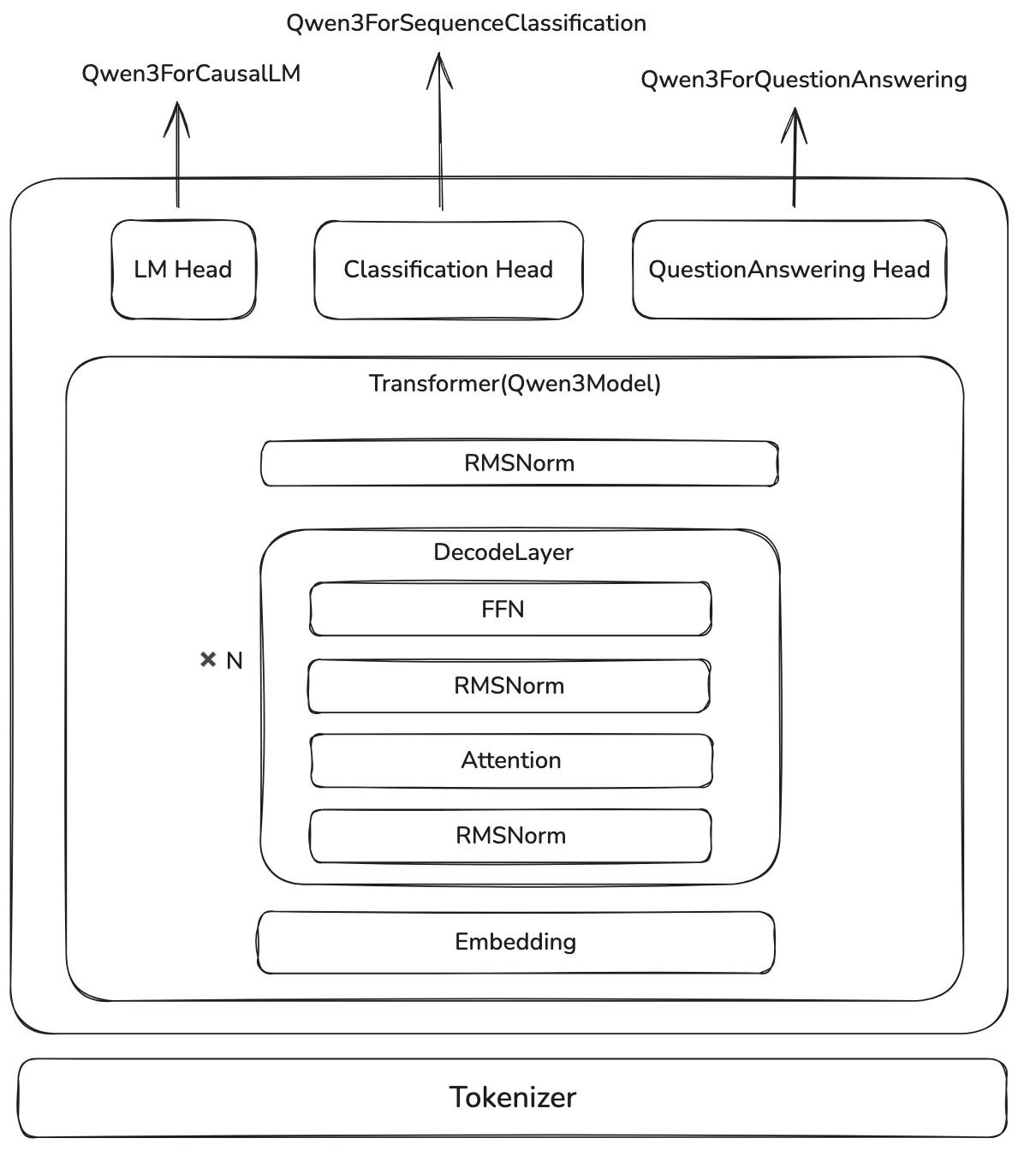
我们以 Qwen3 的模块组织为例,先区分 Transformer 主体与用于不同任务的输出头。
在 Transformer 主体之上配置不同的输出头和训练目标,可以构建面向不同任务的模型,例如:
Qwen3ForQuestionAnsweringQwen3ForCausalLMQwen3ForSequenceClassification
本文选择 Qwen3ForCausalLM 这条路线,说明隐藏状态如何转换为下一个 token 的预测。
CausalLM
编写大语言模型的第一步为定义 Qwen3ForCausalLM
class CausalLM(nn.Module):
    def __init__(self, config):
        self.model = Transformer(config)
        self.lm_head = nn.Linear(config.hidden_size, config.vocab_size, bias=False)

    def forward(self, ...):
        outputs = self.model(***)
        logits = self.lm_head(outputs)

        return logits
这里 lm_head 的作用就是构建 embedding space 到 vocabulary 的映射,即
Transformer
transformer 部分包括四个部分:
- Embedding Layer:将 token 映射到 embedding space
- layers:Transformer 的主体部分,由 个
DecodeLayer组成 - Norm:在输出之前,进行一次 Normalization
- Position Embedding:由于输入的 sequence 长度是固定的,因此我们提前计算好每一层的 position embedding
Transformer 部分的代码
class Transformer(nn.Module):
    def __init__(self, config):
        self.embedding = nn.Embedding(config.vocab_size, config.hidden_size, config.pad_token_id)
        self.layers = nn.ModuleList(
           [DecodeLayer(config, layer_idx) for layer_idx in range(config.num_hidden_layers)]
          )
        self.norm = RMSNorm(config.hidden_size, eps=config.rms_norm_eps)
        self.rotary_emb = RotaryEmbedding(config)

    def forward(self, input_ids,...):
        input_embeds = self.embedding(input_ids)

        hidden_states = input_embeds
        position_embeddings = self.rotary_emb(hidden_states, position_ids)

        for decode_layer in self.layers:
            layer_outputs = decode_layer(hidden_states, position_ids, position_embeddings)
            hidden_states = layer_outputs[0]

        hidden_states = self.norm(hidden_states)

        return logits
DecodeLayer
DecodeLayer 就是 transformer 的核心部分,里面包含四个模块:
- Pre-Normalization:一般是 RMSNorm 或者 LayerNorm
- Attention:self-attention
- Post-Normalization:与 Pre-Normalization 一致
- MLP:FFN,SwiGLU 或者 MoE
DecodeLayer 还会使用 residual connection 来防止梯度消失
DecodeLayer 部分的代码
class DecodeLayer(nn.Module):
    def __init__(self, config, layer_idx):
        self.attn = Attention(config, layer_idx)
        self.mlp = MLP(config)
        self.pre_norm = RMSNorm(config.hidden_size, eps=config.rms_norm_eps)
        self.post_norm = RMSNorm(config.hidden_size, eps=config.rms_norm_eps)

    def forward(self, hidden_states, position_ids, position_embeddings):
        residual = hidden_states
        hidden_states = self.pre_norm(hidden_states)
        hidden_states = self.attn(hidden_states, position_ids, position_embeddings)
        # residual
        hidden_states = hidden_states + residual

        residual = hidden_states
        hidden_states = self.post_norm(hidden_states)
        hidden_states = self.mlp(hidden_states)
        # residual
        hidden_states = hidden_states + residual

        return hidden_states
我们接下来按照
- Normalization
- MLP
- Attention
- Position embedding
的顺序来介绍
RMSNorm
RMSNorm 的作用和 LayerNorm 是一样的,但是实现上更简单
其中 是可学习的参数
其中 是可学习的参数
RMSNorm 代码实现
class RMSNorm(nn.Module):
    def __init__(self, d, eps):
        self.weight = nn.Parameter(torch.ones(d))
        self.eps = eps

    def forward(self, x):
        input_dtype = x.dtype
        x = x.to(torch.float32)
        variance = x.pow(2).mean(-1, keepdim=True)
        x = x * torch.rsqrt(variance + self.eps)
        return self.weight * x.to(input_dtype)
MLP
现在大语言模型的 MLP 使用的激活函数一般都是 SwiGLU, 其定义为
其中 是 sigmoid 函数
MLP 的定义为
其中 ,
一般地,由于 FFN 只有两个权重矩阵,且 , 在 SwiGLU 中,为了保证参数量一致,其隐藏层大小设置为 .
MLP 的代码如下所示
def SwiGLU(x):
    return x * torch.sigmoid(x)

class MLP(nn.Module):
    def __init__(self, d, d_ff):
        self.gate_proj = nn.Linear(d, d_ff, bias=False)
        self.up_proj = nn.Linear(d, d_ff, bias=False)
        self.down_proj = nn.Linear(d_ff, d, bias=False)

    def forward(self, x):
        return self.down_proj(SwiGLU(self.gate_proj(x)) * self.up_proj(x))
Attention
我们先不考虑 position embedding,直接看 attention,attention 定义为
其中 ,
在自回归模型里,我们还会加上 mask, 让每个 token 只能看见前面的 token 的信息
其中
self-attention 的代码如下:
def scaled_dot_product_attention(Q, K, V, mask) -> torch.Tensor:
    d_k = Q.shape[-1] # d_k
    scaled_factor = 1 / d_k**0.5

    scores = torch.einsum("... s_q d_k, ... s_k d_k -> ... s_q s_k", Q, K)
    scores *= scaled_factor

    if mask is not None:
        scores = scores.masked_fill(mask == 0, float("-inf"))

    scores = scores.softmax(dim=-1)

    return torch.einsum("... s_q s_k, ... s_k d_v -> ... s_q d_v", scores, V)
Multi-Head Attention
Multi-Head Attention 定义如下
其中 , 且每一个 Attention heads 的维度会从 .
Multi-Head Attention 的主要作用为:
- 让不同的 head 关注不同的信息
- 并行计算,提高计算效率
MHA 代码
class MultiHeadAttention(nn.Module):
    def __init__(self, d_model: int, num_heads: int) -> None:
        self.q_proj = Linear(d_model, d_model)
        self.k_proj = Linear(d_model, d_model)
        self.v_proj = Linear(d_model, d_model)
        self.output_proj = Linear(d_model, d_model,)

    def forward(self, x, position_embeddings, mask):
        Q = rearrange(self.q_proj(x), "... seq_len (num_heads head_dim) -> ... num_heads seq_len head_dim",
            num_heads=self.num_heads, head_dim=self.head_dim)
        K = rearrange( self.k_proj(x), "... seq_len (num_heads head_dim) -> ... num_heads seq_len head_dim",
            num_heads=self.num_heads, head_dim=self.head_dim)

        if mask is None:
            mask = torch.ones(Q.shape[-2], K.shape[-2])
            mask = torch.tril(mask)

        if position_embeddings is not None:
            sin, cos = position_embeddings
            Q = apply_rotary_pos_emb(Q, sin, cos)
            K = apply_rotary_pos_emb(K, sin, cos)

        V = rearrange(self.v_proj(x), "... seq_len (num_heads head_dim) -> ... num_heads seq_len head_dim",
            num_heads=self.num_heads, head_dim=self.head_dim)

        output = scaled_dot_product_attention(Q, K, V, mask=mask)
        output = rearrange(output, "... num_heads seq_len head_dim -> ... seq_len (num_heads head_dim)")
        return self.output_proj(output)
Position Encoding
Attention 对于输入的顺序是不敏感的,也就是
这里 是一个置换矩阵 (permutation matrix)
Transformer 的解决方法是在 query 和 key 上加上位置信息:
这样
就包含了位置信息
绝对位置编码
Transformer 的使用的位置编码如下所示
RoPE
旋转位置编码 RoPE 的原始论文为 RoFormer (Su et al., 2023)。
苏剑林老师提出了 Position Encoding,现在已经被广泛使用
这样 就仅包含两者的相对位置信息
RoPE 的矩阵定义如下
其中
这里
简化后得到
RoPE 代码 Naive 实现
RotaryEmbedding 代码
class RotaryEmbedding(nn.Module):
    def __init__(self, dim):
        self.inv_freq = 1.0 / (theta ** (torch.arange(0, dim, 2)[: (dim // 2)].float() / dim))

    def forward(self, x, position_ids):
        freqs = einsum(torch.arange(self.max_seq_len),
      self.inv_freq, "seq_len, d_k_half -> seq_len d_k_half")[token_positions]

        sin = torch.sin(freqs)
        cos = torch.cos(freqs)

        return sin, cos
计算部分代码
def apply_rotary_pos_emb(x: torch.Tensor, sin: torch.Tensor, cos: torch.Tensor) -> torch.Tensor:
    x_even = x[..., ::2]  # (seq_len, d_k_half)
    x_odd = x[..., 1::2]  # (seq_len, d_k_half)
    odds = cos * x_even - sin * x_odd  # (...,seq_len, d_k_half)
    evens = sin * x_even + cos * x_odd  # (...,seq_len, d_k_half)
    stacked = torch.stack((odds, evens), -2)  # (...,seq_len, 2, d_k_half)
    stacked_trans = rearrange(
        stacked, "... seq_len double d_k_half -> ... seq_len d_k_half double"
    )  # (...,seq_len, d_k_half, 2)
    out = rearrange(
        stacked_trans, "... seq_len d_k_half double -> ... seq_len (d_k_half double)"
    )  # (..., seq_len, d_k)
    return out
RoPE 标准实现
RotaryEmbedding 代码 (LLaMA)
class LlamaRotaryEmbedding(nn.Module):
    def __init__(self, config: LlamaConfig, device=None):
        inv_freq = inv_freq = 1.0 / (base ** (torch.arange(0, dim, 2, dtype=torch.int64) / dim)) # d_k_half

    def forward(self, x, position_ids):
        # (bsz, d_k_half, 1)
        inv_freq_expanded = self.inv_freq[None, :, None].expand(position_ids.shape[0], -1, 1)
        # (bsz, 1, seq_len)
        position_ids_expanded = position_ids[:, None, :]
        # (bsz, seq_len, d_k_half)
        freqs = (inv_freq_expanded @ position_ids_expanded).transpose(1, 2)
        emb = torch.cat((freqs, freqs), dim=-1) # (..., seq_len, d_k)
        cos = emb.cos() # (..., seq_len, d_k)
        sin = emb.sin() # (..., seq_len, d_k)

        return cos, sin
计算部分代码
def rotate_half(x):
    x1 = x[..., : x.shape[-1] // 2]
    x2 = x[..., x.shape[-1] // 2 :]
    return torch.cat((-x2, x1), dim=-1)


def apply_rotary_pos_emb(q, k, cos, sin, position_ids=None, unsqueeze_dim=1):
    cos = cos.unsqueeze(unsqueeze_dim)
    sin = sin.unsqueeze(unsqueeze_dim)
    q_embed = (q * cos) + (rotate_half(q) * sin)
    k_embed = (k * cos) + (rotate_half(k) * sin)
    return q_embed, k_embed
- Su, J., Lu, Y., Pan, S., Murtadha, A., Wen, B., & Liu, Y. (2023). RoFormer: Enhanced Transformer with Rotary Position Embedding. https://arxiv.org/abs/2104.09864
Transformer based models
- Encoder-decoder: text to text, T5, mT5, ByT5
- Encoder only: BERT, DistilBERT, RoBERTa
- Decoder only: GPT, LLaMA, Qwen, DeepSeek